
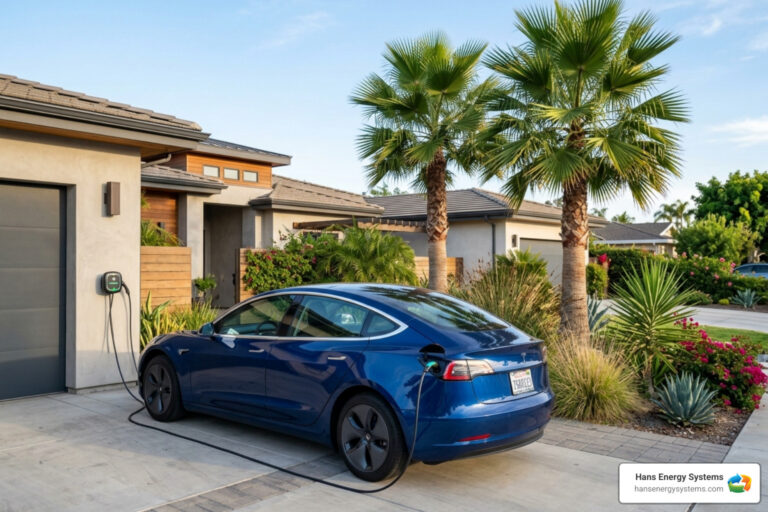
How California EV Charger Incentives and Rebates Can Save You Thousands
California EV charger incentives and rebates are some of the most generous in the country — and most homeowners don’t claim nearly as much as they could. Right now, a combination of federal tax credits, utility rebates, and income-based grants can dramatically reduce the cost of buying and installing a Level 2 home charger.
Here’s a quick look at the main programs available in 2026:
| Program | Who It’s For | Max Benefit |
|---|---|---|
| Federal 30C Tax Credit | Most homeowners | Up to $1,000 |
| PG&E Rebate Plus | Income-qualified PG&E customers | Up to $5,000 |
| SCE Charge Ready Home | SCE customers | Up to $4,200 |
| LADWP Charge Up LA! | LADWP customers | Up to $1,500 |
| Clean Cars 4 All (CC4A) | Low-income residents | Up to $13,500 total |
| SVCE GridShift Rebate | SVCE customers with smart charger | $250 |
The key insight most people miss: these programs can be stacked. A single household can combine a federal tax credit with a utility rebate and, in some cases, an income-based grant — all for the same charger installation.
The landscape has shifted significantly. The broad statewide Clean Vehicle Rebate Project (CVRP) closed in November 2023. Federal EV vehicle purchase credits expired in September 2025. But the federal charger tax credit (30C) is still active through June 30, 2026 — and utility rebate programs across California remain robust.
If you’ve been putting off installing a home charger, the window to capture the full stack of available savings is closing.

Federal Alternative Fuel Vehicle Refueling Property Credit (30C)
While many people focus on state-level perks, the foundation of your savings often starts with the federal government. The Alternative Fuel Vehicle Refueling Property Credit, commonly known as 30C, is a powerful tool for homeowners in the San Diego area and beyond. This credit allows you to claim 30% of the cost of hardware and installation, with a maximum residential cap of $1,000.
To claim this, you’ll generally use IRS Form 8911 when filing your taxes. It is important to note that this credit is currently scheduled to expire on June 30, 2026. This means the equipment must be “placed in service”—installed and ready for use—before that deadline.
Eligibility for the 30C credit is now tied to specific census tracts, primarily focusing on non-urban or low-income areas. Before you purchase your equipment, it is wise to verify if your specific ZIP code in places like Poway or Escondido qualifies under the current federal map. If you are a Tesla owner, understanding your home setup is the first step; check out our Tesla Model 3 Home Charger Guide to see what equipment fits your needs.
Major Utility California EV Charger Incentives and Rebates
In California, your utility provider is often your biggest ally in making home charging affordable. Because the state is pushing for a cleaner grid, utilities are incentivized to help you make the switch. Most programs require professional installation by a licensed electrician to qualify, ensuring the safety and reliability of the connection.
| Utility Provider | Hardware Rebate | Panel Upgrade Support | Special Requirements |
|---|---|---|---|
| PG&E | Up to $700 (Standard) | Up to $5,000 (Rebate Plus) | Must use approved equipment list |
| SCE | Up to $500 | Up to $4,200 | Charge Ready Home program rules |
| LADWP | Up to $1,000 | Included in total | $250 bonus for dedicated meter |
| SDG&E | Varies by program | Up to $4,000 (Make Ready) | Focus on TOU rate enrollment |
For those of us in San Diego and the surrounding suburbs, the application windows can be tight. Typically, you have between 60 to 180 days after purchasing your charger to submit your documentation. For a deep dive into the hardware side of things, our Tesla Wall Mount Charger Complete Guide breaks down the specs you’ll need to provide for these applications.
Maximizing Your California EV Charger Incentives and Rebates with Level 2 Hardware
Not all chargers are created equal in the eyes of rebate administrators. To ensure you don’t miss out, look for hardware that carries the ENERGY STAR certification. Many utilities now also look for “smart” capabilities, which allow the charger to communicate with the grid to balance energy loads.
With the industry shifting toward the J3400 (NACS) connector standard, many newer rebates specifically include these models. Whether you choose a Wall Mount Tesla Charger or a universal Level 2 station, making sure it is on your utility’s “Approved Product List” is the most important step before clicking “buy.”
Stacking Local California EV Charger Incentives and Rebates for Maximum Savings
The secret to paying as little as possible is “stacking.” This involves layering the federal tax credit on top of your utility rebate, and then looking for regional bonuses. For example, some regional air districts offer additional grants for residents who scrap older, high-polluting vehicles.
Funding for these programs often comes from California’s Low Carbon Fuel Standard (LCFS) credits. By installing a smart charger, you are helping the state meet its climate goals, and they are willing to pay you for it. If you really want to maximize your home’s energy independence, consider how California Solar Incentives can further offset your long-term fueling costs.
Income-Qualified Programs and Electrical Panel Upgrades
One of the biggest hurdles to EV adoption isn’t the charger itself—it’s the electrical panel. Many older homes in neighborhoods like La Jolla or Chula Vista were built with 100-amp service, which may not be enough to handle a 40-amp or 50-amp EV circuit.
Fortunately, programs like PG&E’s “Rebate Plus” and SCE’s “Charge Ready Home” offer massive incentives specifically for panel upgrades. If your household income is below 80% of the Area Median Income (AMI), or if you participate in programs like CalFresh or LIHEAP, you could receive up to $5,000 to cover the cost of a new panel and installation.
The Clean Cars 4 All (CC4A) program is another heavy hitter, offering up to $2,000 specifically for charging infrastructure on top of vehicle replacement grants. For any homeowner, a Tesla Wall Charger Installation is much more affordable when the utility picks up the tab for the underlying electrical work.
Optimizing Costs with Time-of-Use (TOU) Rates and Smart Charging
Once your charger is installed, the savings shouldn’t stop. Most California utilities offer Time-of-Use (TOU) rates that make electricity significantly cheaper during “off-peak” hours—usually overnight or during the middle of the day when solar production is at its peak.
By using a smart charger or your vehicle’s built-in app, you can schedule your charging to start at midnight when rates are lowest. Some programs, like SVCE’s GridShift or SDG&E’s managed charging options, even offer monthly bill credits just for allowing them to slightly adjust your charging time to help stabilize the grid. If you are interested in zero-cost fueling, Charging Tesla with Solar Panels is the ultimate way to stay off the grid and avoid peak pricing entirely.
Frequently Asked Questions about California EV Charging
Navigating the paperwork for california ev charger incentives and rebates can feel like a part-time job. To make it easier, we’ve compiled a list of the most common documentation you’ll need to have ready:
- A copy of your recent utility bill (to verify your Service Agreement ID).
- The final invoice from your licensed electrician.
- Photos of the installed charger and the serial number.
- Your vehicle registration (proving the EV is registered at your address).
- Proof of income (if applying for “Rebate Plus” or income-qualified tiers).
How do I check eligibility for California EV charger incentives and rebates based on my ZIP code?
The best place to start is the DriveClean.ca.gov incentive search tool. By entering your ZIP code, you can see a localized list of every city, county, and utility program currently active in your area. Since many programs are first-come, first-served, checking this early in your process is vital.
Are there rebates available for electrical panel upgrades if my home is older?
Yes! As mentioned earlier, utilities like SCE and PG&E have specific funds set aside for “Make Ready” infrastructure. This includes upgrading your panel or adding a dedicated EV meter. In some San Diego areas, these rebates can cover several thousand dollars of the electrical work, which often makes the upgrade virtually free for income-qualified residents.
Can I get a rebate for an EV charger if I live in an apartment or multifamily property?
Absolutely. While it can be more complex, many programs now offer incentives for renters and property managers. LADWP and SCE both have “Charge Ready” programs specifically designed for multifamily dwellings. If you can charge within 500 feet of your residence and have a WiFi-enabled charger, you may still qualify for smart-charging rebates.
Conclusion
Transitioning to an electric vehicle is a major milestone in home ownership, but you shouldn’t have to navigate the financial side alone. At Hans Energy Systems, we’ve spent years helping our neighbors in Poway, San Diego, Oceanside, and throughout the county make their homes more efficient and future-ready.
Whether you need a simple Level 2 outlet or a full electrical panel upgrade to support your new Tesla, our team provides the reliable, professional service you need to ensure your installation meets all rebate requirements. Don’t leave money on the table by missing out on these expiring incentives.
Schedule your professional EV charger installation today and let us help you power your journey into the renewable energy future.