
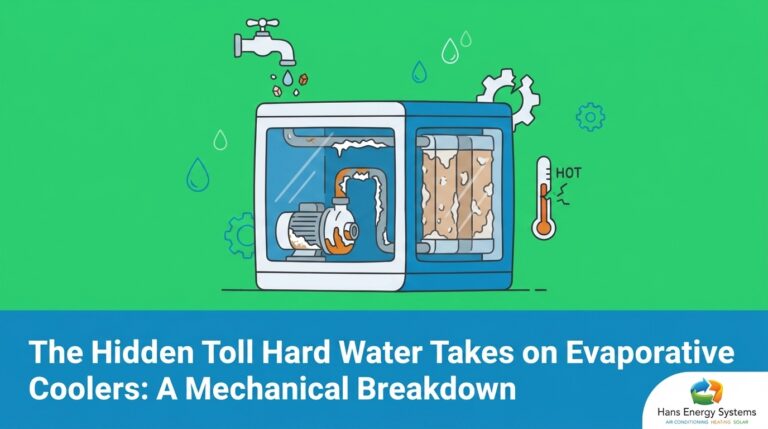
The Silent Threat to Your Evaporative Cooling System
Your system is running constantly, but the house still feels uncomfortably warm. When you rely on an evaporative cooler to beat the heat, a sudden drop in performance usually points to a specific, mechanical culprit. The hidden toll hard water takes on evaporative coolers is one of the most common—and most destructive—issues our technicians at Hans Energy Systems see homeowners face. Rather than a simple mechanical defect, we’ve found this to be a progressive problem where regional water quality quietly chokes your equipment. Recognizing the early signs of mineral scale buildup before the system completely seizes is the critical decision point that saves you from catastrophic failure during the peak July summer heat.
For proactive diagnostics and professional HVAC services, contact us for a service call to protect your equipment.
The Mechanics of Continuous Water Flow
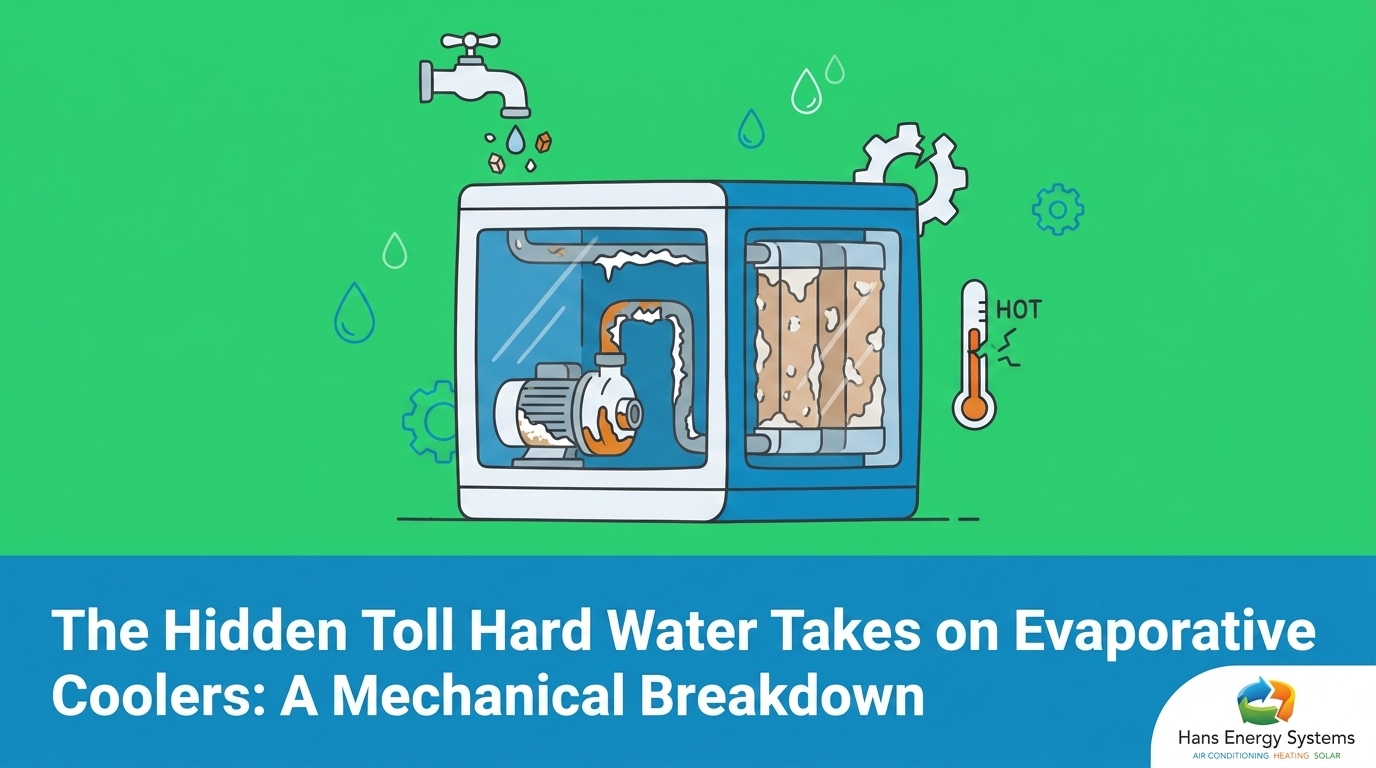
To understand why this threat is so persistent, you have to look at how evaporative coolers operate at a baseline level. Unlike traditional air conditioning systems that use closed-loop chemical refrigerants, evaporative coolers rely on a continuous, open-loop water cycle. A dedicated pump pulls water from a reservoir basin and pushes it up through a distribution network, cascading it over fibrous cooling pads. As hot outside air is pulled through these saturated pads by a powerful blower motor, the water evaporates, naturally dropping the air temperature before it enters your home.
This process is highly energy-efficient and effective in dry climates, but it introduces a massive vulnerability: water quality. Because the system requires a constant flow of fresh water to replace what evaporates, it is continuously introducing new minerals into the unit. When the water supply is heavily laden with dissolved minerals, the cooler effectively acts as a giant mineral trap. Over weeks and months, the constant cycle of saturation and evaporation leaves behind a growing layer of rock-hard scale that coats every internal component.
Proactive awareness is the only way to prevent this silent threat from destroying your system. Many homeowners assume that a drop in cooling performance simply means the system needs a new belt or a motor adjustment. In reality, the root cause is often a severe accumulation of mineral deposits that is actively strangling the airflow and forcing the mechanical parts to work twice as hard just to maintain baseline operation.
The Science of Hard Water and Evaporation Dynamics
The Hard Water Baseline
Water is classified as “hard” when it contains high concentrations of dissolved minerals, primarily calcium and magnesium. These minerals are picked up naturally as groundwater moves through rock formations before reaching the municipal supply. While hard water is generally safe for drinking and household use, it is notoriously hostile to plumbing fixtures, water heaters, and especially evaporative cooling systems. The dissolved minerals remain suspended in the liquid until a chemical or physical change forces them to precipitate out and form a solid structure known as scale.
The Evaporation Multiplier in Poway CA
The core issue lies in the physics of the evaporation process. When liquid water turns into a vapor to cool the air, only the pure H2O molecules escape into the atmosphere. Absolutely 100% of the dissolved calcium and magnesium is left behind inside the cooler. Poway CA features a hot, dry summer climate that is ideal for evaporative cooling, but in our years servicing local homes, we’ve seen how this environment also causes rapid water evaporation. This specific climate concentrates local hard water minerals at a highly accelerated rate compared to national averages.
Because the system is evaporating gallons of water every hour during the heat of the day, the mineral concentration in the remaining reservoir water skyrockets. What starts as microscopic mineral deposits quickly crystallizes into a tough, concrete-like scale that bonds tightly to metal, plastic, and fibrous surfaces.
Comparing Water Usage and Mineral Deposition
To put the scale of this problem into perspective, it helps to compare how evaporative coolers process water compared to standard household fixtures.
| Water Application | Evaporation Rate | Mineral Deposition Risk | Scale Formation Speed |
|---|---|---|---|
| Standard Faucet | Minimal (mostly flows down drain) | Low (minerals wash away) | Months to Years |
| Water Heater | None (closed heating) | Moderate (heat causes precipitation) | Years |
| Evaporative Cooler | Extreme (gallons per hour) | Severe (100% of minerals left behind) | Weeks to Months |
This rapid concentration means that an evaporative cooler operating in a hard water region is essentially functioning as a calcium manufacturing plant. Without proper bleed-off mechanisms or water treatment strategies, the mineral saturation reaches a critical mass where the scale begins to aggressively attack the mechanical integrity of the unit.
How Calcification Destroys Cooler Pads and Restricts Airflow
In our experience, the first casualty in the mineral scale cascade is always the cooling pad. In their ideal state, evaporative cooler pads are highly porous, absorbent, and designed to allow free, unrestricted airflow. Whether they are made from traditional Aspen wood fibers or modern rigid cellulose media, their effectiveness relies entirely on their ability to hold water while maintaining thousands of tiny air channels. This delicate balance is what allows the blower motor to pull massive volumes of air through the wet media without excessive resistance.
The Physical Transformation of the Media
As hard water cascades over the pads and evaporates, the leftover calcium carbonate begins to crystallize along the edges of the fibers. Initially, this might just look like a light white dusting. However, as the continuous evaporation cycle deposits more and more minerals, the calcium buildup literally fills the porous gaps. The flexible, absorbent pads undergo a physical transformation, turning stiff, brittle, and heavy.
- Loss of absorbency: Calcified fibers can no longer soak up water, causing dry spots where hot air bypasses the cooling process entirely.
- Structural blockages: The spaces between the fibers become cemented shut, creating a solid wall of calcium that blocks incoming air.
- Weight stress: Heavy, mineral-laden pads can sag or collapse out of their frames, allowing unfiltered, uncooled air to enter the home.
The Airflow Bottleneck
The direct consequence of this calcification is a severe restriction of airflow through the system. When the pads are cemented shut by mineral scale, the blower motor struggles to pull enough air into the cabinet. This airflow bottleneck immediately leads to poor cooling performance inside the house, as the volume of conditioned air drops drastically.
More importantly, this initial airflow restriction forces the rest of the system to overwork. The evaporative cooler water pumps and blower motors are engineered to operate within specific static pressure parameters. When the intake is choked by calcified pads, the blower motor has to spin against a vacuum, drawing higher electrical current and generating excess heat. This sets the stage for the next phase of mechanical failure.
The Chain Reaction: Pump Strain and Seized Motors
Stage 1: The Sludgy Water Pump
The mechanical escalation begins in the water reservoir. As the water continuously evaporates and leaves minerals behind, the remaining water in the basin turns into a heavy, mineral-rich sludge. The evaporative cooler water pump is responsible for lifting this water up to the distribution tubes, but it is not designed to handle high-viscosity, calcified sludge. Scale quickly builds up on the pump’s internal impeller, throwing it off balance and reducing its ability to circulate water effectively. The pump motor begins to run hotter as it fights against the friction of the mineral deposits, eventually leading to premature pump failure.
Stage 2: The Overheating Blower Motor
While the pump is struggling, the blower motor is facing its own crisis. As established, the restricted airflow from the calcified pads forces the blower to work against extreme negative pressure. This electrical strain significantly increases the operating temperature of the motor windings. Our team at Hans Energy Systems frequently handles peak-summer service calls regarding seized motors, and in almost every case, the pattern we see traces back to a neglected, calcified system that forced the motor to run far beyond its thermal limits.
Stage 3: Catastrophic Failure
The final failure stage occurs when the overworked, overheated motor seizes completely. The internal bearings, stripped of lubrication by the extreme heat, lock up. The motor windings short out, and the system dies entirely. Once a motor reaches this point, it cannot be repaired; it must be replaced.
One local homeowner experienced this exact mechanical dead-end with an old, severely degraded rooftop HVAC unit that had suffered extensive wear and neglected maintenance. Because the existing system was beyond saving and the motor had catastrophically failed, our technicians replaced it entirely with a highly efficient Daikin mini-split system featuring two indoor units. This provided a clean installation and a reliable escape from the cycle of constant mechanical breakdowns, highlighting the severe consequences of letting equipment degrade past the point of no return.

Early Diagnostic Signs of Mineral Buildup
Catching mineral scale before it destroys your pump or blower motor is the key to extending the lifespan of your cooling equipment. Because the damage happens progressively, there is a clear window of opportunity to intervene. By learning how to spot the early diagnostic signs of mineral buildup, homeowners can take action before the peak July summer heat turns a minor maintenance issue into a major breakdown.
- Listen for Auditory Cues: Your system should operate with a smooth, consistent hum. If you begin to hear unusual grinding, squealing, or straining noises coming from the unit, it is a strong indicator of mechanical distress. A grinding noise usually means the water pump impeller is fighting against calcium deposits, while a high-pitched squeal often points to a blower motor whose bearings are overheating due to airflow restriction.
- Check for Visual Indicators: You do not need to take the entire unit apart to spot scale. Look closely at the exterior louvers and the edges of the cooling pads. A thick, white, chalky residue is the most obvious sign of severe hard water precipitation. If you touch the pads and they feel stiff, crusty, or brittle rather than fibrous and slightly pliable, they are heavily calcified and need attention.
- Monitor for Performance Drops: An evaporative cooler working efficiently should provide a steady stream of noticeably cooler air. If the system is suddenly blowing warm air, or if the airflow feels significantly weaker than usual coming out of your vents, the pads are likely choked with scale. The system is running, but the thermodynamic process has been halted by the mineral barrier.
- Understand the System Contrast: It is important to note that evaporative coolers require a different diagnostic approach than traditional air conditioners. While regular AC upkeep focuses heavily on refrigerant levels and closed-loop coils, evaporative coolers are uniquely vulnerable to local water quality. If you live in an area with hard water, scale inspection must be your primary diagnostic focus.
Why Professional Intervention is Critical for Scaled Systems
When an evaporative cooler reaches the point of heavy calcification, standard DIY cleaning solutions are no longer sufficient. We often meet homeowners who have attempted to scrape the scale off or pour store-bought descalers into the reservoir, but our diagnostics prove these superficial fixes do not address the mechanical strain that has already compromised the internal components. Once the evaporative cooler water pumps and blower motors are heavily scaled or overheating, professional intervention is the only safe and effective path forward.
The Risks of Operating Strained Equipment
Continuing to operate a system with a strained blower motor is highly risky. The electrical strain of pulling air through blocked pads causes the motor to draw excessive amperage. This not only spikes your energy consumption but also degrades the internal wiring insulation. Eventually, this leads to a complete electrical short or a seized motor, leaving you without cooling entirely. Tinkering with high-voltage electrical components or attempting to force a seized motor to turn is incredibly dangerous and requires a licensed professional.
What a Professional Diagnostic Entails
A professional HVAC technician approaches a scaled system with precise diagnostic tools to assess the true extent of the damage. They will use a multimeter to check the motor’s amp draw against its factory rating, determining exactly how much strain the airflow restriction is causing. They will verify the pump voltage to ensure it is receiving clean power and hasn’t suffered internal shorting from sludge buildup. Technicians also measure the static pressure and airflow metrics to confirm whether a simple pad replacement will solve the issue, or if the motor has already been permanently compromised.
When dealing with advanced mechanical strain, having the work done properly is paramount. One homeowner recently reached out for HVAC work with a strict focus on quality after a system malfunction. Our technician ensured the customer felt comfortable with the diagnostic process, performed solid, clean work, and left the homeowner feeling that the complex repair was handled the right way, demonstrating genuine care for their equipment. This level of thorough, proactive water management and mechanical testing is what separates a temporary patch from a long-term cooling solution.
Frequently Asked Questions
Can you use hard water in a swamp cooler?
Yes, you can use hard water in a swamp cooler, but it requires diligent management and frequent maintenance. The evaporation process leaves 100% of the dissolved minerals behind, which rapidly forms scale on the internal components. To prevent catastrophic damage, systems running on hard water need regular pad replacements, frequent reservoir flushing, and the installation of a proper bleed-off valve to manage mineral concentration.
How does hard water affect swamp cooler pads?
Hard water turns soft, absorbent swamp cooler pads into stiff, brittle blocks of calcium carbonate. As the water evaporates, the minerals crystallize inside the porous fibers, cementing the air channels shut. This physical transformation destroys the pad’s ability to hold water and severely restricts the airflow needed to cool your home.
Why is my evaporative cooler pump making noise?
A noisy evaporative cooler pump usually indicates that mineral scale has accumulated on the internal impeller or that the pump is struggling to process heavy, mineral-rich sludge from the reservoir. Grinding or humming sounds mean the motor is fighting against physical resistance. If left unaddressed, this friction will cause the pump to overheat and fail completely.
What causes an evaporative cooler motor to seize?
An evaporative cooler motor typically seizes due to extreme overheating caused by restricted airflow. When mineral scale chokes the cooling pads, the blower motor has to work against a heavy vacuum, which drastically increases its operating temperature. This excess heat eventually burns away the bearing lubrication and melts the internal wiring insulation, causing the motor to lock up entirely.
How often should you change swamp cooler pads with hard water?
In regions with exceptionally hard water, you may need to change your swamp cooler pads at least twice a cooling season, or even monthly during peak usage. The exact frequency depends on your local water hardness and how many hours a day the system runs. If the pads feel stiff to the touch or if you notice a drop in airflow, it is time to replace them regardless of the calendar.
Are there specific maintenance routines for coolers in hard water areas?
Yes, coolers in hard water areas require a proactive water management strategy to survive. This includes installing a continuous bleed-off system to drain concentrated mineral water, physically cleaning the reservoir basin to remove sludge, and treating the water with scale inhibitors. Additionally, having a professional check the motor amp draw and pump voltage annually ensures that hidden scale isn’t causing dangerous electrical strain.
The Hidden Toll Hard Water Takes on Evaporative Coolers: Final Thoughts
The hidden toll hard water takes on evaporative coolers is a progressive mechanical threat, but it is entirely manageable when you know what to look for. By recognizing the early signs of calcification on your pads and pumps, you can avoid the severe electrical strain that leads to seized motors. For a clear, mechanical diagnostic and proactive water management strategies, contact our team to ensure your system survives the summer heat efficiently.