
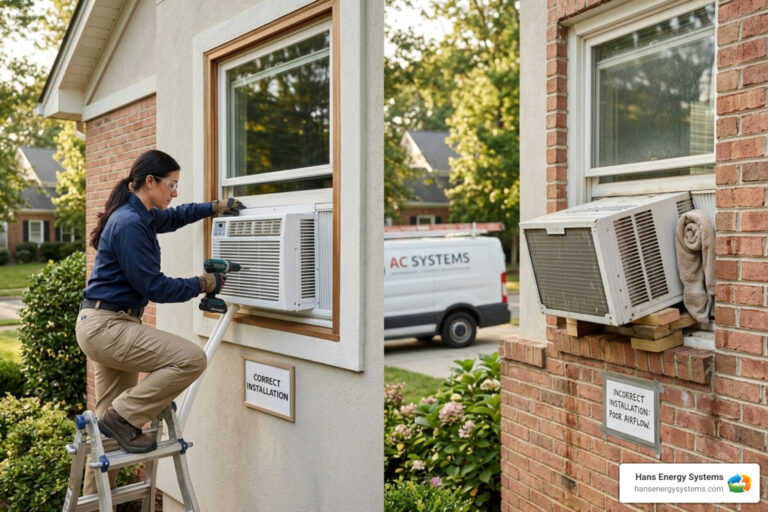
Why How Proper Installation Affects Cooling Performance Is the Most Important Thing to Get Right
How proper installation affects cooling performance is simple: a poorly installed AC can waste up to 30% more energy, fail to control humidity, and break down years before it should — even if the unit itself is brand new.
Here is a quick breakdown of the biggest ways installation quality shapes your cooling results:
| Installation Factor | Impact of Getting It Wrong |
|---|---|
| Incorrect system sizing | Up to 30% more energy use; poor humidity control |
| Refrigerant charge errors | 16%+ higher energy use; early compressor failure |
| Leaky ductwork | ~8% more energy wasted per 10% of duct leakage |
| Poor outdoor unit placement | 15-20% higher electricity consumption |
| Low indoor airflow | Uneven temperatures; mechanical strain |
Research backs this up clearly. A field study of over 4,000 AC units found that 72% had improper refrigerant charge and 44% had improper airflow. A separate study of newly installed systems found that only 18% had the correct refrigerant amount. These are not rare edge cases — they are the norm when installation quality is not prioritized.
For San Diego homeowners, the stakes are real. During summer heat waves, an improperly installed system does not just run up your utility bill. It struggles to keep up, leaves rooms feeling clammy, and puts constant stress on expensive components like the compressor.
The good news is that every one of these problems is preventable. The sections below walk through exactly how each piece of the installation process — from sizing to ductwork to refrigerant charging — directly determines whether your AC system delivers the comfort and efficiency it was designed for.

The Science of Sizing: Why Manual J Beats Square Footage
When we talk about Ac Installation/, the first and most critical step happens before a single tool is lifted. It’s the calculation of your home’s “cooling load.” For decades, many contractors used a “rule of thumb” based solely on square footage. They might say, “Your home is 2,000 square feet, so you need a 4-ton unit.”
In May 2026, we know that this approach is dangerously outdated. Professional installers use the Manual J calculation, which is the national ANSI-recognized standard for residential load calculations. Unlike square footage, Manual J looks at the “whole house” as a living organism. It accounts for:
- The orientation of your home (which rooms get the brutal afternoon sun).
- The type and amount of insulation in your attic and walls.
- The number and efficiency of your windows.
- Local climate data for San Diego and Poway.
- Even the number of people living in the home and the heat generated by appliances.
If you skip this step, you aren’t just guessing on size; you’re gambling with your comfort.
Avoiding the Clammy House Syndrome
The most common mistake in sizing is “oversizing.” Homeowners often think bigger is better—that a larger unit will cool the house faster. However, an oversized AC unit leads to short cycling, where the system turns on, blasts cold air for a few minutes, reaches the thermostat setting, and shuts off.
Why is this bad? Because your air conditioner has two jobs: lowering the temperature and removing humidity. Moisture removal happens as air passes over the cold evaporator coils. If the system only runs for five minutes, the coils don’t stay cold long enough to condense water out of the air. The result is a “clammy” house—the air is cold, but it feels sticky and humid. Proper sizing ensures the unit runs long enough cycles to pull that moisture out, leaving you crisp and comfortable.
How Proper Installation Affects Cooling Performance and Energy Use
We cannot stress this enough: how proper installation affects cooling performance is directly tied to your monthly overhead. According to industry research, improper installation can increase household energy use for space cooling by approximately 30% over what it should be.
Even if you buy a system with a high SEER2 (Seasonal Energy Efficiency Ratio) rating, those efficiency promises “go for naught” if the equipment isn’t set up correctly. For example, if your system is oversized by 100%, you can expect a relative increase in energy use of about 30% due to cycling losses and increased fan power.
| System State | Energy Impact | Comfort Level |
|---|---|---|
| Oversized | 30% Increase | Cold but humid; “Short cycles” |
| Undersized | Runs 24/7 | Never reaches set temperature on hot days |
| Properly Sized | Peak Efficiency | Steady temperature and low humidity |
By investing in Professional Ac Installation For Your Home/, you ensure that the SEER2 rating on the yellow sticker is actually the efficiency you experience in your living room.
The Financial Impact of Installation Errors
The costs of a “cheap” installation show up in two places: your utility bill and your repair history. Short cycling doesn’t just waste electricity; it puts massive mechanical strain on the compressor and fan motor. These components are designed to run for steady periods, not to stop and start 20 times an hour.
Over time, this leads to premature component failure. A system that should have lasted 15 years in a place like Rancho Bernardo might give out in 7 or 8. When you factor in the extra 30% in energy costs over those years, the “savings” from a budget installer disappear very quickly.
Ductwork Integrity: Eliminating the “Dominant Fault”
If the AC unit is the heart of your cooling system, the ductwork is the circulatory system. Research from the National Institute of Standards and Technology (NIST) identifies leaky air ducts as the “dominant fault” in HVAC efficiency.
Energy use increases by approximately 8% for every 10% increment in duct leakage. In a typical home with 30% duct leakage (which is surprisingly common), the energy use is predicted to be 42% higher if the homeowner lowers the thermostat just to compensate for the lost cooling and high humidity.
When we perform an installation, we don’t just “hook up the box.” We evaluate the static pressure—the resistance to airflow within the system. If ducts are too small, pinched, or leaking into the attic, the blower motor has to work twice as hard to push air through. This is why Ductless Mini Split Installation Guide 2025/ has become so popular for homes with problematic ductwork; it removes the “dominant fault” entirely.
Preventing Hot and Cold Spots in Poway Homes
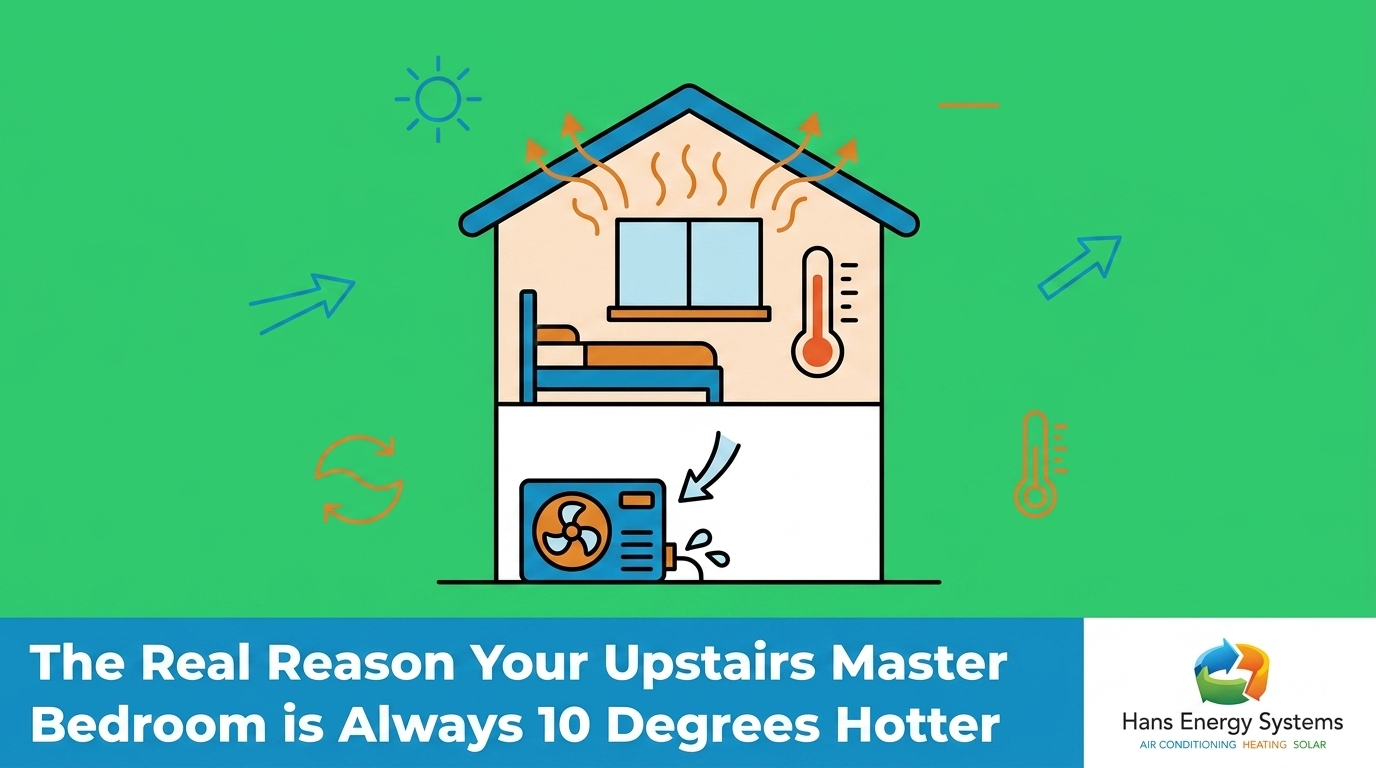
Have you ever noticed one bedroom that stays sweltering while the kitchen is freezing? That is often a sign of poor airflow balancing. During a professional installation, we perform pressure checks and ensure that the return air vents are correctly positioned and sized.
Proper airflow distribution ensures that every room reaches the target temperature at the same time. Without this balance, your thermostat (usually located in a hallway) might think the house is cool, while your upstairs bedrooms are still baking in the San Diego sun.
Precision Charging and Placement for Long-Term Reliability
The physical placement of your outdoor unit matters more than you might think. A unit “choking for air” in a tight corner or buried under a low deck will have a much higher “head pressure.” This forces the compressor to work harder to expel heat, driving up power consumption by 15-20%.
Ideally, the outdoor unit should be placed in a shaded area, such as a North or East-facing wall, to avoid the direct, intense heat of the afternoon sun. It also needs at least 18-24 inches of clear space around it and 5 feet of vertical clearance to “breathe” properly.
How proper installation affects cooling performance through refrigerant precision
Refrigerant is the lifeblood of your AC. It doesn’t just “get used up”—it’s a closed loop that must be charged to exact manufacturer specifications. Unfortunately, field studies show that only about 18% of new systems have the correct amount.
- Undercharging: A 30% refrigerant undercharge can increase seasonal energy use by 16% and significantly degrade the system’s ability to remove moisture.
- Overcharging: This can lead to liquid refrigerant entering the compressor, causing permanent mechanical damage.
During Ac Installation Poway Ca/, we use precision tools to measure “subcooling” and “superheat.” This ensures the charge is perfect, protecting your compressor and maximizing the heat-exchange capacity of the evaporator coil.
Frequently Asked Questions about How Proper Installation Affects Cooling Performance
How proper installation affects cooling performance in humid climates?
Even in the relatively dry climate of San Diego County, humidity control is vital for comfort. How proper installation affects cooling performance here is mostly about runtime cycles. If an installer puts in a unit that is too large, it won’t run long enough to act as a dehumidifier. This leads to poor indoor air quality and potential mold issues. By matching the system size and airflow precisely to your home’s needs, we ensure the system runs long enough to keep your air crisp and dry. You can learn more about this in our guide on Maximizing Energy Savings With Ductless Ac/.
Can poor installation void my manufacturer warranty?
Yes, absolutely. Most major manufacturers require that the system be installed by a licensed, authorized technician to keep the warranty valid. If a “budget” installer makes a mistake—like failing to evacuate the lines with a vacuum pump, which allows moisture to create acid inside the system—the manufacturer will likely deny your claim for a replacement compressor. Always ensure you receive an installation certificate and that your installer follows all local codes in cities like Oceanside or Chula Vista.
Why is professional airflow balancing necessary?
Airflow is the “hidden boss” of HVAC. If the airflow is too low, your coils can freeze. If it’s too high, the air doesn’t spend enough time on the cooling coils to lose its heat and moisture. Professional balancing reduces mechanical strain, lowers operational noise, and—most importantly—ensures that you don’t have to play “thermostat wars” to get your bedroom to a comfortable temperature.
Conclusion
At Hans Energy Systems, we believe that a cooling system is only as good as the hands that install it. From the initial Manual J calculation in Poway to the final static pressure testing in La Jolla, every step we take is designed to maximize your comfort and minimize your utility bills.
As we move through 2026, the technology inside these units is more advanced than ever, but the physics of airflow remains the same. Don’t let a “dominant fault” like leaky ducts or incorrect sizing rob you of the performance you paid for. Whether you are in Carlsbad, El Cajon, or Downtown San Diego, our team is dedicated to providing the reliable, engineered installation your home deserves.
Schedule your professional AC installation today to ensure peak performance and efficiency!