
The Hidden Cost of Coastal Assumptions in Inland Climates
A 15 to 20-degree temperature difference separates the coast from the inland valleys on a typical Southern California summer afternoon. If you want to keep your indoor air cool when those temperatures spike, understanding why Inland Valley homes need different tonnage than coastal properties is the very first step. Many homeowners make a critical mistake when upgrading their cooling systems: they rely on generic, nationwide rules of thumb that ignore our drastic local microclimates. A standard 2,000-square-foot home sizing contrast perfectly illustrates this problem. A house right on the coast and an identical house further inland have entirely different cooling requirements, even if their floor plans match exactly.
The concrete problem starts when a homeowner in an inland valley uses standard coastal HVAC sizing rules. You might plug your square footage into an online calculator and purchase a unit based on those basic numbers. The result is almost always an undersized air conditioner that runs nonstop, struggles to remove humidity, and fails to actually cool the house down. You face a major decision point before spending money on a new system: will you rely on generic square-footage calculators, or will you insist on a microclimate-specific load calculation? Getting the right capacity requires professional San Diego HVAC services from a team that knows the terrain. At Hans Energy Systems, we see this exact scenario play out every August. By insisting on a proper AC installation tailored to your specific neighborhood, you protect your home from the hidden costs of coastal assumptions.
The Myth of the ‘Standard’ 2000-Square-Foot Home
The HVAC industry has long battled the misconception that square footage is the only variable that matters when sizing an air conditioner. National rules of thumb suggest that you need about one ton of cooling capacity for every 400 to 500 square feet of living space. In Southern California, our team knows these generic rules fail drastically. Our region features intense, varied microclimates that change significantly depending on your exact zip code and elevation.
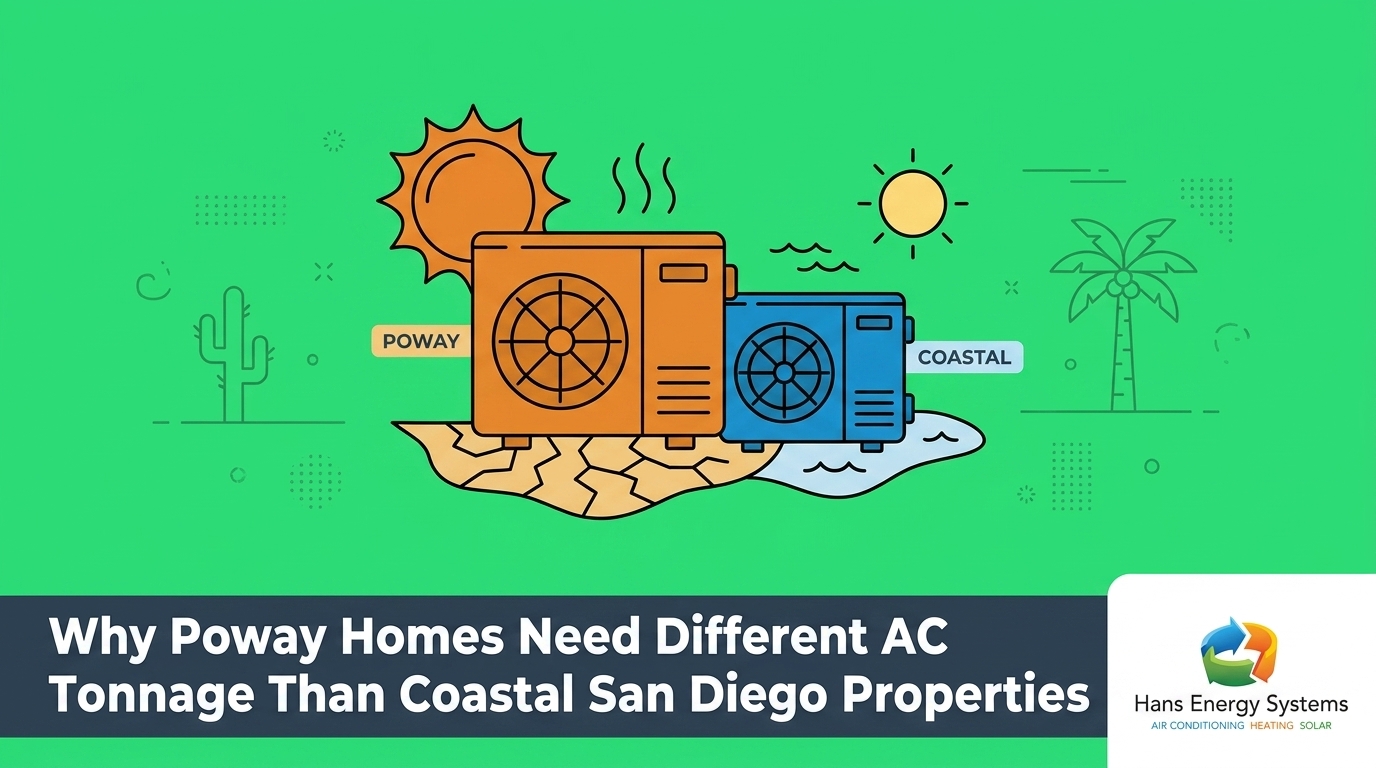
To understand why this matters, our technicians often compare two identical 2,000-square-foot homes. One sits near the beach in coastal San Diego, and the other is located in our primary service area of Poway and surrounding Inland Valley neighborhoods. The coastal home benefits heavily from the marine layer. This natural buffer of low-altitude clouds and cool ocean air acts as a massive thermal shield. It blocks direct solar radiation during the morning hours and keeps ambient temperatures moderate throughout the afternoon. Because of this passive cooling benefit, the coastal home requires significantly less mechanical cooling power to stay comfortable.
The inland home completely lacks this natural marine layer buffer. Without that protective cloud cover, the roof and walls absorb direct, intense sunlight from sunrise to sunset. The thermal load on the building materials is exponentially higher. Even though both homes have the exact same interior volume, we consistently find that the inland home demands a much larger air conditioner to remove the massive amount of heat transferring through the attic and walls.
Why Generic Calculators Fail
Online sizing calculators are built on national averages. They assume a blended average for heat exposure, humidity, and wind patterns across the entire country. Here is exactly why our installation crews find these generic tools lead you astray:
- They ignore local elevation: Higher elevations inland often experience different wind patterns and faster temperature swings than sea-level coastal plains.
- They miss humidity drops: Inland valleys often experience very dry heat during late summer, which changes how the system needs to manage sensible versus latent heat.
- They overlook localized solar gain: A generic calculator does not know that the marine layer burns off hours earlier—or never arrives at all—in your specific neighborhood.
| Cooling Factor | Coastal San Diego Home | Poway / Inland Valley Home |
|---|---|---|
| Marine Layer Protection | Heavy morning coverage, natural cooling | Rare or absent, full sun exposure |
| Peak Summer Temperatures | Moderate (70s to low 80s) | Intense (90s to 100s+) |
| Solar Heat Gain | Low to moderate | Extremely high |
| Generic Calculator Accuracy | Somewhat close to accurate | Drastically undersizes the required unit |
Decoding the 15-Degree Delta: Coastal Breezes vs. Inland Valleys
To properly size an air conditioner, HVAC professionals use a specific metric called the “outdoor design temperature.” This is not the hottest temperature ever recorded in a city. Instead, it is the temperature that a specific location stays at or below for 99% of the cooling season. The outdoor design temperature serves as the absolute foundation of any accurate AC sizing calculation, as it dictates the maximum heat load the system will realistically need to overcome.
The design temperatures in coastal San Diego are highly moderate, often hovering in the upper 70s or low 80s. When you move just a few miles east, the reality changes completely. Inland properties frequently face a 90°F+ ambient temperature during the peak cooling season. This 15 to 20-degree delta directly impacts how hard an air conditioner has to work.
Air conditioning is not about pumping cold air into a room; it is about extracting heat energy out of the indoor air and dumping it outside. When the outdoor temperature is 75°F, it is relatively easy for the system to release that captured heat. When the outdoor temperature is 95°F, the system has to work significantly harder against the ambient heat to complete the thermal transfer. This higher temperature delta directly increases the required cooling capacity, measured in tonnage, needed to successfully remove heat from an inland home.
The specific impacts of this temperature delta include:
- Increased compressor workload: The system must run at higher pressures to reject heat into 95-degree air compared to 75-degree air.
- Faster heat infiltration: A hotter exterior means heat transfers through your walls and windows at a much faster rate, requiring the AC to cycle more frequently.
- Higher continuous BTU demand: To maintain a 72-degree indoor temperature against a 95-degree outdoor temperature requires far more British Thermal Units (BTUs) of cooling power than fighting an 80-degree outdoor temperature.

How Outdoor Design Temperature Dictates Manual J Load Calculations
Because of these drastic regional differences, guessing your tonnage based on floor space is a recipe for disaster. The only accurate way to determine the correct size for an inland property is through an industry-standard ACCA Manual J load calculation. Our team considers this deeply technical evaluation to be non-negotiable for homes facing extreme summer heat.
A proper Manual J load calculation measures far more than just the length and width of your rooms. It takes the exact outdoor design temperature for your specific zip code and combines it with a detailed thermal map of your house. The calculation measures the R-value of your attic insulation, the U-factor of your specific windows, the height of your ceilings, and the compass orientation of your property. A home with massive, single-pane windows facing west will require significantly more tonnage than a heavily shaded home facing north, even if they sit on the same street.
Relying on this mathematical calculation prevents the costly mistake of installing a coastal-spec unit in an inland valley. If your current system constantly breaks down or fails to keep up on hot afternoons, it is likely the wrong size for your microclimate. Instead of paying for another temporary patch fix, consult a professional HVAC replacement guide and schedule a proper evaluation with our experts. Upgrading to the correct tonnage solves the root cause of the comfort issue rather than just treating the symptoms.
The Role of Solar Heat Gain
Solar heat gain is one of the heaviest factors in a Manual J calculation for inland properties. Inland homes experience more direct, unfiltered sunlight hours than their coastal counterparts. Without coastal cloud cover to diffuse the radiation, roof heat absorption is significantly higher. This radiant heat bakes the attic space, pushing thermal energy down through the ceiling and into your living areas. A precise load calculation accounts for this intense solar gain and adjusts the required cooling tonnage accordingly.
The Danger of Undersized Units During Late-Summer Heatwaves
Using a coastal-sized air conditioner in an inland valley might seem fine during a mild spring afternoon, but the real-world consequences become painfully obvious when the weather shifts. The mechanical strain on an undersized unit trying to reach the thermostat setpoint during August late-summer heatwaves is immense. When the ambient temperature climbs toward triple digits, a system lacking the proper tonnage simply cannot remove heat fast enough to keep up with the infiltration.
Our technicians at Hans Energy Systems saw this firsthand when a local Poway homeowner reached out to us during a recent late-summer heatwave when temperatures hovered in the high 90s to 100 degrees. Their AC compressor suffered a complete failure due to a refrigerant leak and melted wire connections, leaving them with no power to the unit. The underlying cause was a system pushed far beyond its design limits. After our team diagnosed the issue and explained the poor condition of their old furnace and ductwork, a full system replacement was necessary. We installed a new, high-efficiency HVAC system, furnace, and proper ductwork over several days, finally providing the home with reliable cooling that matched the local climate demands.
When an undersized system is pushed beyond its design capacity, you will notice a specific set of cascading symptoms. The most obvious sign is a system that runs constantly without ever actually cooling the house to your desired temperature. This continuous operation leads to premature compressor wear, as the most expensive component in your system is forced to run without its necessary rest cycles. Over time, this constant strain causes overheating, short circuits, and eventually, total mechanical failure. If you want to understand more about the long-term damage this causes, learning why an undersized AC will leave you steaming can help you spot the warning signs before a breakdown occurs.
Why Local Expertise Matters for Your Load Calculation
When it is time to replace your air conditioner, the company you choose to perform the load calculation matters just as much as the equipment itself. National chains or out-of-town contractors often use regional averages that blend coastal and inland data into one generic profile. They might look at a map of Southern California and assume a moderate climate, completely missing the severe temperature spikes that hit the valleys.
Precision in load calculations ensures inland homes are fitted with the exact tonnage needed for peak efficiency and comfort. As a deeply rooted local business, our team at Hans Energy Systems understands San Diego’s unique microclimates and performs precise load calculations to ensure inland homes aren’t incorrectly fitted with coastal-sized AC units. A contractor who actually works in your specific neighborhood knows that the afternoon sun hits differently east of the I-15 corridor.
A deeply rooted local team protects homeowners from the long-term costs of improper sizing. By factoring in the true outdoor design temperature and the lack of a marine layer, our local experts ensure your new system has the muscle to handle late-summer heatwaves without short-cycling during milder weather.
Frequently Asked Questions About Regional AC Sizing
Why does climate affect AC tonnage?
Climate dictates the maximum amount of heat energy your air conditioner must remove from your home. Hotter ambient temperatures and higher solar radiation mean heat transfers into your living space much faster. An AC unit must have a higher tonnage capacity to extract that rapid influx of heat and maintain a comfortable indoor temperature.
How is AC size calculated for hot climates?
Professionals use an ACCA Manual J load calculation to determine the exact size needed. This calculation factors in your local outdoor design temperature, roof material, attic insulation, window types, and compass orientation. It replaces generic square-footage guessing with precise thermal mathematics tailored to intense heat.
Why is my AC running constantly during a heatwave?
If your system never turns off during a heatwave, it is likely undersized for your local microclimate. The unit simply lacks the BTU capacity to remove heat as fast as the sun pushes it into your home. This constant running strains the compressor, drives up energy bills, and eventually leads to mechanical failure.
Can I use the same size AC as my neighbor on the coast?
No, using a coastal sizing reference for an inland home is a major mistake. Coastal homes benefit from a natural marine layer that blocks solar heat and keeps ambient temperatures moderate. An inland home lacks this protection and requires a significantly larger system to handle the unshielded heat load.
What happens if my AC is undersized for my local microclimate?
An undersized unit will fail to reach your thermostat setpoint on hot days, leaving your home warm and humid. The constant mechanical strain leads to melted wires, blown capacitors, and premature compressor death. Ultimately, you will pay higher utility bills for a system that cannot keep you comfortable.
Secure the Right AC Tonnage for Your Inland Home
Understanding the unique demands of inland microclimates is the absolute key to proper heat load management. Generic calculators and coastal assumptions will leave you sweating when the August temperatures peak. Proper tonnage sizing is critical to surviving late-summer heat without overworking your system and facing a sudden breakdown.
Do not leave your indoor comfort to chance or national averages. Schedule a professional evaluation with our team and insist on a comprehensive Manual J load calculation tailored specifically to your neighborhood. By securing the exact tonnage your property requires, you ensure reliable, efficient cooling that lasts through the toughest heatwaves of the year. Plus, as you transition into the back-to-school season, keep in mind that upgrading to a qualifying high-efficiency system may make you eligible for federal tax credits or local utility rebates—we always recommend checking current programs with your utility provider or tax professional to maximize your investment.