
The Myth of the ‘Thickest Filter’ During Fire Season
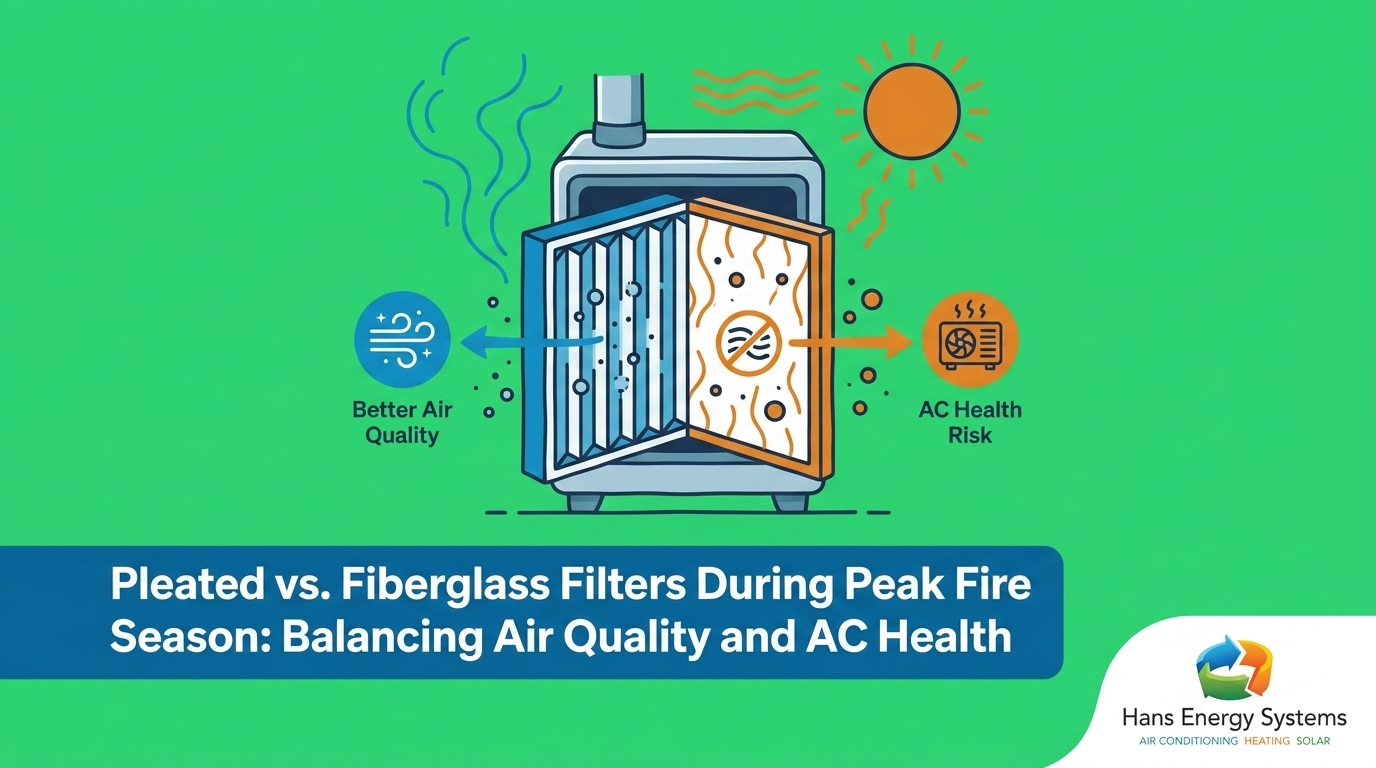
When you are comparing pleated vs. fiberglass filters during peak fire season, buying the thickest, highest-rated option at the hardware store does not automatically protect your home from smoke—in fact, it might just break your air conditioner. It is a common homeowner instinct: you step outside in late summer, smell the heavy ash in the air, and immediately head to the store to buy the most restrictive filter available. At Hans Energy Systems, our team fields countless calls every August from homeowners desperately trying to protect their family’s lungs from the harsh outdoor conditions. However, this well-intentioned decision often creates a severe, hidden dilemma inside your home.
You are suddenly forced to balance protecting your indoor air quality against accidentally suffocating your HVAC system. During the August peak fire season, your cooling system is already working overtime to combat extreme heat. When you introduce a highly restrictive barrier into the return vent, you create a perfect storm of heavy AC usage and restricted airflow. The system struggles to breathe right when you need it most.
If you want to keep your family breathing easy without sacrificing your cooling equipment, you need a balanced approach to indoor air quality and dedicated air purification systems.
Understanding PM2.5: What Wildfire Smoke Actually Is
To understand why certain filters fail and others succeed, you have to look at the microscopic structure of the threat itself. Wildfire smoke is not just a bad smell; it is a complex mixture of gases and fine particles produced when wood and other organic materials burn. The primary health threat during fire season is particulate matter 2.5, commonly known as PM2.5. These particles are 2.5 microns in diameter or smaller.
To put that into perspective, a single strand of human hair is about 70 microns across. PM2.5 is roughly 30 times smaller than the width of a hair. Because these microscopic particles are so tiny, they easily bypass standard residential defenses, slipping through tiny gaps in window seals, doors, and standard ventilation systems.
In Poway CA, hot, dry late-summer August heatwaves perfectly overlap with peak severe wildfire risks. This means your AC is under maximum thermal stress right when heavy ash arrives. The continuous runtime increases the total volume of air—and consequently, the total volume of smoke—passing through your system.
The Anatomy of Wildfire Ash and Smoke
- Microscopic infiltration: Smoke particles are significantly smaller than typical household dust, pollen, or pet dander. They remain suspended in the air for much longer periods.
- The smell test: If you can smell smoke inside your home, PM2.5 has already bypassed your building envelope. The odor is carried by these microscopic particles and the volatile organic compounds (VOCs) attached to them.
- Health implications: Unlike larger dust particles that get trapped in your nose and throat, PM2.5 is small enough to travel deep into the respiratory tract, making effective filtration absolutely necessary.
The Late-Summer Double Threat
- Extreme high temperatures: Late summer brings intense heatwaves that force your air conditioner to run continuously just to maintain a basic level of comfort.
- Poor outdoor air quality: As the heat rises, wildfires generate vast plumes of smoke that settle over the region, creating a dense blanket of poor air.
- Compounded system runtime: Because the AC runs non-stop to fight the heat, it constantly pulls indoor air through the return vents. If the air is full of smoke, the filter catches the brunt of this continuous, heavy load, filling up much faster than it would during a mild spring week.
Fiberglass Filters: Why They Fall Short Against Smoke
If you pull your current filter out of the ceiling or wall grille and can easily see light shining through the loosely woven blue or green fibers, you are looking at a fiberglass filter. These filters were originally designed with a very simple, singular purpose: to protect the internal machinery of your HVAC system from large, damaging debris. They were never designed to protect human lungs or improve indoor air quality.
Fiberglass filters typically carry a MERV rating of 1 to 4. The Minimum Efficiency Reporting Value (MERV) scale measures how effectively a filter traps particles. At the lowest end of this scale, fiberglass filters provide excellent, unrestricted airflow. They allow your blower motor to push and pull air with almost zero resistance, which keeps the equipment running smoothly and efficiently under normal conditions.
However, when it comes to late-summer smoke, they offer zero protection. They capture virtually no PM2.5 smoke particles. Relying on a fiberglass filter during a heavy fire event means you are simply recirculating microscopic ash throughout your living spaces.
The MERV 1-4 Limitation
- The chain-link fence analogy: Using a fiberglass filter to catch wildfire smoke is exactly like using a chain-link fence to stop blowing sand. The holes are simply too large to capture the tiny particles passing through.
- Large debris only: These filters successfully trap large pet hair, carpet fibers, and heavy dust bunnies. They stop the debris that could physically coat and damage the blower wheel or evaporator coil.
- False sense of security: Because the filter might look slightly discolored after a month, homeowners assume it is cleaning the air. In reality, the dangerous, invisible smoke particles are passing right through the fiberglass mesh and into your bedrooms.
Pleated Filters: Superior Smoke Capture With a Hidden Catch
The Problem: When heavy smoke blankets the neighborhood, homeowners need a way to physically trap microscopic PM2.5 particles before they circulate through the ductwork. Fiberglass cannot handle the job.
The Cause: Capturing micro-particles requires a much denser filter media. The fibers must be woven tightly together to create a microscopic maze that traps ash and smoke. However, if you make a flat filter too dense, air cannot pass through it at all.
The Solution: Manufacturers solve this by folding synthetic filter media into pleats. Pleated filters increase the total surface area of the filter without increasing the size of the cardboard frame. This accordion-like design allows the filter to trap significantly smaller particles, including PM2.5, while still allowing air to flow through the expanded surface area. The American Society of Heating, Refrigerating and Air-Conditioning Engineers (ASHRAE) generally recommends a MERV 13 rating for effective smoke capture, which is exclusively found in dense pleated filters.
However, there is a hidden catch. The denser the pleated filter, the higher the static pressure drop across the return grille. Static pressure is the resistance your system must overcome to move air. If you blindly install an ultra-high MERV 13 or MERV 14 filter into an older or incompatible residential system, you risk choking the equipment.
How Pleated Media Traps Micro-Particles
- Synthetic materials: Unlike loose fiberglass, pleated filters use tightly woven synthetic cotton or polyester blends designed to snag microscopic ash.
- Electrostatic charge: Many high-quality pleated filters are electrostatically charged during manufacturing. This allows them to act like a magnet, actively attracting and holding onto fine smoke particles rather than just relying on physical interception.
- Increased surface area: The folds in the material mean a standard 20×20 filter might actually contain several square feet of filtering material, maximizing the capture rate for harmful pollutants.
The Blower Motor Dilemma: When Restrictive Filters Damage Your AC
Understanding MERV rating airflow restrictions is critical before you upgrade your filtration. The blower motor inside your air handler is designed to move a specific volume of air, measured in cubic feet per minute (CFM). When you block the intake with an ultra-dense, highly restrictive pleated filter, you create a vacuum effect. The motor has to work significantly harder to pull the same amount of air through that dense barrier.
This physical strain translates directly into electrical strain. A suffocated blower motor draws higher amperage to overcome the resistance. Drawing higher amperage generates excess heat within the motor itself. Over time, especially during continuous late-summer cooling demands, this excess heat degrades the internal wiring and bearings, risking premature and expensive motor burnout.
A restricted system often presents clear symptoms before a total breakdown. In our years of servicing Poway homes, our technicians typically see a pattern where a homeowner upgrades to a maximum-MERV filter in late August, only to suddenly experience weak airflow to their bedrooms and inconsistent cooling. In one local condo, this severe airflow restriction required our professionals to recalibrate the blower speed settings and rework the ducting to finally restore proper circulation. Slapping an ultra-restrictive filter onto an uncalibrated system causes the exact same type of airflow chokehold.
At Hans Energy Systems, a core focus is energy efficiency. Forcing a blower motor to draw more amperage against a restrictive filter destroys the system’s energy efficiency and spikes your monthly utility costs. Before making a drastic change to your filtration, we highly recommend you schedule preventative AC maintenance to have a professional evaluate your ductwork and blower speeds.
Static Pressure and Airflow Resistance
- The breathing analogy: Think of static pressure like trying to breathe. A fiberglass filter is like breathing through a thin paper mask. A MERV 13 pleated filter is like trying to run a marathon while breathing through a thick wool blanket.
- Evaporator coil risks: When airflow slows down too much, there is not enough warm indoor air passing over the cold evaporator coil. This can cause the coil to literally freeze over into a block of ice, shutting down your cooling entirely.
- System lifespan: Operating under high static pressure forces every component to work outside of its designed parameters, significantly reducing the overall lifespan of the HVAC system.
Signs Your AC is Struggling to Breathe
- Hot spots in the house: If certain rooms suddenly feel warmer than others after changing a filter, the system is failing to push enough air to the furthest branches of the ductwork.
- Unusual noises: A whistling sound at the return grille often indicates that the blower is pulling a heavy vacuum against a restrictive filter.
- Weak vent airflow: Place your hand over a supply register. If the air barely trickles out, your filter is likely too dense or completely clogged with ash.
Pleated vs. Fiberglass: A Side-by-Side Performance Comparison
To make the best decision for your home during fire season, you have to weigh the exact performance metrics of both options. The table below breaks down how standard fiberglass compares to both standard and high-efficiency pleated filters when faced with heavy late-summer smoke.
| Filter Type | Typical MERV Rating | PM2.5 (Smoke) Capture | Blower Motor Strain Risk | Replacement Frequency (Fire Season) |
|---|---|---|---|---|
| Standard Fiberglass | MERV 1 – 4 | Virtually Zero | Very Low | Every 30 Days |
| Standard Pleated | MERV 8 – 11 | Moderate to Good | Moderate | Every 2 – 3 Weeks |
| High-Efficiency Pleated | MERV 13+ | Excellent | High (if uncalibrated) | Weekly or Bi-Weekly |

Finding the MERV ‘Sweet Spot’ for Maximum Efficiency
You do not have to choose between breathing clean air and protecting your expensive cooling equipment. For most homes, the solution lies in finding the MERV “sweet spot.” This is the exact rating that provides substantial protection against outdoor pollutants without crossing the threshold into dangerous static pressure levels.
Based on our team’s extensive experience measuring static pressure in Poway homes, we recommend a sweet spot between MERV 8 and MERV 11 for the vast majority of standard residential systems. A high-quality MERV 11 pleated filter captures a significant percentage of fine particulates and smoke without suffocating a properly maintained blower motor. It offers a massive upgrade over fiberglass, keeping your indoor air visibly and noticeably cleaner.
However, during active fire events, the rules of maintenance change. You cannot leave a MERV 11 filter in place for three months when the sky is orange. The heavy ash load will quickly clog the synthetic media, turning a safe filter into a restrictive wall. You must increase your replacement frequency, sometimes checking and swapping the filter weekly during severe smoke drift, to maintain safe airflow.
When to Consider Dedicated Air Purifiers
- The limits of HVAC filtration: Remember that your AC filter is primarily designed to protect the equipment. If a family member has severe asthma or respiratory issues, a MERV 11 filter might not provide enough medical-grade protection during a fire.
- Bypassing the blower restriction: If your home requires MERV 13 or HEPA-level filtration for severe smoke, you likely need a dedicated whole-home air purification system. These systems often use their own fans or bypass ducting to clean the air without forcing your primary AC blower motor to do all the heavy lifting.
- Comprehensive strategy: Relying on a combination of a safe MERV 11 filter in the return grille and a dedicated purifier in the ductwork gives you the absolute best AC filters for San Diego homes setup, balancing mechanical safety with pristine air quality.
Frequently Asked Questions About HVAC Filters and Smoke
What MERV rating is best for wildfire smoke?
ASHRAE typically recommends a MERV 13 filter for capturing fine wildfire smoke particles (PM2.5). However, this high rating is often too restrictive for standard residential HVAC systems. For most homes without specialized equipment, a MERV 11 filter is the safest “sweet spot” that balances good smoke capture with necessary airflow.
Can a high MERV filter damage my AC blower motor?
Yes, a high MERV filter can severely damage an uncalibrated AC blower motor. Dense filters create high static pressure, forcing the motor to draw more electrical amperage to pull air through the restricted material. Over time, this excess heat and strain can lead to premature motor burnout and spiked utility bills.
Why do fiberglass filters not stop smoke?
Fiberglass filters are constructed with a loose weave designed only to catch large debris like hair, carpet fibers, and heavy dust. The microscopic PM2.5 particles found in wildfire smoke are simply too small; they pass right through the large gaps in the fiberglass mesh and continue circulating throughout your home.
How often should I change my AC filter during fire season?
During an active fire season with heavy smoke, you should check your pleated filter every single week. Because pleated filters are highly effective at trapping ash, they clog much faster than normal. Depending on the severity of the smoke, you may need to replace the filter every two to three weeks to prevent airflow restriction.
Does my HVAC system need modifications to use a pleated filter?
Most modern HVAC systems can handle standard pleated filters (MERV 8 to 11) without modification, provided the ductwork is properly sized. However, if you want to upgrade to a MERV 13 or higher for maximum smoke protection, a professional should assess your static pressure and potentially adjust your blower speed to accommodate the denser media.
Secure Your Home’s Air Quality Before the Next Heatwave
Finding the exact right filter is the only way to protect both your family’s respiratory health and the lifespan of your expensive cooling unit. Relying on cheap fiberglass leaves your lungs vulnerable, while blindly installing the densest pleated filter can suffocate your blower motor during the hottest days of the year. A balanced approach ensures you stay comfortable, efficient, and safe.
Do not wait until the smell of ash is already inside your living room. We encourage you to get a professional assessment of your system’s static pressure and filtration limits today. If you need ultimate protection against late-summer smoke, explore dedicated air purification systems to keep your indoor air pristine without compromising your air conditioner.