
How Long Do Modern High-Efficiency Air Conditioners Really Last?
The average lifespan of modern high efficiency air conditioners is typically 15 to 20 years with proper maintenance and professional installation. Here is a quick breakdown by system type:
| System Type | Typical Lifespan |
|---|---|
| Central Split-System AC | 15-20 years |
| Ductless Mini-Split | 20+ years |
| Heat Pump | 10-16 years |
| Window Unit | 8-12 years |
That said, real-world lifespan varies. Factors like installation quality, local climate, and how well you maintain the system can push a unit past the 20-year mark — or cut it short well before 15.
For San Diego homeowners, this matters a lot. The region’s coastal salt air, inland heat waves, and year-round mild temperatures all affect how hard your system works and how long it lasts. A unit in El Cajon running through triple-digit summer heat faces very different wear than one in Encinitas with ocean breezes.
Modern SEER2-rated systems are built to higher efficiency and durability standards than older units. But even the best equipment will underperform if it is improperly sized, poorly installed, or left without routine service.

Factors Influencing the Average Lifespan of Modern High Efficiency Air Conditioners
When we talk about the average lifespan of modern high efficiency air conditioners, we aren’t just looking at a number on a manufacturer’s warranty card. Think of your AC unit like a high-performance vehicle. If you buy a luxury car but never change the oil, drive it through salt water, and redline the engine every day, it won’t see its tenth birthday.
In our experience serving neighbors from Oceanside to Chula Vista, we see several critical factors that determine if a unit will be a “marathon runner” or a “sprinter.”
System Sizing and Installation Quality
One of the most common reasons a system fails prematurely has nothing to do with the brand and everything to do with the day it was installed. If a unit is “oversized” for your home, it will suffer from “short-cycling.” This means it turns on, cools the house too quickly, and shuts off before it can properly dehumidify the air. This constant starting and stopping puts immense thermal stress on the compressor—the “heart” of your system.
Conversely, an undersized unit will run constantly, struggling to reach the temperature set on your thermostat. This leads to mechanical exhaustion. This is why we always perform a professional AC System Check and a detailed load calculation before any installation. We look at your home’s square footage, insulation levels, and even the direction your windows face in places like Escondido or San Marcos to ensure a perfect fit.
The San Diego Climate Factor: Salt Air vs. Inland Heat
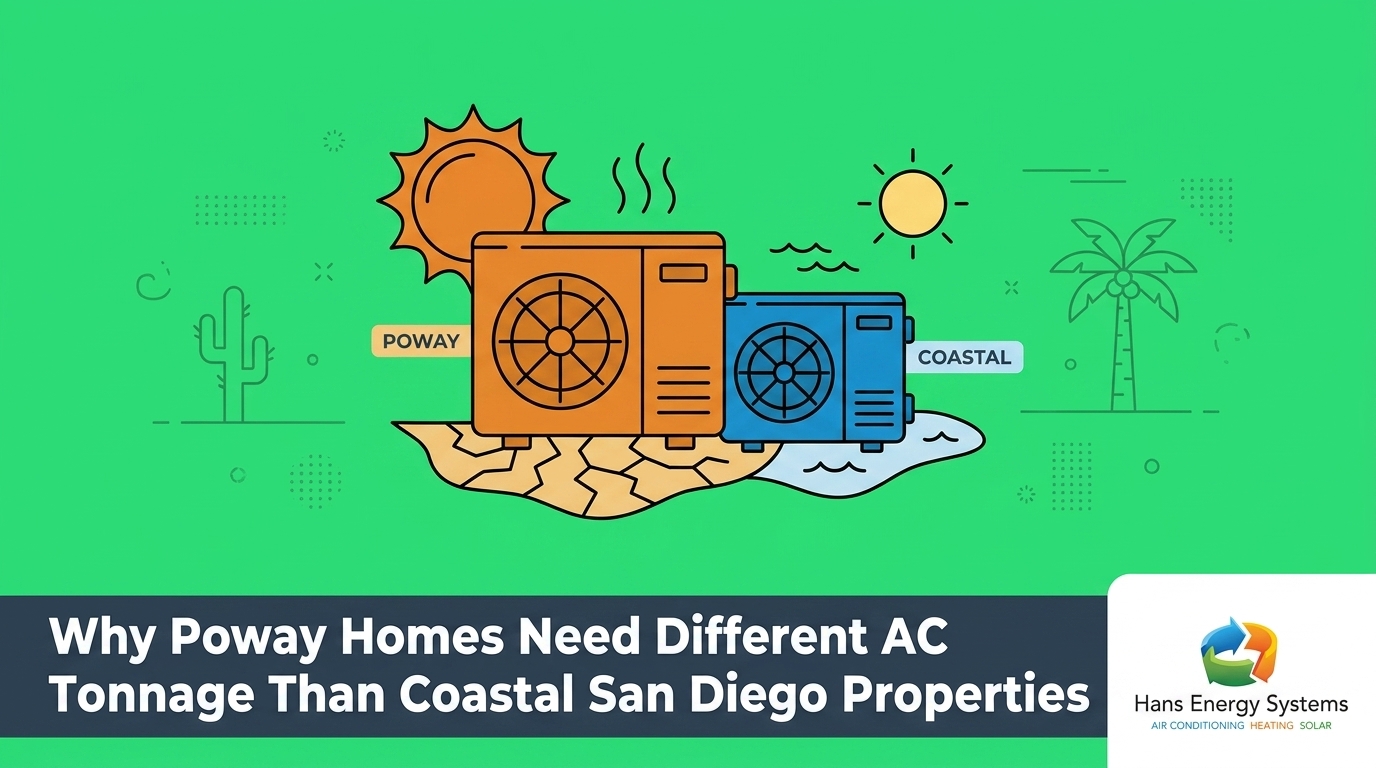
Geography plays a starring role in AC longevity. If you live in Carlsbad, Del Mar, or La Jolla, your unit is constantly exposed to salt-laden marine air. This salt is highly corrosive to the aluminum fins and copper tubing in your outdoor condenser. Without specialized coatings or frequent cleaning, coastal units might only last 10 to 14 years.
Inland areas like Poway, Lakeside, and El Cajon face a different enemy: extreme heat. During those brutal summer weeks, your AC might run for 12 to 18 hours a day. This high “rate of use” naturally accelerates mechanical wear compared to a unit in a milder climate.
How Maintenance Impacts the Average Lifespan of Modern High Efficiency Air Conditioners
If there is one “magic pill” for extending the life of your HVAC system, it is routine maintenance. Industry data shows that annual professional service can extend the viable service life of a unit by 3 to 5 years.
Filter Discipline
We cannot stress this enough: Dirty Air Filters Can Harm AC Efficiency. When a filter is clogged with San Diego dust and pet dander, your blower motor has to work twice as hard to pull air through. It’s like trying to breathe through a plastic bag. We recommend checking your filters every month and replacing them at least every 90 days.
Coil Cleaning and Airflow Optimization
Over time, the outdoor condenser coils get coated in dirt, leaves, and “marine layer” grime. This prevents the system from releasing heat effectively. A professional AC Tune-Up Poway involves cleaning these coils and checking refrigerant levels. If a system is even slightly low on refrigerant, the compressor has to work harder and run longer, which is a recipe for an early breakdown.
Impact of System Type on Longevity
Not all cooling technologies age at the same rate. The mechanical design of your system dictates its “retirement age.”
- Central Split-Systems: These are the workhorses of the American home. With a median service life of 15 years (and a potential for 20), they are reliable but rely heavily on the health of your ductwork.
- Ductless Mini-Splits: These systems often boast the longest lifespans, frequently exceeding 20 years. Because they use inverter-driven compressors that ramp up and down slowly rather than slamming on and off, they experience much less mechanical “shock.”
- Heat Pumps: While modern heat pumps are incredibly efficient, they typically have a shorter lifespan of 10 to 16 years. Why? Because they work year-round! While a standard AC gets a “vacation” during the San Diego winter, a heat pump is busy keeping you warm. This double-duty usage leads to faster wear.
To keep any of these systems running at peak performance, we often recommend a dedicated HVAC Maintenance Plan Poway CA to catch small issues before they become “system killers.”
When to Repair vs. Replace Your Aging System
As we move through May 2026, many homeowners are facing a dilemma: do I keep patching up my old unit, or is it time to let go? Making the right call can save you thousands in the long run.
The $5,000 Rule and the 50% Rule
We use two simple mathematical frameworks to help our customers decide:
- The $5,000 Rule: Multiply the age of your unit by the cost of the repair. If the result is more than $5,000, replacement is the smarter financial move. For example, if a 12-year-old unit needs a $600 repair (12 x 600 = 7,200), it’s time to go shopping.
- The 50% Rule: If a single repair cost exceeds 50% of the value of a new system, don’t throw “good money after bad.”
The Refrigerant Reality: R-22 and R-410A
If your system was installed before 2010, it likely uses R-22 (Freon), which is now completely phased out. Repairing these units is astronomically expensive because the refrigerant must be reclaimed from old systems.
Even R-410A, the “standard” for the last 15 years, saw its production and import prohibited starting January 1, 2025. While we can still service these units, the cost of R-410A is climbing as supplies dwindle. Modern systems now use eco-friendly refrigerants like R-454B or R-32, which are better for the planet and cheaper to maintain in the long term. If you are struggling with a leak in an older system, check out our guide on When to Replace Your AC System in Poway.
Efficiency Decline and Regulatory Changes
HVAC equipment degrades predictably. Without maintenance, a system can lose 5% to 10% of its efficiency every year. A unit that started as a 14 SEER might be performing like an 8 SEER after a decade of neglect.
As of May 2026, the industry has fully embraced SEER2 standards. These are more rigorous testing protocols that ensure your unit performs efficiently in real-world conditions, not just a lab. Upgrading from an old 10 SEER unit to a modern 16 or 18 SEER2 model can slash your cooling bills by 35% to 40%.
Furthermore, the Inflation Reduction Act (IRA) continues to offer significant tax credits for high-efficiency upgrades. Homeowners can often claim up to $2,000 for heat pump installations or $600 for high-efficiency central AC units. When you factor in these incentives and the monthly energy savings, an AC Replacement often pays for itself much faster than you’d think.
Warning Signs Your Unit is Nearing End-of-Life
Your air conditioner usually doesn’t just “die” one afternoon without warning. It sends out “S.O.S.” signals first. Learning to read these can prevent an emergency breakdown during a July heatwave in Santee or El Cajon.
Recognizing Performance Decline
If you’ve lived in your home for a few years, you know how your AC should feel. When that changes, pay attention.
- Frequent Cycling: If the unit turns on and off every 10 minutes, the compressor is struggling. This “short-cycling” is a major red flag.
- Strange Mechanical Noises: Squealing, grinding, or banging sounds are never “normal.” They usually indicate a failing motor bearing or a compressor on its last legs.
- Rising Utility Bills: If your SDG&E bill is creeping up but your usage hasn’t changed, your system is losing its “muscle” and working longer to achieve the same result.
- Poor Humidity Control: Modern ACs are designed to pull moisture from the air. If your home feels “sticky” or humid despite the air being cool, the system is failing.
You can find a deeper dive into these symptoms in our article on Warning Signs AC Needs Replacement in Poway.
Mechanical “Hard-Stops”
There are some issues that simply aren’t worth fixing. A “grounded” compressor or a severely leaking evaporator coil in a unit over 12 years old is usually the end of the line. At that point, the system has reached the end of the average lifespan of modern high efficiency air conditioners. If you’re noticing these Signs Home is Ready for New AC Installation, it’s better to plan the replacement on your own terms rather than during an emergency.
Frequently Asked Questions about AC Longevity
How long does a high-efficiency AC last in San Diego?
In the San Diego area, you can generally expect 15 to 18 years. Coastal residents in places like Oceanside or Solana Beach may see closer to 12-14 years due to salt corrosion, while inland residents in Scripps Ranch or Poway might reach 20 years with diligent maintenance.
Is it worth repairing a 12-year-old air conditioner?
It depends on the repair. A simple capacitor or fan motor? Yes. A compressor or a major refrigerant leak? Probably not. At 12 years, you are entering the “replacement window,” and the money spent on a major repair would be better used as a down payment on a new, warranted SEER2 system.
Does a heat pump last as long as a central AC?
Generally, no. Because heat pumps provide both heating and cooling, they run significantly more hours per year than a straight AC unit. You can expect about 10 to 15 years from a heat pump, whereas a central AC might hit 15 to 20. However, the energy savings from a heat pump often outweigh the slightly shorter lifespan.
Conclusion: Investing in Long-Term Comfort
At Hans Energy Systems, we believe that understanding the average lifespan of modern high efficiency air conditioners helps you take control of your home’s comfort and your financial future. Whether you are in Rancho Bernardo, Carlsbad, or Downtown San Diego, your HVAC system is one of the most significant investments in your home.
We pride ourselves on providing competitive pricing, quick installs, and the kind of reliability our neighbors in Poway have come to trust. We don’t just want to sell you a unit; we want to ensure you have a system that is perfectly sized, expertly installed, and maintained to last for two decades.
If your current system is making strange noises, sending your energy bills into the stratosphere, or simply can’t keep up with the San Diego sun, we’re here to help. From a simple tune-up to a full AC Replacement, our team is dedicated to keeping your home cool and your mind at ease. Reach out to us today to schedule a check-up and ensure your system is ready for the years ahead!