
What Causes Ice to Form on Your AC Unit — and What to Do About It
Ice forming on your ac unit causes and what to do is something every San Diego homeowner should understand before the summer cooling season hits. Here is a quick breakdown:
Common causes of ice on your AC unit:
- Dirty or clogged air filter — restricts airflow over the evaporator coil
- Low refrigerant levels — causes pressure to drop and coil temperatures to fall below freezing
- Dirty evaporator coils — act as insulation, blocking heat exchange
- Blocked or closed vents — starves the system of warm air
- Faulty blower motor — stops warm air from circulating across the coil
- Running AC in outdoor temps below 60°F — disrupts system pressure and causes freezing
- Thermostat or wiring malfunction — keeps the system running when it should cycle off
What to do immediately:
- Turn the thermostat from COOL to OFF
- Set the fan to ON (not Auto) to circulate warm air and speed up thawing
- Replace your air filter if it looks grey or clogged
- Wait 3 to 4 hours for the ice to fully melt
- Call a certified HVAC technician if the unit refreezes after thawing
Ice on your AC is not a sign the system is working extra hard. It is a warning sign. When the evaporator coil drops below 32°F — whether from poor airflow or low refrigerant — the moisture in the air freezes right onto the coil. Once that happens, the ice acts as an insulator, making the problem worse in a feedback loop that can ultimately destroy your compressor.
One homeowner described waking up to an 87-degree house after falling asleep at 76°F — their AC had silently frozen overnight and shut down. It is a surprisingly common scenario, especially during the warm months in the San Diego suburbs when systems run hard and filter maintenance falls behind.

Ice forming on your ac unit causes and what to do
When we see ice in May 2026, we usually expect it to be in a glass of iced tea, not on our HVAC equipment. However, airflow restriction is the leading catalyst for a frozen system. Your air conditioner works by moving warm indoor air over a very cold evaporator coil. The refrigerant inside that coil absorbs the heat, effectively “removing” the warmth from your home.
If that airflow is choked off, there isn’t enough heat for the refrigerant to absorb. As a result, the coil temperature continues to drop until it hits the freezing point. This is why dirty air filters can harm AC efficiency and eventually lead to a total system freeze-up. When the air filter is caked in dust, pet hair, and San Diego pollen, the blower motor can’t pull enough “warm” air through to keep the coils above 32°F.
Identifying the main ice forming on your ac unit causes and what to do next
Aside from airflow, the most common culprit is low refrigerant. Some homeowners mistakenly believe that refrigerant is like gasoline in a car—that it eventually “runs out.” In reality, your AC is a closed-loop system. If you are low on Freon, you have a leak.
When the refrigerant level drops, the pressure inside the evaporator coil also drops. According to the Joule-Thomson effect—a principle of thermodynamics—this drop in pressure leads to a significant drop in temperature. Paradoxically, having less cooling fluid makes the coil colder than it should be, causing moisture in the air to flash-freeze upon contact.
If you suspect a leak, listen closely. You might hear hissing or bubbling noises coming from the indoor unit or the copper lines outside. If you notice these signs, you likely need an AC Freon recharge, but only after a professional has located and sealed the leak.
A homeowner’s guide to ice forming on your ac unit causes and what to do
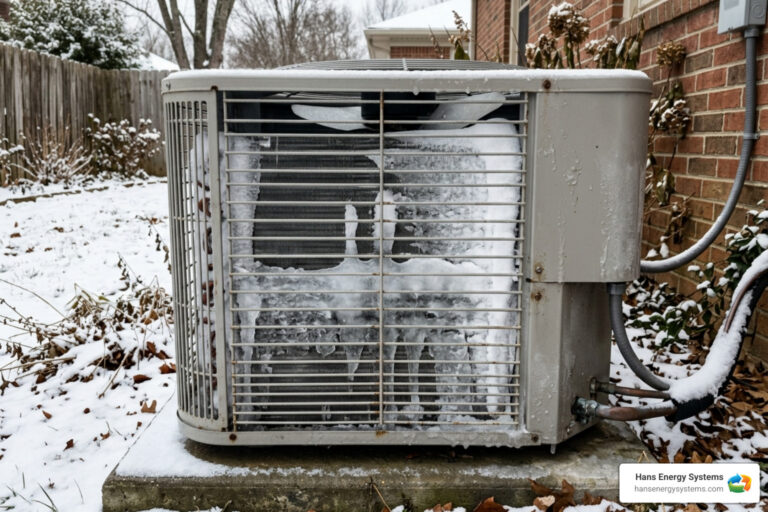
If you walk outside and see your unit looking like an Arctic sculpture, the first thing you must do is stop the cooling cycle. Switch your thermostat from “Cool” to “Off.” Next, change the fan setting from “Auto” to “On.” This forces the blower motor to run continuously, pushing unconditioned (warm) indoor air over the ice to help it melt.
We often get calls for AC repair Poway CA where the homeowner tried to keep the AC running while it was frozen. This is a recipe for disaster. Thawing usually takes between 3 to 4 hours, though in severe cases where the ice is several inches thick, it may need to sit overnight.
Why is my AC unit leaking water in Poway?
It’s a common sight in the San Diego area: a homeowner notices a puddle forming around their indoor furnace or air handler and asks, “Why is my AC unit leaking water in Poway?“
The answer is often linked to the thawing process. When a massive block of ice on your evaporator coil begins to melt, it produces a significant amount of water. If your condensate drain line is clogged with algae or debris, or if the sheer volume of melting ice overwhelms the drain pan, that water has nowhere to go but onto your floor or through your ceiling.
Signs your AC is currently frozen or has recently thawed:
- Weak Airflow: You feel very little air coming out of the registers.
- Warm Air: The air coming out isn’t cold, even though the compressor is running.
- Visible Frost: You see white frost on the copper refrigerant lines (the “suction line”).
- Hissing Noises: The sound of refrigerant escaping a leak.
- Puddles: Water pooling around the base of the indoor unit.
- High Utility Bills: The system runs constantly but never reaches the set temperature.
Ignoring these signs can lead to structural property damage, including mold growth in drywall and warped flooring. If you see water where it shouldn’t be, it’s time for an AC system check to ensure your drainage and cooling components are functioning correctly.
How to safely thaw a frozen air conditioner
Thawing your unit requires patience. While it’s tempting to grab a screwdriver and start chipping away at the ice, never do this. The evaporator coil fins are made of delicate aluminum, and the refrigerant lines are made of copper. One wrong slip and you’ve punctured a line, turning a simple repair into a much more expensive replacement.
| Step | DIY Action | Professional Role |
|---|---|---|
| 1. Shutdown | Turn thermostat to OFF. | Verify electrical safety and wiring. |
| 2. Airflow | Set fan to ON. | Test blower motor for proper RPM. |
| 3. Filter | Replace dirty air filter. | Inspect ductwork for internal collapses. |
| 4. Inspection | Check vents for obstructions. | Clean the evaporator coil with specialized chemicals. |
| 5. Leak Test | Look for oily residue on lines. | Perform nitrogen pressure test to find leaks. |
We sometimes see advice online suggesting the use of a hair dryer to speed things up. While a hair dryer on a low, cool setting held at least six inches away can help, we generally advise against it. The uneven heat can cause the metal to expand too quickly, and the risk of getting water into the hair dryer’s electrical components is high. Natural airflow from your system’s fan is the safest way to go.
Can I run my AC if the coils are frozen?
The short answer is a resounding no. Operating an air conditioner with frozen coils is one of the fastest ways to kill your compressor—the “heart” of your system.
Air conditioners are designed to compress gas, not liquid. When the coils are encased in ice, the refrigerant doesn’t absorb enough heat to turn back into a vapor. This can lead to “liquid slugging,” where liquid refrigerant travels back to the compressor. Since liquid cannot be compressed, it can cause the internal components of the compressor to shatter.
Beyond the risk of AC repair or total failure, running a frozen unit is incredibly inefficient. The ice acts as a thermal barrier, meaning your system will run 24/7 without actually lowering the temperature in your home. This leads to massive energy waste and unnecessary mechanical strain on every component, from the fan motor to the capacitors.
How to prevent frozen AC coils this summer
Prevention is always better (and cheaper) than a mid-summer breakdown. In May 2026, as we prepare for the peak heat in places like Escondido and El Cajon, a little AC maintenance goes a long way.
Your May 2026 Maintenance Checklist:
- Monthly Filter Checks: In the dusty San Diego climate, check your filters every 30 days. If you have pets, you may need to change them more frequently.
- Clear the Vents: Ensure that at least 80% of your home’s supply vents are open. Closing too many vents to “save energy” actually increases pressure and causes the coils to freeze.
- Outdoor Clearance: Keep at least two feet of clearance around your outdoor condenser unit. Remove weeds, leaves, and “San Diego snow” (dandelion fluff) that can block airflow.
- Annual Tune-ups: Have a professional clean your evaporator coils. Even a thin layer of dust can act as an insulator, triggering the freezing process.
- Check the Drain: Ensure your condensate line is clear. A backup can trigger a safety switch that shuts your system down, but it can also contribute to humidity issues that make freezing more likely.
Frequently Asked Questions about Frozen AC Units
How long does it take for an AC unit to thaw?
Typically, it takes 3 to 4 hours if you turn the system off and run the fan. However, if the unit is a solid block of ice, it could take up to 24 hours to melt completely. Do not attempt to restart the cooling cycle until the ice is 100% gone.
Is it safe to use a hairdryer to melt the ice?
It is generally not recommended. While it can speed up the process, the risk of damaging the delicate aluminum fins or causing an electrical short with melting water is significant. It is much safer to let the system’s fan do the work.
Can low outdoor temperatures cause my AC to freeze?
Yes. Most residential AC units are not designed to operate when outdoor temperatures drop below 60°F. If you run your AC on a cool San Diego night, the pressure in the system can drop, causing the coils to freeze. If you need cooling when it’s cool outside, consider opening the windows instead!
Conclusion
A frozen AC unit is more than just a nuisance; it’s a cry for help from your HVAC system. Whether the cause is a simple dirty filter or a more complex refrigerant leak, taking immediate action is the only way to prevent “catastrophic” compressor failure. At Hans Energy Systems, we pride ourselves on being the reliable choice for home comfort across San Diego, from the coastal breeze of Del Mar to the inland heat of Rancho Bernardo.
We understand that when your AC stops working in the middle of a heatwave, you need fast, professional service you can trust. Don’t let a block of ice ruin your summer comfort or lead to expensive property damage.
Schedule your professional AC repair in Poway today and let our experienced technicians get your system back in peak condition. Whether you need a quick filter change, a leak repair, or a full system upgrade, we are here to ensure your home stays cool all year long.