
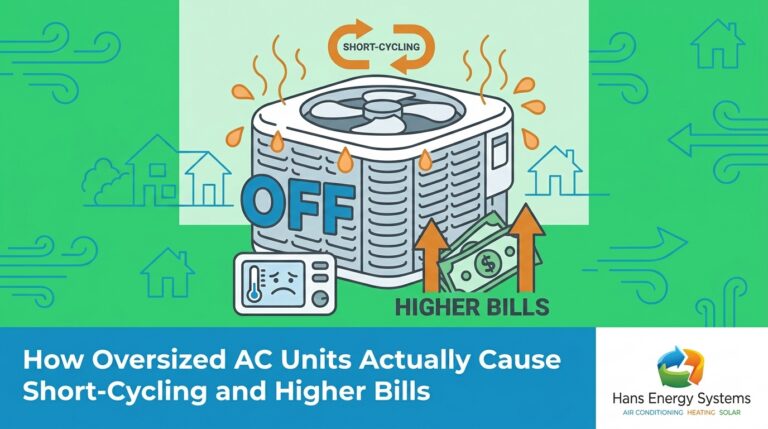
The “Bigger is Better” Cooling Myth: Why Oversized ACs Sabotage Comfort
Buying the largest possible air conditioner doesn’t guarantee a cooler, more comfortable home—it actually guarantees the opposite. In our years of serving Poway, we’ve found that how oversized AC units actually cause short-cycling and higher bills is a mechanical reality that catches many homeowners off guard, especially when the July peak summer heat sets in. Many people mistakenly believe that throwing maximum cooling capacity at a hot house will provide the ultimate defense against the weather. The truth is far more complicated.
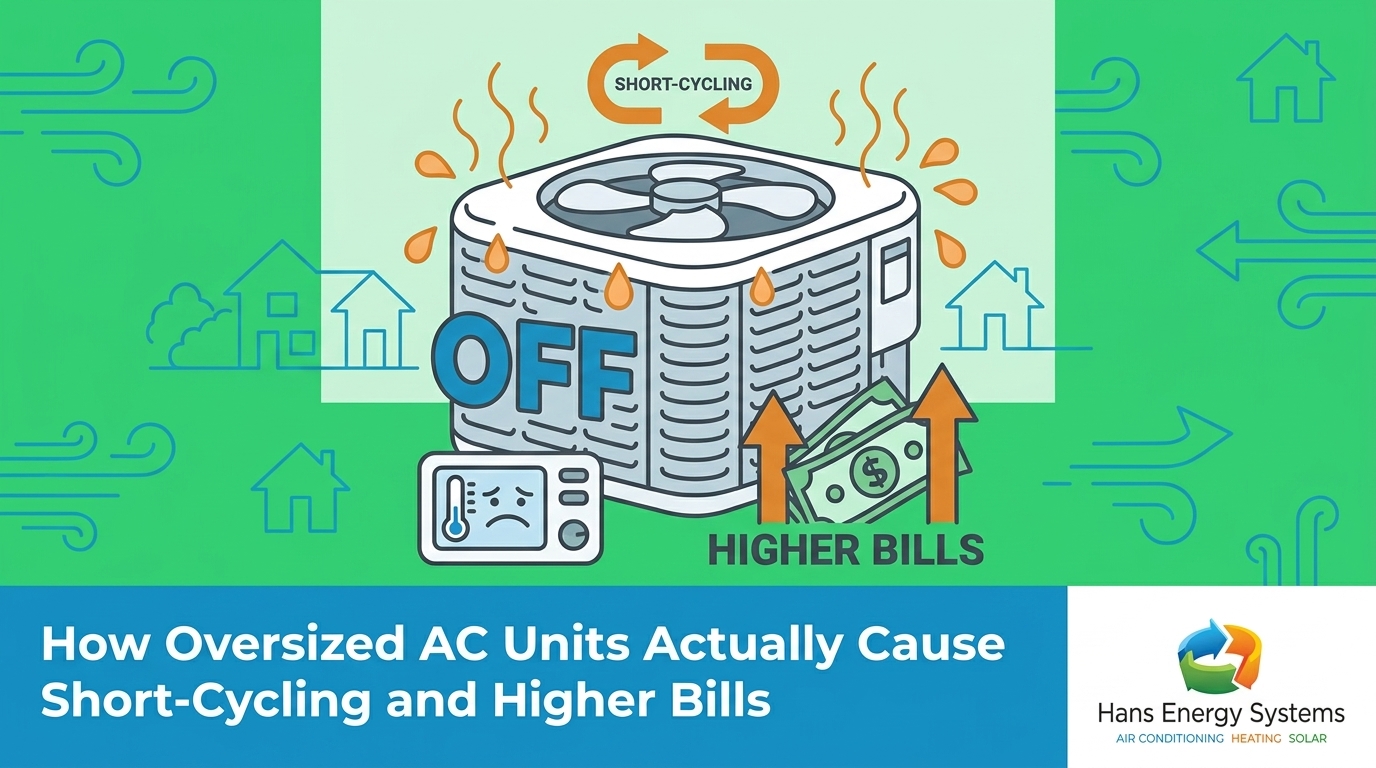
In reality, an oversized system cools the ambient air entirely too fast. It blasts a massive volume of cold air into your living space, dropping the temperature on the thermostat in a matter of minutes. However, this rapid temperature drop completely ignores indoor humidity. The result is a phenomenon known as short-cycling, where the unit turns on, runs for a brief moment, and immediately shuts down. This constant starting and stopping destroys internal components and spikes your energy consumption.
Understanding this mechanical reality is your first step toward achieving proper sizing and true indoor comfort. If you are evaluating your current HVAC services or planning for future HVAC replacements, knowing exactly why bigger isn’t better will save you from years of frustration, mechanical breakdowns, and wasted energy.
Understanding the Physics of Short-Cycling
The Problem: When the Poway inland climate drives temperatures up, our team typically sees homeowners panic and demand maximum tonnage for their next system. They assume a massive unit will conquer the heat instantly. Instead, they end up with a system that turns on, roars for five minutes, and abruptly shuts off, only to repeat the process a few minutes later.
The Cause: This rapid on-and-off behavior is the textbook definition of short-cycling caused by oversized equipment. Your air conditioner operates like a car on the highway. It is designed to start up, reach a steady cruising speed, and run efficiently for long stretches. When the system is too large for the square footage and thermal envelope of the house, it never gets the chance to cruise. It simply sprints and stops.
The Solution: Stopping this cycle requires understanding how your equipment actually reads the environment. The system relies entirely on your thermostat to tell it when the job is done, but the thermostat only tells half the story of true indoor comfort.
The Thermostat’s Role in Rapid Cycling
To grasp why oversized units fail so spectacularly, you have to look at how thermostats measure your indoor environment.
- Sensible heat measurement: Standard thermostats measure sensible heat, which is the actual temperature of the air (the number you see on the screen).
- Latent heat blindness: Most standard thermostats do not measure latent heat, which is the amount of moisture or humidity suspended in that air.
- The premature shutdown: An oversized blast of cold air satisfies the sensible heat requirement almost instantly. The thermostat detects the rapid temperature drop and tricks the system into ending the cooling cycle prematurely, leaving all the latent heat (humidity) behind.
The Dehumidification Timeline: Creating a Cold, Clammy Cave
One of the most vital functions of your air conditioner is removing moisture from the air. In our experience servicing Poway homes during the July peak summer heat, even dry inland climates experience significant indoor humidity generated by cooking, showering, and simply breathing inside a sealed house. To remove this moisture, your air conditioner relies on a very specific timeline.
An air conditioning system typically needs to run continuously for 15 to 20 minutes before the indoor evaporator coil gets cold enough to effectively extract humidity from the air. The warm indoor air must blow across a thoroughly chilled coil so the moisture can condense into water droplets and drain away. This is a physical process that cannot be rushed.
Because oversized units short-cycle and shut off in just five to ten minutes, they never reach this critical 15-to-20 minute threshold. The evaporator coil never gets cold enough, for long enough, to wring the water out of the air. The resulting indoor environment feels wet, heavy, and deeply uncomfortable. You end up creating a “cold, clammy cave” effect. The thermostat might proudly display 70 degrees, but you will still feel sticky and uncomfortable because the latent heat was never addressed.
Sensible vs. Latent Cooling
Achieving total home comfort requires a delicate balance of both sensible and latent cooling. Sensible cooling lowers the temperature you feel on your skin, while latent cooling removes the moisture that makes the air feel heavy. Proper comfort requires a steady, prolonged runtime that only a correctly sized unit can provide. When a system is oversized, you get 100% sensible cooling and nearly 0% latent cooling, completely ruining your indoor air quality.
Mechanical Breakdown: The Hidden Cost of High In-Rush Current
The Problem: Beyond poor comfort, short-cycling actively destroys the machinery inside your air conditioner. Homeowners with oversized units frequently experience premature part failures, particularly with electrical components and the compressor itself.
The Cause: Air conditioners draw their highest electrical load during startup. This massive surge of electricity is known as in-rush current. Starting a heavy compressor requires three to five times more electricity than it takes to keep it running. When a properly sized unit runs for 45 minutes, it only experiences that massive electrical surge once. When an oversized unit short-cycles, it might start up six, seven, or eight times in that same hour, subjecting the internal components to relentless electrical stress.
The Solution: Sizing the unit correctly ensures fewer starts and longer runtimes, drastically reducing the strain on the system. The consequences of ignoring this are severe. One of our customers recently reached out to us during a brutal summer heat wave when their AC compressor leaked refrigerant, overheated, and caused a massive short circuit. The constant stress on an oversized or failing system leads directly to total mechanical failure, and in that specific case, a full system replacement was the only path forward to restore efficiency and safety.
Why Contactors Fail Under Stress
The contactor is a heavy-duty electrical switch inside your outside unit that controls the high-voltage electricity flowing to the compressor. Every time the system turns on, the contactor snaps shut to let the power flow.
- Excessive heat generation: The massive in-rush current of a startup generates significant heat across the contactor’s metal plates.
- Pitting and welding: When an oversized unit short-cycles, the contactor slams shut and pulls that massive current dozens of times a day. Over time, this causes the metal contacts to pit, burn out, or even weld themselves permanently shut.
- Compressor death: If a contactor welds shut, our technicians often find the compressor has run continuously until it burned itself out entirely, leading to catastrophic system failure.
Utility Bill Spikes: The Financial Reality of Oversized Systems
The mechanical realities of short-cycling directly translate to wasted energy and skyrocketing monthly costs. The massive energy penalty of constant startup surges directly impacts your utility bills, particularly during the July peak summer heat when the system is fighting the hardest.
Think of your air conditioner like a heavy freight train. It takes an enormous amount of diesel fuel to get a stopped train moving, but very little fuel to keep it rolling at a steady speed on flat tracks. Your AC compressor works exactly the same way. A properly sized unit that runs longer, steady cycles is exponentially more energy-efficient than a large unit that starts and stops constantly. The myth that “cooling the house faster saves money” is completely debunked by the undeniable physics of high in-rush current.

Finding the Balance: Oversized vs. Undersized Systems
To truly appreciate the necessity of proper sizing, it helps to look at both extremes. While oversized units suffer from short-cycling and clammy air, undersized units present their own unique set of frustrating problems in the Poway inland climate. Precision in sizing is the only way to avoid the pitfalls of either extreme.
| System Status | Runtime Behavior | Humidity Control | Mechanical Impact |
|---|---|---|---|
| Oversized AC | Short-cycles (runs 5-10 mins, shuts off). | Poor. Leaves the home feeling cold but clammy. | High stress on contactors and compressors from constant startups. |
| Undersized AC | Runs continuously without shutting off. | Good dehumidification, but cannot lower the sensible temperature enough. | Overheating and excessive wear from never getting a rest cycle. |
| Properly Sized | Runs in steady, efficient 20-45 minute cycles. | Excellent. Balances temperature and moisture removal perfectly. | Maximum lifespan with minimal electrical stress. |
Both extremes lead to excessive mechanical wear, high energy bills, and poor indoor comfort. If you are curious about the opposite end of the spectrum, you can explore why an undersized AC will leave you steaming to see how endless runtimes cause their own damage.
The Only Real Solution: Professional Manual J Load Calculations
Square-footage rules of thumb are completely obsolete. In the past, contractors would simply look at the size of a house and guess the required tonnage. We’ve seen firsthand that this lazy approach is the primary reason so many homes suffer from oversized installations today. Proper HVAC sizing requires a rigorous, mathematical process known as a Manual J load calculation.
At Hans Energy Systems, our team’s foundational commitment to energy efficiency means that precise load calculations are non-negotiable for long-term reliability. We do not guess with your comfort. One local homeowner recently reached out to us for a complete cooling overhaul. Our technician took the time to explain the entire sizing process clearly, ensuring the new system matched the home perfectly, and completed the installation quickly with excellent workmanship. That level of precision is what guarantees a system will perform efficiently for years.
Here is what our professional load calculation actually entails before any AC installation begins:
- Evaluating the thermal envelope: Assessing the quality and R-value of your attic and wall insulation, as well as the type of windows installed.
- Mapping home orientation: Calculating how much direct sunlight hits your roof and windows based on which direction your house faces.
- Factoring in heat generation: Accounting for the heat generated by large appliances, lighting, and the number of people living in the home.
- Assessing ductwork: Mapping the efficiency, size, and layout of your existing ductwork to ensure it can handle the required airflow without restriction.
What Goes Into a Manual J Calculation?
A Manual J calculation takes all of the specific variables of your Poway inland climate home and runs them through specialized software. It removes the guesswork. It calculates exactly how many BTUs (British Thermal Units) of heat your home gains during the hottest part of the day, and prescribes the exact tonnage required to remove that specific amount of heat. Investing in a precise load calculation is the only way to ensure true comfort, lower bills, and a full system lifespan.
Secure True Comfort with Precision HVAC Sizing
A clear, logical understanding of run-time, dehumidification, and component wear proves that proper sizing is critical. Don’t let the “bigger is better” myth ruin your summer comfort, spike your utility bills, or destroy your equipment during the July peak summer heat. Precision sizing is about matching the machine perfectly to the unique physics of your home.
If your system is short-cycling, leaving you clammy, or costing a fortune to run, it is time for a professional evaluation. Rely on data-driven load calculations rather than outdated guesswork. When you are ready to secure true, lasting comfort, contact our team to schedule a comprehensive system assessment.
Frequently Asked Questions
What happens if my AC is too big for my house?
An oversized AC will cool the air too rapidly and shut off before it has a chance to remove humidity from your home. This leads to a phenomenon known as short-cycling, where the system constantly turns on and off. Over time, this rapid cycling wears out electrical components like contactors and the compressor. It also leaves your home feeling cold but uncomfortably clammy.
Why does my AC turn on and off so quickly?
This rapid on-and-off behavior is usually caused by an oversized unit satisfying the thermostat’s temperature setting too fast. Because the blast of cold air lowers the ambient temperature quickly, the thermostat shuts the system down prematurely. The system never runs long enough to achieve a steady, efficient cruising speed, leading to severe mechanical stress and poor indoor air quality.
Can an oversized AC cause humidity problems?
Yes, an oversized AC is one of the leading causes of high indoor humidity during the summer. An air conditioner needs to run continuously for 15 to 20 minutes before the evaporator coil gets cold enough to extract moisture from the air. Because an oversized unit shuts off in just five to ten minutes, it leaves all the humidity behind, creating a sticky, uncomfortable environment.
Does an oversized AC use more electricity?
Yes, an oversized AC uses significantly more electricity because of the high in-rush current required to start the compressor. Air conditioners draw three to five times more power during startup than they do while running steadily. Because an oversized unit starts and stops constantly, it repeatedly pulls that massive surge of electricity, causing your monthly utility bills to spike.
How do I know if my AC is oversized?
The most common signs of an oversized AC include short run cycles (less than 10 minutes), a home that feels cold but humid, uneven temperatures between rooms, and unusually high energy bills. You may also notice frequent electrical failures, such as blown fuses or burnt contactors. The only definitive way to know is to have a professional perform a Manual J load calculation.
What is a Manual J load calculation?
A Manual J load calculation is a precise mathematical formula used by HVAC professionals to determine the exact cooling capacity your home needs. It factors in your home’s square footage, insulation levels, window quality, roof orientation, and local climate data. This calculation ensures you get a properly sized unit that provides optimal comfort, efficiency, and longevity.