
The Myth of Equal Sunlight: Why Moving Shadows Demand the Right Inverter
A widespread misconception is that any solar panel array will produce optimal energy as long as the sun is shining, but evaluating microinverters vs. string inverters when your roof has partial palm tree shading reveals a very different reality. Many homeowners assume a few narrow shadows crossing their roof won’t make a noticeable dent in their daily energy production. The truth is that solar technology reacts dramatically to uneven light. Moving shadows from nearby trees create a constantly fluctuating energy landscape across your roofline. If your system is not equipped to handle these localized variations, you could lose a massive percentage of your overall capacity right when you need it most.
To ensure your system performs at its peak, it helps to explore the full scope of home energy and solar services available for complex rooflines.
The core issue lies in how solar panels are wired together and how the system’s “brain”—the inverter—processes the electricity they generate. Panels produce direct current (DC) power, which must be converted into alternating current (AC) power for your home to use. How and where that conversion happens dictates how resilient your system is to shade. During peak summer (July), when residential energy demands skyrocket, a poorly specified inverter system can cripple your solar production. Choosing the right inverter technology is the single most important decision we help our customers make to prevent your system from bottlenecking under the shifting shadows of tall trees.
The Anatomy of a Palm Tree Shadow on Solar Production
Not all shade is created equal. To understand why certain inverters fail under pressure, you have to look at the specific characteristics of the shadows crossing your roof. There is a fundamental difference between soft shading and hard shading, and solar panels react differently to each.
- Soft Shading: This occurs during overcast days or heavy smog. The sunlight is diffused, meaning the reduction in light is spread evenly across the entire solar array. While total production drops, all panels continue to operate in unison at a lower capacity.
- Hard Shading: This happens when a solid object blocks direct sunlight from hitting a specific portion of a panel. Chimneys, roof peaks, and trees create hard shading, causing a severe localized drop in power generation.
In our extensive experience designing solar systems for Poway CA properties with mature palm trees, our team at Hans Energy Systems has found that the shading environment is uniquely challenging. Abundant year-round sunshine creates exceptionally high-contrast, hard shadows. Unlike a dense oak tree that might blanket an entire roof in shade, tall palm fronds cast narrow, stark, and fast-moving shadows. As the wind blows and the sun moves across the sky, these finger-like shadows sweep across the solar array, hitting different panels at different times of the day.
Because solar cells are highly sensitive to hard shading, even a small fraction of a single panel covered by a dark palm frond shadow can disrupt the electrical flow of an entire array if the system is not designed to isolate the problem. The intense contrast between the glaring Poway sun and the dark shadow creates a volatile electrical environment that older inverter technologies struggle to manage.
How String Inverters Handle the Bottleneck Effect
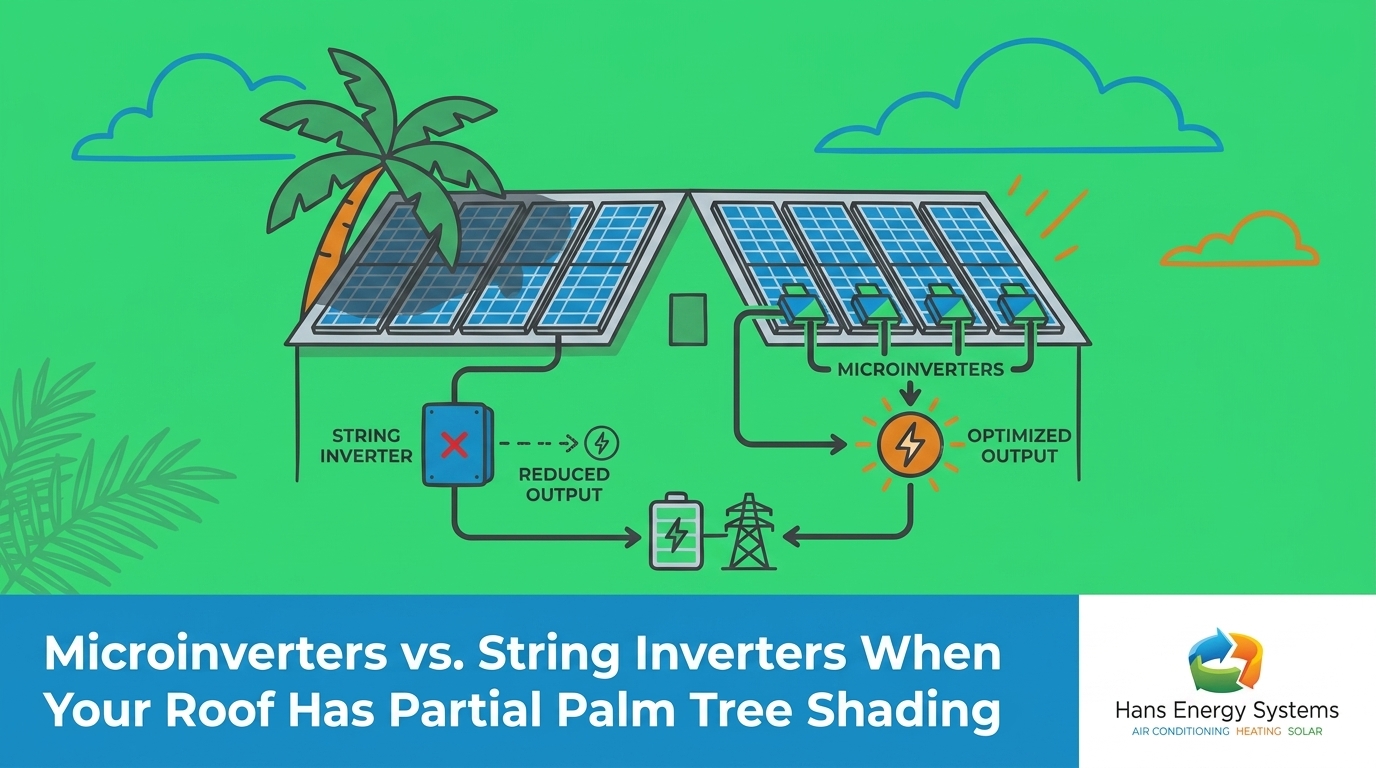
To understand the limitations of traditional solar setups, you have to look at how a string inverter operates. In a conventional system, solar panels are wired together in a series circuit, often referred to as a “string.” The DC power flows from one panel to the next, much like water flowing through a single hose, before reaching a central string inverter mounted on the side of the house.
The most common way to visualize this is the classic “Christmas light” analogy. If one bulb on the string goes out or dims, the entire string goes dark or loses power. In a solar array, if a palm tree shadow falls across a single panel, that panel’s electrical output drops. Because the panels are wired in series, the central string inverter forces all the other unshaded panels on that string to drop their output to match the weakest link. A shadow covering just ten percent of one panel can drag the production of the entire string down by a massive margin.
During a recent peak-summer project, our team worked with a local homeowner who needed solar equipment installed and was concerned about efficiency while running their AC. By guiding them through the equipment purchase, installation, and monitoring setup, we helped them avoid these exact bottlenecks that plague standard series-wired systems.
Understanding why your solar system might be producing less power often traces directly back to this bottleneck effect. However, string inverters are not inherently bad. They are highly efficient, cost-effective, and perfectly suited for simple, wide-open rooflines with zero shading obstructions.
The Impact of Partial Shade on Series Circuits
From a technical standpoint, a central string inverter relies on Maximum Power Point Tracking (MPPT) to extract the most available power from the array. The MPPT algorithm constantly adjusts the voltage and current to find the “sweet spot” of maximum electrical output.
When uneven, moving shadows from palm trees hit the array, the MPPT gets confused. It has to choose between dropping the voltage to bypass the shaded panel (which lowers overall power) or maintaining the voltage but dropping the current to match the shaded panel (which also lowers overall power). During peak summer (July), this constant struggle to find the maximum power point under shifting shade leads to severe underperformance.
Isolating Performance: The Microinverter Advantage
The solution to the bottleneck effect is to change the way the panels are wired and how the power is converted. Microinverters fundamentally alter the architecture of a solar array by decentralizing the conversion process. Instead of sending DC power down to a single, central box, a small microinverter is installed on the underside of every individual solar panel.
This localized approach solves the partial shade problem through parallel wiring. Here is how the process works step-by-step:
- Localized Conversion: Each panel converts its own DC power into AC power right on the roof. The electricity traveling down to your electrical panel is already in its final, usable form.
- Independent Operation: Because the panels are wired in parallel rather than in series, they operate completely independently of one another. The “hose” is no longer connected end-to-end; each panel has its own dedicated line to the electrical panel.
- Shade Isolation: If a narrow palm frond shadow falls across Panel A, only Panel A experiences a drop in production. Panels B, C, and D continue to pump out energy at 100% capacity. The weakest link no longer dictates the performance of the whole system.
- Granular Monitoring: Because every panel has its own microinverter, you gain access to panel-level monitoring. You can look at an app and see exactly how much power each individual panel is producing in real-time, making it incredibly easy to spot shading issues or hardware faults.
For Poway CA properties with mature palm trees, this independence is critical. As the harsh, high-contrast shadows move across the roof throughout the day, the microinverters seamlessly isolate the shaded panels while harvesting maximum energy from the panels sitting in direct sunlight.
Side-by-Side: Microinverters vs. String Inverters for Shaded Roofs
When deciding how to equip your home for peak summer (July) energy production, seeing the technologies compared directly helps clarify the right path forward. Here is how the two primary inverter strategies stack up against each other under challenging roof conditions.
| Feature | Traditional String Inverter | Microinverter System |
|---|---|---|
| Performance Under Hard Shade | Poor. A shadow on one panel drops the output of the entire string. | Excellent. A shadow on one panel only affects that specific panel. |
| Wiring Architecture | Series wiring (dependent on the weakest link). | Parallel wiring (independent operation). |
| System Expansion | Difficult. Adding panels usually requires matching older equipment or buying a new central inverter. | Simple. New panels and microinverters can be added to the existing array easily. |
| Monitoring Capabilities | System-level only. You can only see the total output of the entire array. | Panel-level. You can track the exact production of every individual solar panel. |
| Best Use Case | Wide-open, unshaded roofs with simple, single-direction planes. | Complex roofs with multiple angles, dormers, or moving tree shade. |

The Middle Ground: String Inverters with Power Optimizers
While pure microinverters are a fantastic solution for shaded roofs, there is a third option that blends the two technologies: string inverters paired with power optimizers. This hybrid approach is frequently utilized in modern solar designs to capture the benefits of panel-level optimization without placing the actual DC-to-AC conversion hardware on the roof.
Power optimizers are a type of Module-Level Power Electronics (MLPE). Like a microinverter, one optimizer is attached to the back of every single solar panel. However, instead of converting the DC power to AC power on the spot, the optimizer “conditions” the DC power. It fixes the voltage and current at the optimal level for that specific panel, regardless of whether it is shaded or in full sun. The conditioned DC power is then sent down the string to a central inverter for conversion into AC power.
This technology effectively breaks the “Christmas light” bottleneck. If a palm frond shades one optimized panel, that panel’s output drops, but the optimizer prevents it from dragging down the voltage of the rest of the string. The unshaded panels continue to operate at maximum efficiency.
For many Poway CA properties with mature palm trees, optimizers offer shade-handling capabilities that rival pure microinverters. They also provide the same panel-level monitoring benefits. When researching solar installation programs in Santee and surrounding areas, you will often find optimizers specified for complex roofs where keeping the primary conversion hardware off the hot roof is preferred.
Tying Solar Output to Peak Cooling Demands
Choosing the right inverter technology isn’t just an isolated decision about solar panels; it is a critical component of your overall home energy strategy. The timing of palm tree shadows often creates a “perfect storm” of energy demand and restricted supply.
Because palm trees are exceptionally tall, their shadows stretch the furthest across your roofline in the late afternoon as the sun begins to lower in the sky. Unfortunately, this exact time block—typically between 3:00 PM and 7:00 PM—coincides with the highest residential cooling demands. As the heat of the day builds up inside the house, air conditioning systems kick into overdrive.
If you have a traditional string inverter without optimizers, those long, late-afternoon palm shadows will choke your solar production exactly when your HVAC system is drawing the most electrical current. This forces your home to pull expensive, peak-rate electricity from the grid to keep the air conditioner running.
As a comprehensive provider of Solar, HVAC, and Electrical services, our focus at Hans Energy Systems is always on the big picture—ensuring your solar output is optimized specifically to meet high cooling demands. Maximizing solar output during these partially shaded periods is essential for successfully offsetting heavy air conditioning loads.
This holistic approach was essential during a recent summer project where we helped a homeowner who needed mini splits installed in every room. Our technicians found discreet and efficient ways to conceal the hardware while ensuring the new, high-efficiency cooling system had the robust electrical support it needed from an optimized energy setup. During peak summer (July), having an electrical system that seamlessly supports heavy HVAC loads without faltering under temporary roof shade is the ultimate goal.
Evaluating Your Roofline for the Right Solar Strategy
Ultimately, partial and moving shade dictates a strict need for module-level optimization. Whether you achieve that through microinverters or power optimizers, the goal remains the same: isolating underperforming panels so the rest of your array can carry the load.
If your property has a complex roofline, dormers, chimneys, or tall vegetation, you do not have to abandon the idea of generating your own clean energy. A shaded roofline can still produce excellent, reliable energy yields with the right equipment installed. The key is recognizing that standard series-wired systems will not provide the resilience you need.
For Poway CA properties with mature palm trees, a professional evaluation of your specific shading patterns, roof angles, and daily energy loads is the best way to determine which technology fits your home. Taking the time to map out how shadows move across your property ensures your investment performs exactly as expected.
To get a clear picture of your home’s potential and to evaluate your specific roofline, contact our solar experts today for a comprehensive energy assessment.
Frequently Asked Questions
How do palm trees affect solar panels?
Palm trees cast narrow, high-contrast, and fast-moving shadows across solar panels as the sun moves and the wind blows. Because solar panels are highly sensitive to hard shading, even a small palm frond shadow can severely disrupt the electrical output of a traditional series-wired system. This moving shade requires specialized inverter technology to prevent the entire array from bottlenecking.
Do microinverters solve partial shading?
Yes, microinverters are highly effective at solving partial shading issues. Because a microinverter is installed on every individual panel, each panel operates independently of the others. If one panel is shaded by a tree or chimney, only that specific panel’s output drops, allowing the rest of the unshaded panels to continue producing power at maximum capacity.
Why do string inverters drop power when one panel is shaded?
String inverters drop power because the solar panels are wired together in a series circuit. In a series circuit, the electrical current must flow through every panel sequentially. If one panel is shaded and its output drops, the central inverter forces all the other panels on that string to lower their output to match the shaded panel, creating a massive bottleneck.
Are microinverters worth it for partial shade?
At Hans Energy Systems, we highly recommend microinverters for roofs that experience partial or moving shade throughout the day. While the initial equipment costs may be slightly higher than a basic string inverter, the ability to isolate shaded panels prevents massive daily energy losses. Over the lifespan of the system, the increased energy harvest usually offsets the difference in equipment costs.
How much shade ruins solar panel output?
In a traditional string inverter system, a surprisingly small amount of hard shade can ruin output; covering just 10% of a single panel can drag the production of the entire string down significantly. However, in a system equipped with microinverters or power optimizers, that same 10% shade will only reduce the output of that specific panel by 10%, leaving the rest of the system unaffected.
Can power optimizers handle moving shadows as well as microinverters?
Yes, power optimizers handle moving shadows very similarly to microinverters. Optimizers are attached to each panel and condition the DC power independently, preventing a shaded panel from dragging down the voltage of the rest of the string. Both technologies provide the panel-level optimization necessary to combat moving shadows from tall trees.