
The Clock is Ticking on Your Summer Solar Production
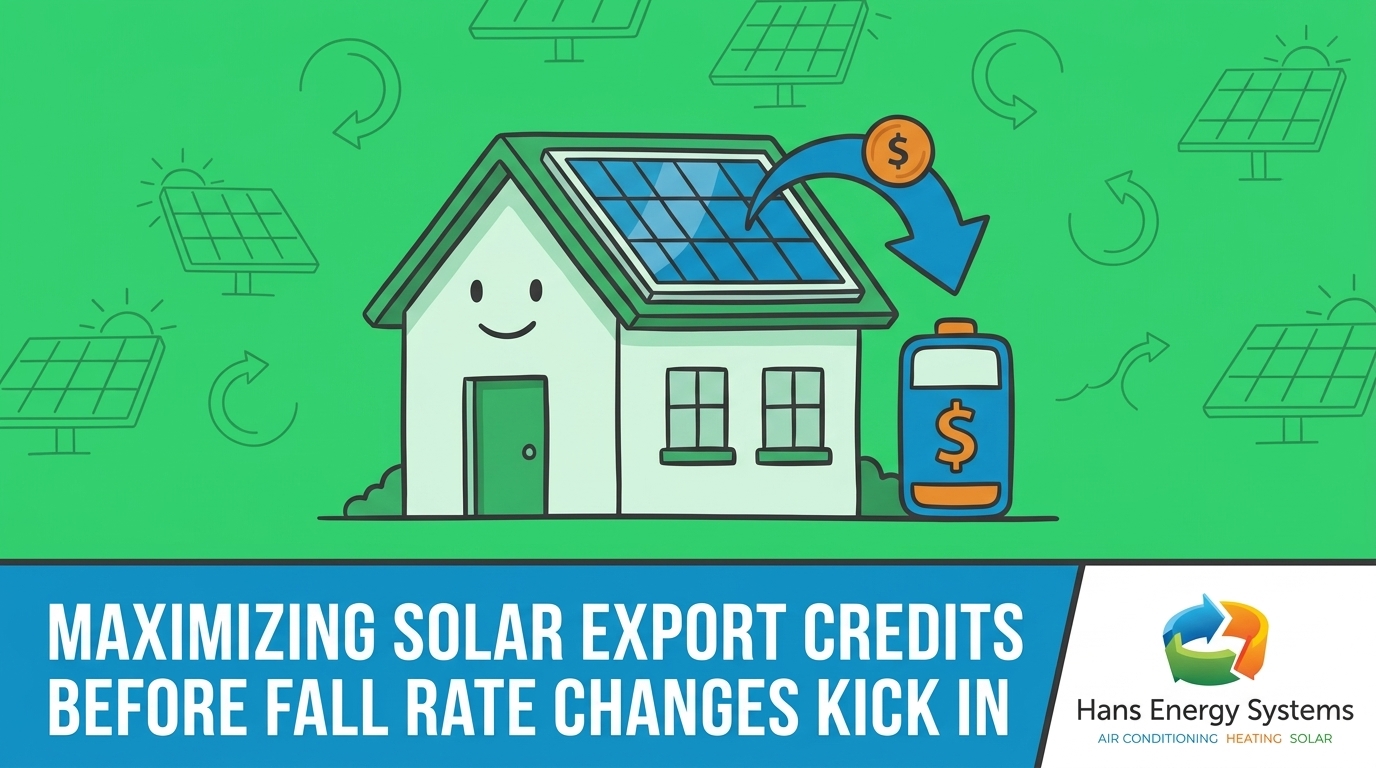
When peak summer July hits, figuring out a strategy for maximizing solar export credits before the fall rate changes kick in becomes a daily balancing act for local homeowners. At Hans Energy Systems, our team works with Poway residents every day who are battling the intense summer heat. The current season demands heavy reliance on air conditioning, which can quickly drain the very energy your rooftop panels are working so hard to produce. If your HVAC system is running nonstop to fight off the afternoon heat, you might be sacrificing the valuable utility credits you need to offset energy costs later in the year.
The impending shift in utility Time-of-Use (TOU) schedules coming this autumn means the window to bank excess energy is rapidly closing. Strategic daily timing of your cooling and household energy consumption is the most effective way to protect and maximize your net metering banks. By adjusting when and how you cool your home, you can maintain perfect indoor comfort without giving up your hard-earned grid credits. If you are looking to optimize your home’s overall performance, exploring comprehensive energy efficiency services is a crucial first step toward long-term independence.
The core challenge: Your solar panels produce the most power during the middle of the day, but your home typically demands the most power in the late afternoon and early evening. Bridging this gap requires a proactive approach to how your home consumes electricity.
Why the Autumn Time-of-Use Shift Demands Action Now
In our experience navigating utility agreements across the region, California TOU schedules typically transition to fall rates in November, completely changing the mathematical equation of your rooftop production. During peak summer July, the longest daylight hours provide the highest solar production potential of the entire year. This creates a highly valuable, limited-time opportunity to bank export credits. Because export credit values fluctuate significantly based on both the time of day and the month of the year, understanding the mechanics of these shifts is vital for protecting your investment.
For homeowners navigating the complexities of modern utility agreements, knowing exactly how NEM 3.0 net billing works reveals why summer banking is so critical. Under current regulations, the value of the energy you send back to the grid is highly dependent on grid demand at that specific hour. When you produce excess energy during the long, sunny days of summer, you have the opportunity to build a reserve that helps offset future usage when days get shorter and your panels have less time to generate power.
The Impact of Decreasing Daylight
As the calendar moves toward autumn, the sun sits lower in the sky and sets earlier in the evening. This natural shift drastically reduces your daily production capacity. If you enter the late autumn months without a healthy bank of export credits, you will be forced to rely more heavily on grid power during the shorter days.
Consider the mathematical advantage of banking excess energy right now. To clearly illustrate why the current season is so important, let’s look at how solar dynamics shift as the year progresses:
| Energy Factor | Peak Summer (July/August) | Late Autumn (Nov) |
|---|---|---|
| Daylight Hours | Maximum exposure (13-14 hours) | Reduced exposure (9-10 hours) |
| Production Potential | Highest annual generation | Significantly lower generation |
| Export Credit Value | High during late afternoon peaks | Lower overall valuation |
| HVAC Demand | High cooling load | Lower baseline load |
Taking action now means securing the highest possible yield from your panels before the seasonal advantage disappears.
Navigating the 4 PM to 9 PM Danger Zone
The most critical element of any utility rate strategy our experts design is mastering the 4 PM to 9 PM window. This specific timeframe is widely recognized as the peak utility window across California. During these hours, the statewide electrical grid experiences its highest demand as people return home from work, turn on their televisions, start cooking dinner, and ramp up their air conditioning units.
The problem for solar owners is that this massive spike in household energy demand aligns perfectly with the time your solar production begins to drop off. As the sun lowers in the sky during those 90°F+ afternoons, your panels are generating a fraction of what they produced at noon. If your heavy HVAC loads are running continuously during this unaligned window, you are rapidly draining your accumulated net metering banks. Instead of exporting valuable power to the grid, you are pulling expensive power from it.
The anatomy of the peak window:
- 4:00 PM: Solar production begins its steep decline just as utility rates switch to their highest tier.
- 5:30 PM: Household appliance usage typically spikes, compounding the energy draw.
- 7:00 PM: Solar production drops to near zero, leaving the home entirely dependent on the grid or battery storage.
- 9:00 PM: Peak rates finally end, and standard off-peak pricing resumes.
Surviving this danger zone without draining your credits requires a deliberate load-shifting strategy. You cannot simply turn off your air conditioner and suffer through a sweltering evening, but you also cannot afford to let it run unchecked during the most expensive hours of the day. The solution lies in shifting the heavy lifting to the hours when your panels are overproducing.
Strategic HVAC Pre-Cooling for Inland Climates
Here in Poway, inland areas experience significantly hotter late afternoons compared to the coast. When our technicians perform home energy audits, we consistently find that proactive cooling strategies are essential for avoiding massive peak-hour energy draws. When you are dealing with 90°F+ afternoons, waiting until you feel hot to turn on the AC guarantees you will be paying peak rates. The primary actionable strategy for maintaining comfort without utilizing heavy AC during peak hours is HVAC pre-cooling.
Pre-cooling simply means dropping your thermostat a few degrees lower than your normal preference during the peak solar production hours (typically between 12 PM and 4 PM). By doing this, you are utilizing the excess solar power your panels are generating right then, rather than sending it to the grid at lower midday rates. Your home’s structure—the drywall, the floors, the furniture—acts as a thermal battery, absorbing that cooling energy.
A well-insulated home retains this deep cooling through the evening peak window. When the clock strikes 4 PM, you allow the thermostat to drift upward, effectively turning off the heavy AC compressor while your home slowly releases the stored coolness over the next several hours.
Automating Your Thermostat for Solar Synergy
Manually adjusting your thermostat every day is tedious and easy to forget. We always recommend automating the daily cycle using a smart thermostat. Follow these steps to set up a typical summer pre-cooling schedule:
- Morning Baseline (8 AM – 12 PM): Set the thermostat to a comfortable baseline, such as 76°F. Your solar panels are ramping up production and can easily cover this mild load.
- The Sub-Cooling Phase (12 PM – 4 PM): Program the thermostat to drop to 70°F or 72°F. This forces the AC to run hard while your solar panels are producing their maximum output. The energy used here is essentially free.
- The Coasting Phase (4 PM – 9 PM): Program the thermostat to rise to 78°F or 80°F. Because the house was deeply cooled during the previous phase, it will take several hours for the indoor temperature to actually reach this number. The AC compressor stays off, and your export credits remain untouched.
- The Recovery Phase (After 9 PM): Return the thermostat to your preferred sleeping temperature once off-peak rates have resumed.
This automated load-shifting strategy ensures you stay comfortable during the hottest part of the evening without sacrificing your utility credits.
Shifting Heavy Appliance Loads to Peak Production Hours
While the HVAC system is typically the largest energy consumer in a home, expanding your load-shifting strategy to other major appliances is critical for maximizing your summer export credits. High-draw appliances can quickly eat into your banked energy if they are run during the evening danger zone.
Every kilowatt of energy you shift to the midday hours is a kilowatt saved from peak evening rates. When your solar panels are overproducing under the midday sun, that is the exact moment you should be running your most demanding equipment.
Major appliances to shift to midday operation:
- Electric Vehicles (EVs): If you are home during the day, plug your EV in at noon. Charging a vehicle requires massive amounts of sustained power.
- Pool Pumps: Program your pool filtration system to run exclusively between 10 AM and 3 PM.
- Electric Dryers: Avoid doing laundry in the evening. The heating elements in electric dryers consume vast amounts of electricity. Run them when the sun is highest.
- Dishwashers: Use the delay-start feature on your dishwasher so it runs at 1 PM rather than immediately after dinner.
Properly sizing your solar array is also vital for handling concurrent heavy loads. One Poway homeowner we recently worked with found themselves needing more solar panels specifically to charge electric vehicles during the summer months. By having our team install a second set of panels correctly sized for their actual usage, they were able to shift their EV charging entirely to midday, resulting in an optimized billing cycle. Matching your production capacity to your actual consumption habits is the key to making load-shifting work.
The Whole-Home Energy Synergy Strategy
Maximizing your export credits isn’t just about producing more power on your roof; it is about consuming that power smarter inside the walls of your home. True efficiency requires optimizing both your solar generation and your HVAC consumption together, bridging the gap between what you make and what you use.
As a family-built company focused strictly on comprehensive energy efficiency here in Poway, we know that true utility savings come from looking beyond just slapping panels on a roof. Optimizing whole-home consumption means treating the property as a unified energy ecosystem. When we combine high-efficiency HVAC equipment—like variable-speed heat pumps or multi-stage air conditioners—with a robust solar array, we see a significant drop in a home’s baseline consumption. A system that uses less power to begin with leaves far more solar energy available to export back to the grid.
Treating solar and HVAC as separate entities often leads to wasted potential. For example, another local Poway homeowner reached out to us looking for improved home comfort alongside better energy efficiency. After our team reviewed both their HVAC and solar options together, we performed a smooth, clean installation of a unified system. Because the new cooling equipment was designed to communicate seamlessly with their energy production, the homeowner noticed significantly improved comfort and much better overall energy efficiency.
Professional guidance ensures that both systems are operating in tandem. When your thermostat, your cooling equipment, and your solar inverter are all aligned with the same daily goal, banking credits before the autumn shift becomes an automatic, stress-free process.
Your Daily Summer Schedule for Maximum Export Credits
To make banking credits as simple as possible during peak summer July, follow this featured daily timeline. Sticking to this schedule ensures you are consuming power when it is cheapest (or free) and exporting it when it is most valuable.
- Morning (8 AM – 12 PM): Normal Operation. The sun is rising, and panels are waking up. Run your home at a normal, comfortable baseline. If your electric vehicle is in the driveway, begin charging it now.
- Mid-Day (12 PM – 4 PM): Maximize Self-Consumption. This is the golden window. Pre-cool the home by dropping the thermostat several degrees. Run the pool pump, the dishwasher, and the electric dryer. Maximize your self-consumption of peak solar production so nothing goes to waste.
- Evening (4 PM – 9 PM): The Coasting Phase. Avoid major appliance use entirely. Let the thermostat rise and coast on the deep pre-cooling you achieved earlier. Allow your panels to export whatever remaining late-day sun they catch directly to the grid at premium peak rates.
- Night (After 9 PM): Off-Peak Resumption. The danger zone has passed. Resume normal operation, run any necessary remaining appliances, and set your thermostat to your preferred sleeping temperature using off-peak grid rates.

Frequently Asked Questions About Solar Export Credits
How do I optimize my solar panels for time of use rates?
Our team recommends optimizing your panels for time of use (TOU) rates by shifting your home’s heavy energy consumption to the middle of the day. By running high-draw appliances like electric dryers, pool pumps, and EV chargers when the sun is highest, you utilize free energy. You then drastically reduce your consumption during the peak evening hours, allowing any remaining solar generation to be exported to the grid at the highest possible valuation.
When should I run my AC with solar panels?
In our experience, the best time to run your air conditioning with solar panels is between 12 PM and 4 PM. During this window, your panels are producing their maximum output, easily covering the heavy electrical draw of the AC compressor. Running the system hard during this time allows you to pre-cool the house, meaning you can turn the AC down or off completely during the expensive 4 PM to 9 PM peak utility window.
How can I maximize my net metering credits before fall?
To maximize your net metering credits before the autumn utility shift, we advise protecting your summer solar production from unnecessary evening consumption. Implement a strict load-shifting schedule that moves all heavy appliance usage to the midday hours. By automating your thermostat to pre-cool the home and coast through the late afternoon, you ensure that the maximum amount of energy is sent back to the grid during the longest days of the year.
Does pre-cooling my house save energy with solar panels?
Yes, pre-cooling your house is one of the most effective ways we’ve found to save energy and protect your solar credits. By dropping the temperature of your home’s structural elements (like drywall and flooring) during peak solar production hours, you create a thermal battery. This stored cooling keeps the house comfortable through the 90°F+ afternoons, allowing you to avoid running the AC when grid power is at its most expensive.
What are the peak time of use hours for solar in California?
In California, the peak time of use hours generally fall between 4 PM and 9 PM. This five-hour window represents the highest demand on the statewide electrical grid, and utility companies charge significantly higher rates for energy consumed during this time. Conversely, any excess solar energy you export to the grid during these specific hours is credited at a much higher premium, making it vital to keep your household consumption low during this timeframe.
Secure Your Energy Independence Before the Season Changes
Banking your solar credits now is the most reliable way to protect your household against the inevitable rate shifts coming this autumn. The long days of summer provide a brief, powerful opportunity to build a reserve that will offset your utility needs when the days grow shorter. By implementing strategic pre-cooling and load-shifting routines today, you take full control of your home’s energy ecosystem.
Don’t wait until the late summer heat drains your potential savings. If you are a Poway homeowner ready to optimize your unified home energy systems, taking action now ensures you get the absolute most out of your investment. To get expert guidance on aligning your HVAC operation with your solar production, contact our team at Hans Energy Systems to implement a clear, actionable strategy that maximizes your net metering bank before the fall rate changes arrive.