
Why Your Solar Setup Seems Sluggish on Late-Summer Mornings
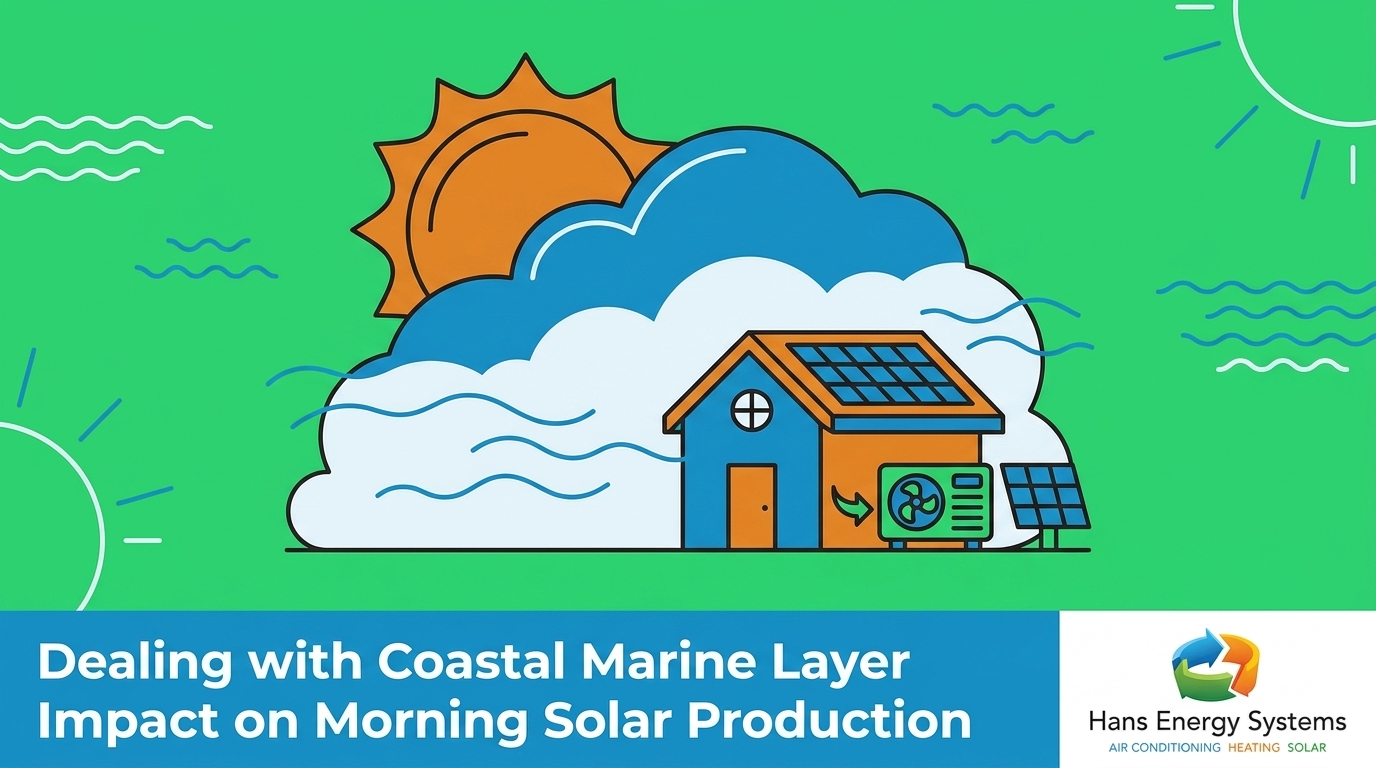
Your solar monitoring app shows barely a trickle of energy, but the calendar says it is peak summer. You step outside expecting bright sunshine, only to find a thick, gray blanket of clouds hovering over your neighborhood. Dealing with Coastal Marine Layer Impact on Morning Solar Production is a common frustration we hear at Hans Energy Systems from homeowners who expect maximum efficiency during the hottest months of the year. Instead of a soaring energy graph, your system seems to be asleep.
This sluggish early performance rarely points to a failing inverter or damaged equipment. Instead, the culprit is the persistent coastal marine layer. Most locals are highly familiar with the “May Gray” and “June Gloom” weather patterns, but our team frequently sees this dense cloud cover unexpectedly extend deep into late summer. When you are relying on your solar panels to offset high seasonal energy use, watching the morning pass by with minimal generation can feel like a setback.
The core issue is not a lack of overall solar capacity, but a misalignment between when the sun finally breaks through and when your household demands power. Recognizing that the August late-summer marine layer burn-off dictates your actual energy curve is the first step toward reclaiming your efficiency. By understanding this localized weather phenomenon, you can adapt your daily routines to match the sun’s delayed appearance, ensuring you still get the most out of your renewable energy investment.
The Science Behind Fogust and the Coastal Marine Layer
To effectively manage your energy consumption, you first need to understand the meteorological mechanics driving this persistent cloud cover. The coastal marine layer is a highly predictable, seasonal climate event rather than random bad weather. It forms due to a specific atmospheric condition known as a temperature inversion.
During a typical summer pattern, the air higher up in the atmosphere becomes significantly warmer than the air near the ocean surface. The cold water of the Pacific chills the air immediately above it, creating a dense, moist layer. The warm air sitting on top acts like a pressurized lid, trapping this cool, moist air near the ground. As this trapped moisture condenses overnight, it forms the thick stratus clouds that define the “May Gray” and “June Gloom” seasons. However, because ocean temperatures and atmospheric pressures fluctuate, this pattern frequently stretches well into “Fogust,” surprising homeowners who expect clear summer skies.
The Overnight Inland Push: As the sun sets and inland temperatures drop, this dense cloud cover physically pushes eastward. It flows through the canyons and blankets the valleys, settling heavily over Poway and San Diego coastal-adjacent communities before retreating the following day.
How Far Inland Does the Gloom Reach?
The distance this cloud cover travels inland depends heavily on the strength of the inversion layer and the overnight temperature drop. The thicker the marine layer, the further east it pushes, and the longer it takes to dissipate.
| Geographic Zone | Marine Layer Impact | Typical Burn-Off Window |
|---|---|---|
| Immediate Coast | Heavy, dense fog; very low morning visibility | 11:00 AM – 1:00 PM (Sometimes lingers all day) |
| Coastal-Adjacent Valleys | Moderate to thick cloud cover; overnight settling | 9:30 AM – 11:30 AM |
| Deep Inland / Foothills | Light morning overcast; rapid clearing | 8:00 AM – 9:30 AM |
Because coastal-adjacent valleys experience a delayed burn-off compared to higher elevations, your morning solar production will naturally lag behind homes located further east. However, these same valleys clear up significantly earlier than the immediate coast, giving you a strong afternoon window to capture peak sunlight.
Validating Your System: Weather Factors vs. Equipment Issues
If you notice a sharp drop in early energy generation, your first instinct might be to call a technician. However, it is vital to differentiate between the temporary dip caused by morning clouds and actual hardware malfunctions. Data from the National Renewable Energy Laboratory (NREL) demonstrates that solar panels do not simply shut down when the sun is hidden. Even under heavy fog or dense overcast skies, modern photovoltaic systems still produce roughly 10% to 25% of their normal capacity by capturing diffused light.
At Hans Energy Systems, we regularly field calls from concerned customers during late summer. Just recently, our team expertly walked a local Poway homeowner through their solar equipment monitoring process after they noticed a sharp morning drop in generation. By analyzing their daily energy curves and comparing their data against local weather reports, we demonstrated that their hardware was functioning perfectly—it was simply the lingering weather pattern suppressing early output. This kind of verification provides significant peace of mind.
How to check your system’s health during a cloudy morning:
- Review the production curve: A healthy system under a marine layer will show a slow, gradual climb in the morning, followed by a sharp, nearly vertical spike once the sun breaks through.
- Check for error codes: If your inverter or monitoring app displays a green status light without any fault codes, the low production is almost certainly weather-related.
- Compare day-over-day data: Look at your generation on a perfectly clear day versus a cloudy day. If the afternoon peaks match, your equipment is fine.
Understanding why your solar system is producing less power during these specific hours saves you from unnecessary service calls. The August late-summer marine layer burn-off simply shifts your production schedule; it does not break your system.
Strategic Load-Shifting: Timing Your Heavy Appliances
Once you confirm your system is healthy, the next step is adapting your household habits to maximize your solar self-consumption. Because the sun is effectively “sleeping in,” your heavy electrical loads need to sleep in, too. In our experience designing solar solutions across Poway, this strategy—known as load-shifting—is the single most effective way to offset the financial impact of delayed morning production.
Recently, our Hans Energy Systems team guided a local family on how to perfectly align their heavy appliance usage with their actual solar production hours. Following a smooth, efficient installation, they noticed immediate improvements in home comfort and energy efficiency simply by delaying their heavy power usage until the early afternoon. You can achieve the same results by following a strategic daily schedule.
Actionable steps for late-summer load-shifting:
- Delay the pool pump: Pool pumps are massive energy consumers. Instead of running yours at 8:00 AM, reprogram the timer to start at 11:00 AM, right as the clouds begin to part.
- Reschedule laundry and dishes: Wait to run your washing machine, electric dryer, or dishwasher until the midday sun is shining brightly.
- Hold off on EV charging: If you charge an electric vehicle at home, avoid plugging it in during the morning gray. Schedule the charger to activate only after the sun has fully broken through the clouds.
The 1 PM to 4 PM Power Window
For Poway and San Diego coastal-adjacent communities, the three-hour window between 1:00 PM and 4:00 PM is the most efficient time for solar self-consumption in late summer. By 1:00 PM, the fog has entirely dissipated, and your panels are generating maximum power. Just as importantly, this window occurs right before peak Time-of-Use (TOU) utility rates kick in at 4:00 PM.
The pre-cooling strategy: Instead of waiting until 5:00 PM to turn on your air conditioner—when grid power is at its most expensive and your solar production is starting to drop—start pre-cooling your home at 1:00 PM. Drop the thermostat several degrees while your panels are overproducing. By the time 4:00 PM arrives, your home will be deeply cooled, allowing you to turn the AC off or turn the thermostat up, successfully coasting through the expensive evening hours without drawing heavily from the grid.

Bridging the Morning Gap with Advanced Battery Storage
While behavioral changes like load-shifting are highly effective, they do require active daily management. If you prefer a more automated technical solution to offset the morning efficiency drop without changing your daily habits, integrating a home battery system is the logical next step. Batteries fundamentally change how you interact with your generated power.
During the bright afternoon hours, your panels often generate far more electricity than your home can use in real-time. Without a battery, that excess power is sent back to the grid. With solar battery storage, that surplus energy is captured and stored on-site. The true advantage of this setup reveals itself the following morning.
When the August late-summer marine layer burn-off is delaying your panel production, your home can automatically draw from the battery instead of pulling expensive power from the utility grid. Your lights, coffee maker, and morning appliances run entirely on yesterday’s stored afternoon sunshine. This creates true energy independence, smoothing out the variable production curve caused by local weather and ensuring your home operates efficiently regardless of what the morning sky looks like.
Navigating Micro-Climates in Southern California
Southern California is not a single, uniform climate zone. It is a complex map of highly specific micro-climates, and treating it as a monolith leads to inaccurate energy expectations. An immediate coastal home requires a vastly different energy strategy than an inland valley home, even if they are only a few miles apart.
Consider the difference in morning conditions. A home right on the water deals with thick, lingering fog that blocks direct sunlight well into the afternoon. Meanwhile, just a short drive east, the skies clear up much faster. If a solar system is designed using generic regional weather data, the production estimates will be skewed. Understanding exact burn-off times is crucial for accurate solar production forecasting and load planning.
This is where our team’s deep expertise in San Diego’s unique micro-climates becomes essential. At Hans Energy Systems, we ensure systems are optimized specifically for local coastal and inland weather patterns to prevent the frustration of underperforming panels. Whether we are designing an Oceanside solar installation or a project further inland, our designs account for exactly how the marine layer behaves in that specific zip code. For residents in Poway and San Diego coastal-adjacent communities, tailoring your usage to your specific micro-climate ensures you are never caught off guard by the weather.
Frequently Asked Questions About Solar Production and Marine Layers
Why is my solar production low in the morning?
Your solar production is low in the morning primarily due to the coastal marine layer blocking direct sunlight. During these hours, your panels are relying entirely on diffused light, which significantly reduces their output. Once the morning clouds burn off and direct sunlight hits the panels, production will spike rapidly to normal levels.
Do solar panels work in the morning fog?
Yes, solar panels still work in the morning fog, though at a reduced capacity. Modern photovoltaic cells can capture scattered, diffused light penetrating through the cloud cover. You can generally expect your system to produce between 10% and 25% of its maximum capacity during heavy morning fog.
How much does the marine layer reduce solar production?
The marine layer typically reduces early morning solar production by 75% to 90% compared to a perfectly clear day. This reduction is temporary and isolated to the hours before the cloud cover dissipates. For homes in Poway and San Diego coastal-adjacent communities, the midday and afternoon production often makes up for this early morning dip.
How to use solar power efficiently in San Diego?
To use solar power efficiently in San Diego, you must align your heavy energy usage with your peak production hours. This means delaying the use of high-draw appliances like pool pumps, dishwashers, and electric vehicle chargers until the late morning or early afternoon when the sun is brightest. Pre-cooling your home before peak utility rates begin at 4:00 PM is also highly recommended.
Should I run my pool pump during morning June Gloom or wait until afternoon?
You should absolutely wait until the afternoon to run your pool pump. Running a heavy electrical load during the morning gloom forces your home to pull power from the utility grid because your panels are not producing enough to cover the demand. Shifting the pump’s schedule to start after 11:00 AM ensures it runs entirely on your own generated solar power.
Adapt Your Energy Habits for Late-Summer Efficiency
Sluggish morning production is a natural, predictable result of the late-summer marine layer, not a sign that your system is failing. The August late-summer marine layer burn-off simply shifts your peak generation window slightly later in the day. By recognizing this pattern, you can take control of your energy consumption.
Shifting heavy energy usage to the afternoon—like pre-cooling your home or delaying the pool pump—allows you to fully offset these weather delays. For an even more seamless experience, utilizing battery storage can capture that afternoon sun to power your home through the next morning’s fog. If you want to analyze your specific production data and explore how storage options can optimize your setup, reach out to our local experts at Hans Energy Systems today to ensure your system is perfectly tuned to your neighborhood’s unique climate.