
Why Boiler and Radiant Heating Benefits Matter for Your Home
The boiler and radiant heating benefits are hard to ignore once you understand what this technology actually does. Instead of blasting hot air through leaky ducts, a boiler-powered radiant system delivers steady, even warmth directly to the floors, walls, and objects in your home — and to you.
Here is a quick look at the core advantages:
- Energy efficiency — Radiant systems can cut annual heating costs by 15–30% by eliminating duct heat loss, which can waste up to 30% of generated heat in forced-air systems
- Superior comfort — Heat rises evenly from the floor up, eliminating cold spots and drafts
- Cleaner indoor air — No blowers or ducts means no circulating dust, pet dander, or allergens
- Quiet operation — No fan noise, no rattling ductwork, no sudden blasts of air
- Long system life — Boilers routinely last 15–30 years, and hydronic floor tubing can last 50 years or more
- Zoning flexibility — Control temperatures room by room to avoid heating spaces you are not using
- Humidity balance — Unlike forced air, radiant heat does not dry out the air in your home
For San Diego homeowners dealing with rising energy bills and outdated heating equipment, this combination offers a meaningful upgrade in both comfort and efficiency.

How Boiler and Radiant Systems Work Together
To understand the boiler and radiant heating benefits, we first need to look at the “engine” behind the warmth. A boiler is essentially a specialized water heater. Instead of heating air to be blown through a house, it heats water (or sometimes steam) and sends it through a network of pipes.
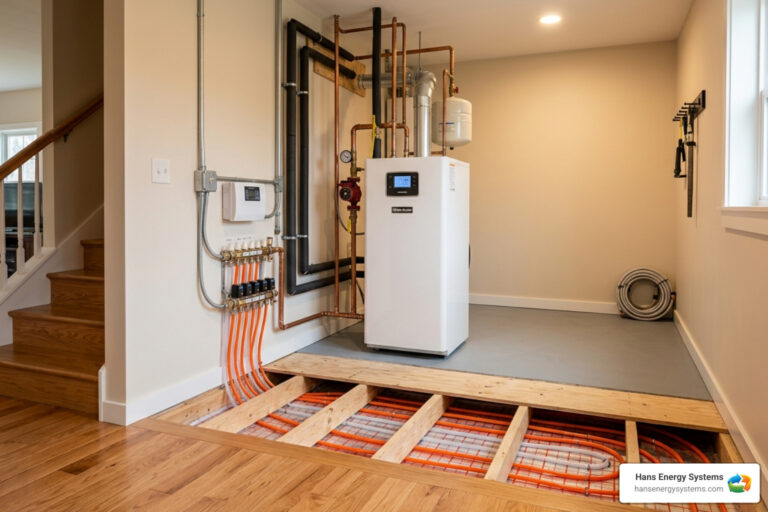
In a modern radiant heating systems setup, we use what is called a hydronic system. This involves a high-efficiency condensing boiler that circulates warm water through flexible PEX (cross-linked polyethylene) tubing. This tubing is usually installed beneath your floors, though it can also be tucked inside walls or ceilings.
The magic happens through a process called thermal mass. When the warm water flows through the PEX tubing, it heats the floor material itself—whether that is a concrete slab, tile, or specialized subfloor panels. This material acts like a “heat battery,” holding onto the warmth and slowly releasing it into the room. This is the ultimate form of heat transfer: radiation. Just like the sun warms your skin on a cool day in Del Mar, radiant floors warm the objects and people in a room directly, rather than just swirling warm air around.
Key Boiler and Radiant Heating Benefits for Modern Homes
When we talk to families in Poway or Rancho Bernardo about why they love their radiant systems, the conversation usually starts with one word: comfort. Imagine waking up on a chilly January morning and stepping onto a floor that feels like a warm bath instead of a frozen lake. That is the daily reality of these systems.
Because the heat starts at floor level and rises slowly, the warmth stays where you actually live—within the first six feet of the room. In traditional systems, the hot air immediately rushes to the ceiling, leaving your toes cold while the top of the room is sweltering. With a boiler-powered system, you get consistent warmth from corner to corner.
Another one of the hidden boiler and radiant heating benefits is furniture placement flexibility. Since there are no floor vents or wall registers to worry about, you can place your sofa, rug, or bookshelf anywhere you like. Your interior design is no longer dictated by where the HVAC installer decided to cut a hole in the floor.
Superior Energy Efficiency and Boiler and Radiant Heating Benefits
Efficiency is where the boiler and radiant combination really shines. Traditional forced-air systems are notorious for “duct loss.” The U.S. Department of Energy estimates that the average homeowner loses 20% to 30% of their heating energy through leaks, gaps, and poor insulation in the ductwork. Radiant systems eliminate this problem entirely because they don’t use ducts.
Furthermore, water is a much more efficient medium for moving heat than air. It holds heat better and stays warm longer. This allows our Hvac/Poway Ca/Heating Service team to set up systems that operate at much lower water temperatures. While a traditional radiator might need water at 160°F, a radiant floor often only needs water between 85°F and 140°F.
Modern modulating condensing boilers can reach up to 95% AFUE (Annual Fuel Utilization Efficiency). Because they can adjust their output to match the exact heating load of your home, they avoid the constant “on-off” cycling that wears out furnaces and wastes fuel. Over time, these energy savings can lead to 15% to 30% lower annual heating bills compared to forced-air alternatives.
Healthier Air Quality and Boiler and Radiant Heating Benefits
If anyone in your household suffers from allergies or asthma, this might be the most important section of this guide. Forced-air systems act like a giant fan for your home’s dust. They suck up pet dander, pollen, and dust mites, and then blast them back into your living space. Even with high-quality filters, some of those particles always make it through.
One of the most significant boiler and radiant heating benefits is that there is no air movement involved in the heating process. No blowers mean no dust clouds. It is a naturally “allergy-safe” environment. Additionally, because there are no high-velocity fans, the system is virtually silent. You won’t hear the “whoosh and rattle” of a furnace kicking on in the middle of the night.
Radiant heat also helps maintain a natural humidity balance. Forced-air systems tend to strip moisture from the air, leading to dry skin, scratchy throats, and static electricity shocks. Since radiant systems don’t blow dry air across your skin, you stay comfortable at lower temperatures, which further protects your respiratory health. If you’ve noticed Signs You Need Heating Repair In Poway like excessive dust or dry air, switching to a radiant system could be a life-changer.
Comparing Radiant Comfort to Traditional Forced-Air Systems
To truly appreciate the difference, let’s look at how these systems stack up side-by-side.
| Feature | Radiant Boiler System | Forced-Air Furnace |
|---|---|---|
| Heat Distribution | Uniform, floor-to-ceiling | Uneven, air stratifies at ceiling |
| Energy Loss | Minimal (no ducts) | 20-30% through duct leaks |
| Noise Level | Silent operation | Audible blower and duct noise |
| Air Quality | Excellent (no dust circulation) | Moderate (circulates allergens) |
| Lifespan | 20-30+ years | 15-20 years |
| Response Time | Slower (high thermal mass) | Fast (instant air movement) |
While forced-air systems are common in San Diego because they can share ductwork with air conditioners, they often suffer from “convective drafts.” This is that feeling of being warm one minute and chilly the next as the system cycles. Radiant systems focus on the “mean radiant temperature” of the room. By warming the surfaces around you, they make you feel cozy even if the air temperature is a few degrees lower.
If your current system is struggling with cold spots, you might be looking for Hvac/Poway Ca/Heating Repair. However, if you are tired of the noise and the dust, it might be time to consider the long-term comfort of a hydronic upgrade.
Longevity and Maintenance of Hydronic Systems
We often get asked about the durability of these systems. The good news is that boilers are built to last. While a standard heat pump might last 10–15 years and a furnace 15–20, a well-maintained boiler can easily provide 25 to 30 years of service. In fact, when operated at the lower temperatures required for radiant floors, some boiler components can last even longer.
The PEX tubing used in the floors is incredibly resilient. It is designed to be buried in concrete or tucked under subfloors for 50 years or more without needing heating repair. Because there are fewer moving parts—mainly just a circulator pump and the boiler itself—there is less that can go wrong compared to the complex blowers and motors in a forced-air unit.
Maintenance is straightforward but essential. We recommend annual inspections to check the water chemistry, ensure the pumps are running smoothly, and verify that the manifold (the “brain” that distributes water to different rooms) is balanced correctly. If you are considering Heating Replacement In Poway, it is worth noting that radiant systems are an investment in the long-term value and structural integrity of your home.
Frequently Asked Questions about Boiler Radiant Heating
Is radiant floor heating suitable for retrofitting existing homes?
Yes, but the approach differs from new construction. In a new build, we usually install the tubing in a concrete slab (a “wet” installation). For existing homes, we often use “dry” installations. This involves thin subfloor panels with pre-cut grooves for the tubing that can be installed right over your existing subfloor. It’s a popular choice during a heating replacement project when homeowners are also updating their flooring. Another option for older homes with existing boilers is to upgrade old, clunky radiators to modern, high-efficiency versions or sleek baseboard hydronic units.
How long do boiler-powered radiant systems typically last?
As mentioned, these systems are the marathon runners of the HVAC world. The boiler unit itself typically lasts 15 to 30 years. The circulator pumps may need replacement every 10–15 years, but the actual radiant loops (the pipes in your floor) are virtually permanent, often rated for 50+ years. Regular heating repair and annual check-ups are the key to hitting those high numbers. Compared to other systems, the “total cost of ownership” is often lower because you aren’t replacing the entire system every decade.
Does radiant heating work well in mild climates like San Diego?
It works exceptionally well! While we don’t have the freezing winters of the Midwest, San Diego’s coastal dampness and desert-fringe chilly nights make the consistent, “bone-deep” warmth of radiant heat very appealing. Because our heating season is shorter, the seasonal efficiency of a boiler is excellent. It provides luxury comfort in bathrooms and kitchens where tile floors can feel icy even in a Mediterranean climate. Our Hvac/Poway Ca/Heating Service team finds that many local homeowners appreciate the humidity control and silent operation during our quiet, cool evenings.
Conclusion
At Hans Energy Systems, we believe that your home should be your sanctuary. The boiler and radiant heating benefits—from the silence of the operation to the incredible energy savings—make it one of the best investments you can make for your long-term comfort. Whether you are building a new custom home in Rancho Santa Fe or looking to upgrade your existing residence in Poway, we are here to help you navigate hydronic heating.
Our commitment to reliability and exceptional customer service means we don’t just install a system; we ensure it provides peak performance for decades to come. If you’re ready to experience a level of comfort that forced-air systems simply can’t match, explore our radiant heating systems options today. Let us help you bring the efficiency and warmth of a modern boiler system into your San Diego home.