
What Every San Diego Homeowner Should Know About Radiant Heating
How does a radiant heating system work is one of the most common questions homeowners ask when exploring smarter, more efficient alternatives to forced-air heating. Here is the short answer:
A radiant heating system warms your home by transferring heat directly to objects, floors, and people through infrared radiation — rather than blowing heated air through ducts.
Here is how it works, step by step:
- A heat source (boiler, heat pump, or electric element) generates heat energy
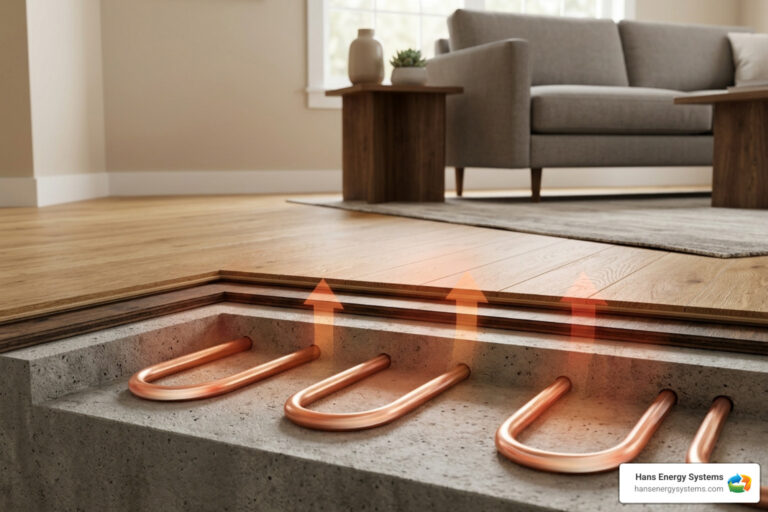
- That energy travels through tubing or cables installed beneath your floor, or inside walls and ceilings
- The heated surface emits infrared radiation outward into the room
- Objects, furniture, and people absorb that warmth directly
- Natural air circulation (convection) then spreads warmth evenly through the space
Unlike forced-air systems, there are no ducts pushing hot air up to the ceiling where it goes to waste. The heat stays low — right where you actually live.
That difference matters more than most people realize. Radiant systems can reduce energy use by up to 40% compared to traditional forced-air setups, and they allow you to feel comfortable at thermostat settings up to 4°F lower than you would need with a conventional furnace. For San Diego homeowners already dealing with high utility bills, that kind of efficiency is hard to ignore.

The Science of Comfort: How Does a Radiant Heating System Work?
To understand the “magic” of radiant heat, we have to look at the physics of how we feel warmth. Most of us in the San Diego area are used to forced-air furnaces. These systems work by heating air and blowing it into a room. The problem? Air is a terrible conductor of heat. It rises quickly to the ceiling, leaving your feet cold while the top of the room is sweltering.
Radiant heating operates on the principle of infrared energy. Think about standing outside on a clear winter day in Poway. Even if the air is cool, you feel the sun’s warmth on your skin. That is radiation. A radiant heating system turns your entire floor (or wall) into a low-temperature radiator that mimics the sun.
Electromagnetic Waves and Thermal Mass
The system sends electromagnetic waves through the room. These waves don’t “heat” the air they pass through; instead, they only turn into heat when they strike a solid object—like your sofa, your pet, or your own body. This is known as sensible heat. Because the objects in the room stay warm, they eventually begin to warm the air around them through gentle convection, but the primary source of comfort is that direct, object-based warming.
Furthermore, these systems utilize thermal mass. When we install tubing in a concrete slab or beneath a tile floor, that material stores heat energy and releases it slowly over time. This prevents the “vicious cycle” of forced-air systems where the heater kicks on and off constantly. With radiant heat, the energy dissipation is steady and silent.
Hydronic vs. Electric: Two Paths to a Warm Home
When deciding on a system for your home, you will generally choose between two main types: hydronic (water-based) and electric (wire-based). Both are excellent, but they serve different needs depending on whether you are doing a full-home build in Carlsbad or a small bathroom remodel in Del Mar.
| Feature | Hydronic Radiant Heat | Electric Radiant Heat |
|---|---|---|
| Heat Carrier | Hot water in PEX tubing | Electric resistance cables |
| Best For | Whole-house heating | Single rooms / additions |
| Efficiency | Extremely high (30-40% savings) | High, but higher fuel cost |
| Installation | Complex (Boiler/Manifolds) | Simpler (Mats/Cables) |
| Longevity | 40-50 years | 30-40 years |
How does a radiant heating system work with water?
Hydronic systems are the gold standard for efficiency. They use a closed-loop system where a heat source—usually a high-efficiency boiler or an air-to-water heat pump—warms water to a relatively low temperature (typically between 110°F and 120°F).
This water is then circulated through PEX tubing (cross-linked polyethylene) embedded in the floor. A distribution manifold acts as the “brain” of the system, directing the right amount of hot water to different “zones” or rooms in your house. This allows for precise zoning; you can keep your bedroom cool while keeping the living room cozy. Because water can carry significantly more energy than air (a 3/4-inch water pipe can transfer the same heat as a large 14×8 inch duct!), the circulator pumps use 75-90% less electricity than a standard furnace fan.
How does a radiant heating system work with electricity?
Electric radiant heating uses resistance wires, often made of a nichrome alloy, woven into mats or cables. When electricity flows through these wires, they encounter resistance, which generates heat.
These systems are incredibly thin, making them perfect for retrofitting existing homes where you don’t want to raise the floor height significantly. They are often installed in a layer of thin-set mortar directly under tile. While electricity is generally more expensive than the fuel used for hydronic systems, electric mats are perfect for localized heating—like warming up a chilly bathroom floor in Encinitas before you jump in the shower.
Installation Methods: Wet vs. Dry Systems
How we install the system depends largely on your home’s structure. We categorize these into “wet” and “dry” installations.
Wet Installations
This is the traditional method, often used in new construction in areas like Scripps Ranch. We lay the PEX tubing or electric cables down and then pour a “wet” material over them—typically a thick concrete slab or a thinner layer of Gyp-Crete. The concrete acts as a massive thermal battery, holding onto heat for 8 to 10 hours even after the system is turned off.
Dry Installations
As we move into May 2026, dry installations are becoming the preferred choice for many San Diego retrofits. Instead of heavy concrete, we use structural panels or subfloor sandwiches that have pre-cut grooves for the tubing.
- Aluminum Heat Diffusers: To make up for the lack of concrete mass, these systems use aluminum plates to spread the heat evenly across the floor surface.
- Joist-Space Heating: In some cases, we can “staple up” the tubing between the floor joists from the crawlspace or basement.
- Reflective Insulation: This is crucial in dry systems to ensure the heat is reflected upward into your living space rather than being lost to the ground or the floor below.
Maximizing Efficiency and Flooring Compatibility
A radiant heating system is only as good as the floor covering on top of it. Some materials are “conductors” (they let heat through easily), while others are “insulators” (they block the heat).
- Ceramic and Stone Tile: These are the absolute best materials. They have high thermal conductivity, meaning they heat up quickly and stay warm.
- Polished Concrete: Excellent for modern homes; it provides a sleek look and incredible heat retention.
- Engineered Hardwood: A great choice, but we recommend keeping boards under 6 inches wide to prevent cupping.
- Laminate and Vinyl: Most modern luxury vinyl planks (LVP) are compatible, provided the system doesn’t exceed a certain temperature (usually around 80°F-85°F).
- Carpet: You can use carpet, but it acts as an insulator. We recommend a thin carpet with a dense, low-profile pad to keep the total R-value below 2.5.
Beyond comfort, one of the biggest benefits we see in San Diego homes is the allergy benefit. Because there are no fans blowing air, there is no dust, pollen, or pet dander being whipped through your house. It is a silent, clean way to breathe easier.
Maintenance and Longevity of Modern Systems
One of the most attractive parts of radiant heat is its durability. While a standard furnace might last 15 to 20 years, a hydronic radiant system can easily last 40 to 50 years. The PEX tubing itself is designed to be leak-free and non-corrosive, often outlasting the flooring it sits under.
However, “low maintenance” doesn’t mean “no maintenance.” To keep your system running at peak efficiency in Oceanside or Chula Vista, we recommend:
- Annual Boiler/Heat Pump Inspections: Just like a car engine, your heat source needs a tune-up to ensure it’s burning fuel cleanly.
- Pressure Gauge Checks: A quick look at the system’s pressure gauge can tell you if there is a leak. A reading of zero is a sign that the system needs professional attention.
- ECM Motor Service: Modern circulator pumps use Electronically Commutated Motors (ECM) which are highly efficient but should be checked for proper flow.
- Corrosion Prevention: Using PEX with an oxygen barrier prevents air from entering the system and rusting any metal components like the boiler or valves.
Frequently Asked Questions about Radiant Heat
Can radiant heating be installed in an existing home?
Absolutely. While “wet” concrete installs are harder to retrofit, “dry” systems using low-profile panels or joist-space heating are perfect for existing homes in San Marcos or La Jolla. We can often install these systems without significantly altering your existing floor heights.
Is radiant heating more efficient than forced-air systems?
Yes. Radiant systems eliminate “duct loss”—the energy lost as heated air travels through leaky or uninsulated ducts. Additionally, because water is a superior heat conductor, hydronic systems can reduce fuel consumption by up to 30% per year.
What type of flooring works best with radiant heat?
Ceramic tile, stone, and concrete are the champions of radiant heat because they conduct and store heat better than any other material. However, with the right installation methods, you can successfully use hardwood, vinyl, and even thin carpeting.
Conclusion
At Hans Energy Systems, we believe that your home should be your sanctuary. Whether you are in Poway, Escondido, or Downtown San Diego, a radiant heating system offers a level of comfort that traditional HVAC simply cannot match. It is silent, invisible, and incredibly efficient.
If you are tired of cold toes and high energy bills, it might be time to see how does a radiant heating system work for your specific floor plan. Our team specializes in reliable, quick installations and exceptional customer service throughout the San Diego area. From solar-integrated hydronic systems to electric bathroom retrofits, we have the expertise to bring the “magic” of radiant heat into your home. Contact us today to discuss how we can make your May 2026 home comfort goals a reality.