
Understanding What It Means When Your AC Circuit Breaker Keeps Tripping
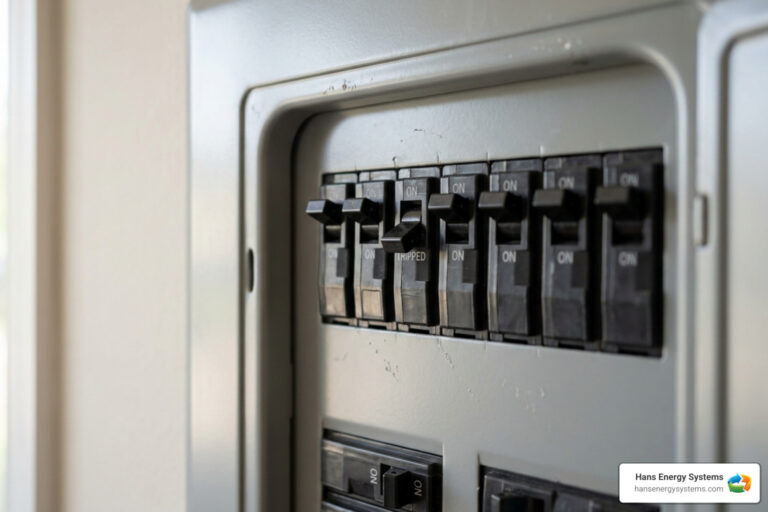
When you are standing in your garage in May 2026, staring at your electrical panel while the San Diego sun beats down outside, it is easy to feel frustrated. However, understanding that your circuit breaker is an overcurrent protection device changes the perspective. It isn’t a “broken” part; it is a safety switch designed to protect your home from catastrophic failure.
Every circuit in your home is rated for a specific amount of electricity, measured in amps. Your air conditioner typically sits on a dedicated circuit with a double-pole breaker, which handles the high voltage required to run the compressor and fan motors. If the system tries to pull more amperage than that breaker is rated for—say, 30 amps on a 20-amp circuit—the breaker flips to the “OFF” position. This prevents the wire insulation from melting due to heat buildup. Without this circuit breaker tripped response, that excess heat could easily lead to an electrical surge or a house fire. Essentially, the breaker is the “bouncer” of your home’s electrical system, kicking out the power before it can cause permanent damage to your expensive HVAC equipment or your property.
Common Mechanical Culprits Behind a Tripping Breaker
You might wonder how a mechanical part like a fan or a filter can cause an electrical problem. In the HVAC world, mechanical strain equals electrical gain. When your system has to fight to do its job, it “guzzles” electricity. Performing a regular ac system check is the best way to ensure these mechanical components aren’t secretly sabotaging your electrical panel.
How a Dirty Filter Causes Your AC Circuit Breaker to Keep Tripping
It sounds almost too simple to be true, but a clogged air filter is one of the most frequent reasons for a trip. Think of it like trying to run a marathon while breathing through a straw. A dirty filter creates high static pressure, which means the blower motor has to spin much harder and longer to pull air through the house.
This motor overexertion leads to a spike in energy consumption. Furthermore, restricted airflow causes the evaporator coils to drop below freezing. Once they are a block of ice, the system stays on indefinitely, trying to cool a house it can no longer reach. This continuous operation leads to overheating, and eventually, the breaker steps in to stop the madness. This is one of the most common ac problems in poway and solutions we see during the first heatwave of the year.
Dirty Condenser Coils and Outdoor Unit Obstructions
Your outdoor unit’s job is to release the heat it gathered from inside your home. If the condenser coils are coated in San Diego dust, pet hair, or grass clippings, that dirt acts like a thermal blanket. Instead of releasing heat, the unit traps it, causing the refrigerant to stay much hotter than intended.
When the heat can’t escape, the compressor has to work at much higher pressures to move the refrigerant. High pressure equals high amperage. If you haven’t had a professional ac service recently, your outdoor fan might be struggling to pull air through those “blanketed” coils, leading to a thermal overload trip. Keeping at least two feet of clearance around the unit and ensuring the coils are clean is vital for proper heat exchange. Even a thin layer of grime can reduce efficiency significantly, forcing the electrical components to draw more current just to maintain the same cooling output.
Electrical Failures and Component Wear
Sometimes the issue isn’t about dirt or airflow; it’s about the electrical components themselves reaching the end of their lifespan.
| Issue | What Happens | Urgency |
|---|---|---|
| Short Circuit | Electricity bypasses its path (wire to wire) | Critical – Immediate Trip |
| Ground Fault | Electricity hits the metal housing (wire to ground) | Critical – Immediate Trip |
| Failing Capacitor | Motor struggles to start, drawing huge current | High – Delayed or Immediate Trip |
| Loose Wiring | Arcing and heat buildup at connections | High – Intermittent Trip |
Why Your AC Circuit Breaker Keeps Tripping Immediately Upon Startup
If you flip the breaker and it snaps back to the “OFF” position the second the outdoor unit tries to kick on, you likely have a “dead short” or a grounded compressor. This is a critical situation. A grounded compressor occurs when the internal motor windings break down and touch the side of the metal housing. This creates a direct path to the ground, causing a massive surge of “Locked Rotor Amps” (LRA).
In some cases, an aging compressor just needs a little help. We often install a “hard start kit,” which is essentially a high-powered capacitor that provides the extra torque needed to get the motor spinning without drawing enough current to snap the breaker. However, if the compressor is truly grounded, it usually requires a professional ac repair or a full unit replacement.
Failing Capacitors and Fan Motors
The capacitor is like a small battery that gives your compressor and fan motor the electrical “kick” they need to start. When a capacitor begins to fail, it can’t provide that startup torque. The motor will sit there and hum or buzz, trying to start but failing, which draws a huge amount of voltage.
Eventually, the heat builds up so much that the breaker trips to protect the motor. If you hear a clicking or humming sound followed by a trip, it’s a classic sign of component wear. Our team providing hvac service in poway ca often finds that replacing a simple capacitor can save a homeowner from the much larger expense of a burnt-out motor.
Pitted Contactors and Electrical Arcing
Another common electrical failure involves the contactor, which is the relay that sends power to the compressor and fan. Over time, the silver coating on the contactor points can wear down or “pit” due to the high-voltage arcs that occur every time the system starts. If the contactor is pitted or charred, it creates electrical resistance. This resistance generates heat and can cause the voltage to drop, forcing the amperage to spike to compensate. This is a subtle issue that often leads to intermittent tripping that seems to have no rhyme or reason.
Safe Troubleshooting Steps for Homeowners
While we never recommend that homeowners poke around inside their electrical panel or the outdoor unit’s high-voltage cabinet, there are a few safe steps you can take if you are in Poway or the surrounding San Diego area.
- Check the Filter: If it’s gray and fuzzy, replace it immediately.
- Clear the Area: Ensure no bushes, trash cans, or stray tennis balls are blocking the outdoor unit.
- The “One-Time” Reset: You can try to reset the breaker exactly once. Turn the AC off at the thermostat first. Go to the panel, flip the breaker all the way to “OFF” until it clicks, then back to “ON.”
- The 30-Minute Rule: Wait 30 minutes before turning the thermostat back to “Cool.” This allows the internal pressures in the AC system to equalize and gives the compressor time to cool down.
- Observe: If it trips again immediately or within the hour, stop. Do not try a third time. It’s time to call for ac repair poway ca to prevent a fire hazard.
- Check the Thermostat: Ensure your thermostat isn’t rapidly cycling the system on and off. If the batteries are low or the settings are incorrect, it could be sending “start” signals too quickly. This “short cycling” doesn’t give the compressor enough time to equalize pressures, leading to a massive amperage draw on restart and a tripped breaker.
Frequently Asked Questions
Is it safe to keep resetting a tripped AC breaker?
No, it is not. A circuit breaker is a warning. Resetting it repeatedly is like ignoring a smoke alarm. Each time the breaker trips, it is because the wires are getting dangerously hot or there is a short circuit. Doing this multiple times can cause repetitive stress to the compressor and can eventually lead to the wire insulation melting completely, which is a major fire risk.
Can hot weather cause my breaker to trip?
Yes, but usually only if there is an underlying weakness. On record-breaking hot days in San Diego, your AC runs continuously. High ambient temperatures increase electrical resistance in the wires. If you have a loose connection in your panel or a weak breaker, the extreme heat of the afternoon can be the “last straw” that pushes the amperage draw over the limit.
When should I call a professional for a tripping breaker?
You should call us immediately if you notice any of the following:
- An immediate trip the moment the AC starts.
- A burning smell coming from the vents or the outdoor unit.
- Visible scorch marks or “soot” on the circuit breaker or wires.
- A buzzing or grinding noise coming from the electrical panel or the AC.
- The breaker feels hot to the touch.
Can the circuit breaker itself be the problem?
Yes, circuit breakers can weaken over time. Every time a breaker trips, the internal spring mechanism and the bi-metal strip inside undergo mechanical stress. If a breaker has tripped dozens of times over several years, it may become “weak” and begin to trip at a lower amperage than its original rating. In these cases, the AC system might be perfectly fine, but the hardware in your electrical panel needs to be replaced by a professional. This is why we recommend against repeated resets; you aren’t just risking the AC, you’re wearing out the safety device itself.
Conclusion
At Hans Energy Systems, we know that a tripping breaker is more than just an inconvenience; it is a disruption to your family’s comfort and safety. Whether you are in Poway, Escondido, or Downtown San Diego, our team is dedicated to providing reliable, quick, and expert solutions. We pride ourselves on exceptional customer service and the technical expertise to tell the difference between a simple dirty coil and a complex electrical short.
Don’t stay in the heat and don’t take risks with your home’s wiring. A tripping breaker is often a sign that internal components are failing and require professional intervention to prevent further damage. For expert ac repair, we are here to help you get your cool back safely. Our technicians are ready to diagnose the root cause and ensure your home remains a sanctuary against the San Diego heat.