
Why Boiler and Radiant System Maintenance Tips Matter for San Diego Homeowners
Boiler and radiant system maintenance tips every homeowner should know right away:
- Check system pressure monthly – keep it between 12-21 PSI during heating season
- Bleed air from the system if you notice cold spots or uneven floor warmth
- Inspect the boiler visually for leaks, rust, or corrosion at the start of each season
- Test the pressure relief valve annually to confirm it opens and closes cleanly
- Replace thermostat batteries once a year and check calibration
- Schedule a professional tune-up at least once a year, ideally in early fall
- Flush the hydronic system every 3-5 years to remove mineral buildup and add corrosion inhibitors
Your radiant heating system works quietly beneath your floors, delivering steady, even warmth without blowing dust around the house. Most homeowners don’t think about it until something goes wrong — a cold patch on the floor, a strange noise from the boiler room, or a pressure gauge that’s drifted out of range.
The good news is that most problems are completely preventable. Boilers that receive regular maintenance can last 20-30 years. Neglected systems often fail in half that time. And over 50% of HVAC service calls trace back to one root cause: skipped maintenance.
Whether your system has been running for two years or twenty, this guide walks you through exactly what to check, when to check it, and when to call a professional.
How Does My Radiant Heating System Work with a Boiler?
If you are living in a home in Poway or Rancho Bernardo, you likely appreciate the silent, “invisible” comfort of radiant heat. Unlike forced-air systems that blow hot air through vents, a radiant system turns your entire floor into a giant radiator.
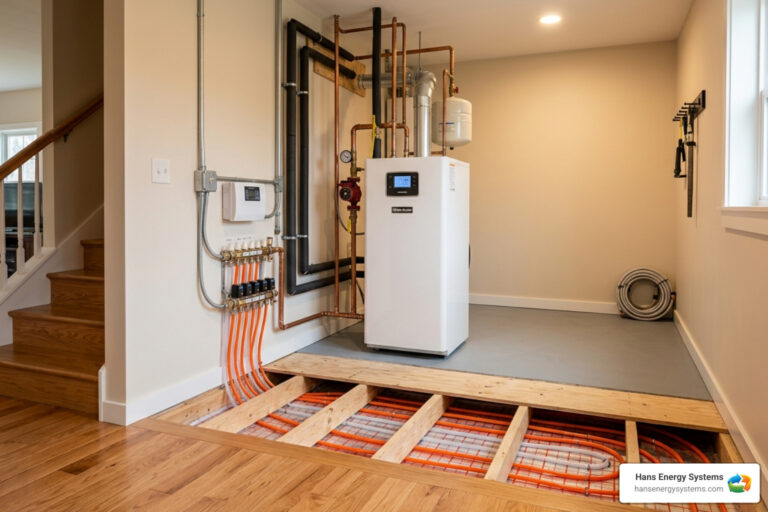
At the heart of this setup is the boiler. Think of the boiler as the engine and the radiant floor as the delivery network. In a hydronic (water-based) system, the boiler heats water to a specific temperature—usually between 75°F and 85°F for floor surfaces—and a pump then pushes that warm water through a network of flexible PEX tubing hidden beneath your flooring.
This is a closed-loop system, meaning the water stays inside the pipes, circulating back to the boiler to be reheated. Because water is a much better conductor of heat than air, these systems are incredibly efficient. However, because it is a closed loop, maintaining the integrity of that loop is the secret to a long-lasting system. You can learn more about the specifics of these setups on our Radiant Heating Systems page.
Understanding the Boiler and Radiant System Connection
The magic happens at the manifold. This is the hub where the main hot water line from the boiler splits into several smaller “loops” that go to different rooms or “zones.”
- The Heat Source: The boiler (gas, electric, or even solar-thermal) heats the water.
- The Circulation Pump: This small mechanical motor provides the force needed to move water through hundreds of feet of tubing.
- PEX Tubing: High-tech, oxygen-barrier plastic piping that carries the heat.
- Thermal Mass: This is your floor (concrete, wood, or tile) which absorbs the heat from the pipes and slowly releases it into the room.
Essential Boiler and Radiant System Maintenance Tips for Homeowners
Maintenance isn’t just about fixing things when they break; it’s about preserving efficiency. Statistics show that regular maintenance can improve energy efficiency by up to 15% and reduce the risk of unexpected breakdowns by 50%. In a coastal or inland San Diego climate, where systems might sit idle for months, a “startup” check in May 2026 is vital to ensure everything is ready for the cooler evenings.
Start with a visual inspection. Walk around your boiler and look at the base. Are there puddles? Do you see white, crusty mineral deposits on the pipe joints? These are early signs of leaks. Because 90% of radiant leaks in the floor are “invisible” (leaking downward into the slab), monitoring the visible parts of the system is your best defense. For more detailed advice, check out our guide on Hvac/Poway Ca/Hvac Maintenance/.
DIY Boiler and Radiant System Maintenance Tips for Pressure Control
Your system needs the right amount of pressure to move water effectively. If the pressure is too low, the water won’t reach the furthest rooms. If it’s too high, you risk damaging the boiler or blowing a seal.
- The Magic Number: For most residential hydronic systems, you want to see a reading between 12 and 21 PSI (pounds per square inch). Some systems may sit closer to 12-15 PSI when cold.
- The Expansion Tank: This looks like a small propane tank or a large ball attached to your piping. It handles the “expansion” of water as it heats up. If you tap it and it sounds completely solid (full of water), the internal bladder may have failed, leading to pressure spikes.
- The Relief Valve: This is a safety device. Once a year, you can briefly lift the handle to ensure it discharges water. Warning: The water may be hot! Ensure the discharge pipe is pointed safely toward a drain or bucket.
Troubleshooting with Boiler and Radiant System Maintenance Tips
Is your system trying to tell you something? Listen to the sounds it makes.
- Kettling: A high-pitched whistling or banging sound. This usually means there is lime or scale buildup on the heat exchanger, much like a tea kettle.
- Gurgling: This almost always means there is air trapped in the lines.
- Cold Spots: If one part of your floor is warm and another is cold, you likely have an air pocket or a balancing issue at the manifold.
- Thermostat Issues: Dust can settle inside thermostat covers, interfering with sensors. Give them a gentle puff of air or a light dusting annually, and always replace the batteries.
I’m Noticing Cold Spots on My Floor. How Do I Bleed the System?
Air is the enemy of a hydronic system. When air bubbles get trapped in the PEX tubing, they act like a dam, stopping the hot water from flowing. This results in those frustrating cold spots. “Bleeding” the system is the process of letting that air out.
If you have radiators, you’ll use a radiator key. If you have a radiant floor, you’ll usually find air bleed valves on the manifold.
Steps to Remove Trapped Air
- Turn off the system: You don’t want the pump running while you do this, as it will just keep the air bubbles moving.
- Locate the bleed valve: On a manifold, these are usually at the very top.
- Open slowly: Use your key or a screwdriver. You will hear a hissing sound—that’s the air escaping.
- Wait for water: Once a steady stream of water (no bubbles or “spitting”) comes out, close the valve.
- Check the pressure: Bleeding air often causes the system pressure to drop. You may need to add a little water to get back to that 12-21 PSI range.
| Feature | Manual Air Vents | Automatic Air Vents |
|---|---|---|
| Maintenance | Requires homeowner to manually bleed | Bleeds air automatically |
| Reliability | Very high; rarely leaks | Can eventually leak or clog with minerals |
| Best For | Older systems and radiators | Modern manifolds and high points |
If you’re unsure about the process, our Heating Repair Complete Guide/ provides further context on system repairs.
When Should I Schedule Professional Heating Service in Poway?
While DIY checks are great for day-to-day peace of mind, there are technical tasks that require a professional touch. We recommend an annual professional tune-up every fall to ensure your home in San Diego or El Cajon stays warm all winter long. You can see the benefits of regular professional care on our Hvac Maintenance Plan Poway Ca/ page.
What a Professional Tune-Up Includes
When we come out for a service call, we don’t just look at the pressure. A comprehensive tune-up includes:
- Combustion Analysis: We check the gas-to-oxygen ratio to ensure the boiler is burning fuel cleanly.
- Heat Exchanger Inspection: We use specialized tools to look for cracks or soot buildup that could lead to carbon monoxide leaks.
- Flame Sensor Cleaning: A dirty sensor can cause the boiler to “short cycle” (turn on and off rapidly).
- Pump Lubrication: Some older pumps require a few drops of 10-30W non-detergent oil to keep the bearings from seizing.
- Flue and Venting: We ensure that the exhaust pipe is clear of bird nests or debris.
Long-Term Care: Flushing and Corrosion Inhibitors
Over time, the water inside your pipes can turn into a “sludge” made of microscopic rust and mineral deposits. This sludge makes the pump work harder and reduces heat transfer.
We recommend a professional system flush every 3 to 5 years. During this process, we drain the old water and refill the system with fresh water and a corrosion inhibitor. This chemical treatment protects the metal components of your boiler and pump from the inside out, helping your system reach that 30-year lifespan goal.
Safety First: Inspecting Your Boiler for Leaks and Carbon Monoxide
Safety is our top priority at Hans Energy Systems. Because boilers use combustion to create heat, there is always a small risk of carbon monoxide (CO) if the system isn’t venting properly.
Critical Safety Checks for May 2026
- The Flame Test: Peek into the burner window. The flame should be a steady, crisp blue. If you see a flickering yellow or orange flame, it indicates incomplete combustion. This is a red flag—turn off the system and call us for Hvac/Poway Ca/Heating Service/ immediately.
- Carbon Monoxide Detectors: Ensure you have CO detectors on every level of your home, especially near the boiler room and sleeping areas. Replace the batteries in these at the same time you check your thermostat.
- Clear the Area: Don’t store boxes, paint cans, or cleaning chemicals near your boiler. The system needs “combustion air” to breathe, and flammable vapors are a major fire hazard.
- Draft Hood: Ensure the exhaust vent (the “chimney” for the boiler) is securely attached and shows no signs of heavy rusting or holes.
Frequently Asked Questions about Boiler and Radiant Maintenance
What is the ideal pressure for a hydronic radiant system?
For most residential systems in the San Diego area, the ideal pressure is between 12 and 21 PSI. If your pressure drops below 10 PSI, your boiler may shut down as a safety precaution (low-water cutoff). If it rises above 30 PSI, the relief valve will likely start dripping to protect the tank.
How often should I flush my radiant heating loops?
A full professional flush and refill with corrosion inhibitors is generally recommended every 3 to 5 years. However, if you live in an area with particularly hard water, you might benefit from more frequent checks of the water’s pH levels (which should ideally be between 8.5 and 10.5).
Why is my boiler making a whistling or banging noise?
This is often called “kettling.” It’s usually caused by mineral deposits (scale) building up on the heat exchanger. The water gets trapped under the scale, turns to steam, and “pops,” creating a banging sound. A professional cleaning or a system flush can usually resolve this.
Conclusion
A well-maintained boiler and radiant system is a “set it and forget it” luxury that can provide decades of comfort for your family. By following these boiler and radiant system maintenance tips, you are protecting your investment and ensuring your home remains a cozy sanctuary, whether you’re in Poway, Carlsbad, or Downtown San Diego.
At Hans Energy Systems, we pride ourselves on reliability and exceptional customer service. If you’ve noticed a drop in pressure, a cold spot on your floor, or it’s simply been a few years since your last professional inspection, don’t wait for a total breakdown.
Ready to ensure your system is in peak condition? Visit our Radiant Heating Systems page to see how we can help you keep the heat flowing smoothly all year long!