
What to Expect During Air Conditioner Installation (And How to Prepare)
What to expect during air conditioner installation comes down to a clear, structured process that most San Diego homeowners can plan around in a single day.
Here is a quick overview of what happens:
- Site assessment and permit verification – The crew reviews your home’s layout, confirms sizing, and checks that permits are in order.
- Old system removal – Technicians safely recover refrigerant per EPA regulations and disconnect the old unit.
- Indoor unit installation – The evaporator coil and air handler are set and aligned for proper airflow.
- Outdoor condenser placement – The new unit is set on a level pad with correct clearances.
- Refrigerant line and electrical connections – Copper lines are brazed, electrical is wired to code, and a condensate drain is routed.
- System evacuation and charging – A deep vacuum is pulled to below 500 microns before refrigerant is added.
- Testing and commissioning – Technicians verify temperature split, airflow, and thermostat communication.
- Homeowner walkthrough – You learn how to operate your new system, change filters, and register your warranty.
Most standard installations in San Diego take one full day (roughly 7 to 10 hours). Complex projects involving ductwork changes or electrical upgrades can extend to two or three days.
Installing a new air conditioner is one of the most impactful home upgrades you can make — not just for comfort, but for energy efficiency and long-term savings. According to the U.S. Department of Energy, a properly installed system can reduce cooling costs by up to 30% compared to an aging, inefficient unit. But the key word is properly. As one HVAC professional puts it, a rushed or incomplete installation can turn a high-quality unit into a comfort-robbing liability before its time.
For homeowners in San Diego’s inland communities — where summer heat can push temperatures well above 90°F — a reliable, correctly installed AC system is not a luxury. It is a necessity. The good news is that when you know what to expect, the process is far less stressful than most people assume.

Pre-Installation: How to Prepare Your Home for the Big Day
Preparation is the secret to a smooth installation day. While our team at Hans Energy Systems handles the heavy lifting, a little “homework” on your part can significantly speed up the process and ensure everyone stays safe.
The journey actually begins before the installation crew arrives. A professional site assessment is the first critical step. During this visit, we perform a Manual J load calculation. Unlike the old-school “rule of thumb” (which usually resulted in oversized, inefficient units), a Manual J takes into account your home’s square footage, insulation quality, window orientation, and even the local San Diego climate. This ensures your new system is sized perfectly — not so small that it struggles, and not so large that it “short cycles,” wasting energy and wearing out parts prematurely.
Clearing the Way
On the morning of the install, we recommend clearing a six-foot path around the outdoor condenser unit. Trim back any shrubs, weeds, or rogue vines. Modern air conditioners are often 20-50% larger in height and width than units from 20 years ago to accommodate larger, more efficient coils. That old corner where your unit used to hide might be a tight squeeze now!
Inside the home, please clear a path to your furnace or air handler (often located in a closet, attic, or garage). If we have to move your holiday decorations or heavy storage bins to reach the equipment, it eats into the installation time.
Safety for the “Four-Legged Foremen”
We love pets, but an installation site is an “industrial zone” with open doors, heavy machinery, and high-voltage electrical work. To keep your curious Labrador from taking an unapproved tour of the neighborhood or your cat from investigating a newly opened duct, please secure them in a separate room or a pet resort for the day.
Protecting Your Property
Our technicians use floor runners and drop cloths to protect your carpets and hardwoods. However, if you have fragile items on the walls near the work area, it’s a good idea to move them. The vibration from drilling and hammering can travel through studs and occasionally knock a picture frame loose.
The Step-by-Step Process of What to Expect During Air Conditioner Installation
Once we arrive, the first hour is dedicated to staging equipment and the critical task of refrigerant recovery.
Per EPA Section 608 regulations, it is illegal (and environmentally damaging) to simply vent old refrigerant into the atmosphere. We use specialized recovery machines and tanks to safely drain the old system. Once the lines are empty, we disconnect the electrical and remove the old unit. We don’t just leave your old unit on the curb; we handle the environmentally responsible disposal of all decommissioned equipment.
The AC installation continues with the placement of the indoor evaporator coil. If you are doing a full system replacement, this coil is typically mounted on top of your furnace. Proper alignment here is crucial; if the coil isn’t level, the condensate (moisture) won’t drain correctly, leading to potential water damage or mold.
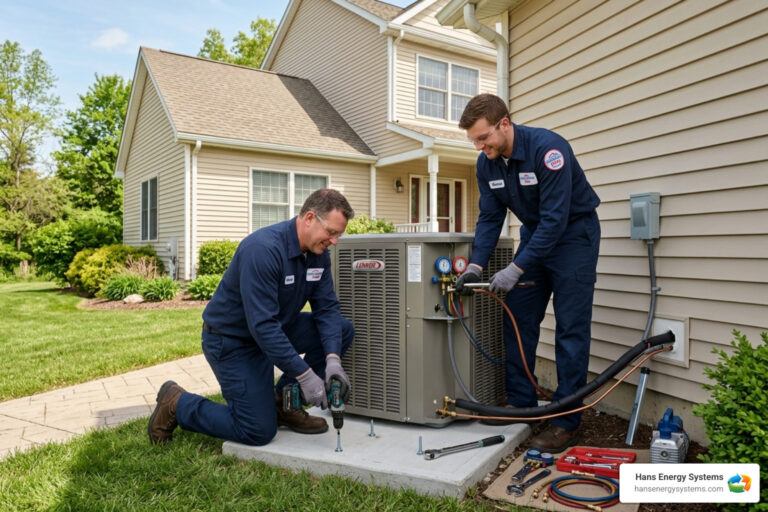
Next, we set the outdoor condenser. We prefer using composite pads over concrete because they absorb vibrations better, leading to a quieter system. We also ensure the unit is perfectly level to prevent oil from settling in the wrong part of the compressor, which can lead to a premature breakdown.
Electrical Upgrades and Safety Measures to Expect During Air Conditioner Installation
Electricity and air conditioning are a high-stakes pairing. During a professional installation in Poway, we don’t just “plug it in.” We inspect your home’s electrical panel to ensure it can handle the load of a modern, high-efficiency system.
We typically replace the electrical “whip” (the weather-proof cable connecting the unit to the house) and the disconnect box. Codes change over time, and what was safe in 2005 might not meet 2026 standards. These safety measures ensure that if there’s ever an electrical surge, your expensive new investment is protected, and your home stays safe from fire hazards.
Handling the Technical Connections and Refrigerant Lines
This is where the “art” of HVAC comes into play. We connect the indoor and outdoor units using copper line sets. Instead of simple fittings, we use a brazing process, heating the joints to over 1,200 degrees Fahrenheit to create a permanent, leak-proof seal.
While brazing, we perform a nitrogen purge. This involves flowing dry nitrogen through the pipes to prevent oxidation (scaling) from forming inside the tubes. Without this step, tiny flakes of soot could eventually clog your system’s expansion valve, causing a total failure. It’s a technical detail that separates a professional AC installation from a rushed job.
System Sizing and the Critical Role of Ductwork
You can buy the most expensive, 20-SEER2 air conditioner on the market, but if your ductwork is leaky or undersized, you’ll never feel the benefits. Think of your ducts as the “circulatory system” of your home. If the arteries are clogged or leaking, the heart (the AC unit) has to work twice as hard.
During the installation guide process, we check your system’s static pressure. This is essentially a “blood pressure test” for your HVAC system. If the pressure is too high, it means your ducts are too small for the amount of air the new unit is trying to push. We may recommend duct modifications or using mastic sealant to ensure every bit of cold air reaches your living room instead of your attic.
Understanding the Timeline: How Long Does Installation Take?
Most pre-summer installations in Poway are completed in a single day. Here is a realistic breakdown of the 8-to-10-hour window:
- Arrival & Setup: 30–60 minutes.
- Removal & Refrigerant Recovery: 1–2 hours.
- Indoor Unit Mounting: 2–3 hours.
- Outdoor Unit Placement: 1–2 hours.
- Technical Finishing (Wiring/Brazing): 1–2 hours.
- Testing & Walkthrough: 1 hour.
If we encounter damaged ductwork or need to upgrade an old electrical panel, the project may extend into a second day. We always communicate these timelines upfront so you aren’t left in the dark (or the heat).
Testing, Commissioning, and Your Final Walkthrough
The most critical part of the day happens after the unit is physically installed. This is the commissioning phase. We don’t just flip a switch and leave.
We use a vacuum pump and a digital micron gauge to pull a deep vacuum on the refrigerant lines. Our goal is to reach below 500 microns. This removes every trace of moisture and air from the system. If even a tiny drop of moisture remains, it can mix with the refrigerant oil to form acid, which will eat your compressor from the inside out over the next few years.
Once the vacuum is held, we introduce the refrigerant and perform a detailed system check. We measure the “superheat” and “subcooling” — technical terms that basically mean we are ensuring the refrigerant charge is exactly what the manufacturer specified for maximum efficiency.
Post-Installation Quality Checks to Expect During Air Conditioner Installation
Before we pack up our tools, we perform a temperature split test. We measure the air going into the return vent and the air coming out of the supply vent. Ideally, we want to see a difference of 15 to 20 degrees.
We also take the time for a full homeowner walkthrough. We will show you:
- How to program your new smart thermostat.
- Where your air filters are located (and how often to change them).
- How to register your equipment for the full 10-year manufacturer warranty.
- What “normal” sounds to expect from your high-efficiency variable-speed compressor.
Frequently Asked Questions About AC Installation
Can I install a central AC unit myself?
While it might be tempting to save money, installing a central AC is not a DIY project. It requires specialized (and expensive) tools like vacuum pumps, recovery machines, and torches. More importantly, handling refrigerant requires EPA Section 608 certification. Attempting a self-install will almost certainly void your manufacturer warranty and could lead to significant safety risks involving high-voltage electricity and pressurized gases.
Do I need a permit for my new air conditioner in San Diego?
Yes. In San Diego County and cities like Poway, Oceanside, and Chula Vista, a mechanical permit is required for an AC installation. This ensures that a third-party city inspector verifies the work meets safety and energy codes (like Title 24 compliance). At Hans Energy Systems, we handle the permit process for you to ensure your home remains compliant and safe.
What are the differences between central AC and mini-split installation?
A mini-split installation is often faster because it doesn’t require ductwork. Instead of a large central air handler, we mount small “heads” directly on your walls. These are perfect for room additions or older homes in areas like La Jolla or North Park where installing ducts isn’t feasible. While the outdoor unit setup is similar, the indoor process involves much less “surgery” on your home’s structure.
Conclusion
At Hans Energy Systems, we believe that what to expect during air conditioner installation should be transparency, professionalism, and a dramatic improvement in your home’s comfort. Whether you are in Poway, Carlsbad, or Downtown San Diego, our goal is to make your installation day the start of a decade-plus of worry-free cooling.
A new AC is a major investment. By choosing a team that prioritizes technical precision — from 500-micron vacuums to nitrogen-purged brazing — you ensure that your investment pays off in lower utility bills and a cooler home for years to come.
Ready to upgrade your home comfort? Schedule your professional AC installation today and experience the Hans Energy Systems difference.