
Why Does My AC Run All Day in Extreme Heat?
Why does my ac run all day in extreme heat is one of the most common questions San Diego homeowners ask during a summer heatwave — and the short answer is: it’s usually normal.
Here’s why your AC runs all day in extreme heat:
- Extreme temperature gap — Your AC is designed to keep indoor temps roughly 15–20°F cooler than outside. When it’s 100°F out and you’re set to 78°F, that’s a massive load to maintain.
- Constant heat gain — Your home absorbs heat through walls, windows, and the roof all day long. The AC has to run just to offset that incoming heat.
- High humidity — Even in San Diego, humidity adds to the cooling load. Your AC removes moisture from the air as well as heat, which takes extra energy and time.
- Attic heat radiation — Attic spaces can exceed 140°F on hot days, pushing heat down into living areas and forcing your system to work harder.
- The system is doing its job — On moderate days, an AC might cycle 2–3 times per hour for 15–20 minutes at a time. During a heatwave above 90°F, running 12–16 hours a day (or nearly continuously in the afternoon) is expected behavior.
The key question isn’t just how long your AC runs — it’s whether it’s actually keeping your home cool. If your home is holding a steady temperature, your system is likely working as intended. If it’s running nonstop but your home keeps getting warmer, that’s when something may be wrong.
Keep reading to understand exactly what’s happening inside your system, what warning signs to watch for, and what you can do to help your AC keep up during the hottest days of the year in Poway and across San Diego.
When the sun beats down on San Diego, your air conditioner becomes the “marathon runner” of your home. To understand why it rarely shuts off, we have to look at the 20-degree rule. Most residential cooling systems are engineered to handle a temperature differential (or “Delta T”) of about 20 degrees between the outdoor air and the indoor air.
If it is 100°F in Escondido, your AC is technically performing at its peak if it keeps your living room at 80°F. When you ask it to reach 72°F during a record-breaking heatwave, you are asking it to perform a feat it wasn’t necessarily designed for. This results in “heat gain”—the process where the sun’s energy enters your home faster than your AC can pump it out.
To ensure your system is actually functioning correctly and not just spinning its wheels, a professional AC System Check is vital. We often see units that are mechanically sound but simply overwhelmed by the ambient temperature.
| Condition | Typical Cycle Length | Total Daily Runtime |
|---|---|---|
| Moderate Heat (75°F – 85°F) | 15–20 Minutes | 8–12 Hours |
| Extreme Heat (95°F+) | 40+ Minutes / Continuous | 12–16+ Hours |
| System Malfunction | Continuous (No cooling) | 24 Hours |
Why does my AC run all day in extreme heat even when set to 77°F?
Many homeowners are surprised to find that even a modest setting like 77°F or 78°F results in nonstop operation. This happens because of design capacity. An AC unit doesn’t “blow colder” air when you lower the thermostat; it simply blows the same temperature air for a longer period until the sensor reaches your goal.
During peak solar radiation (usually between 2:00 PM and 7:00 PM), the thermal equilibrium of your home shifts. The heat radiating from your roof and through south-facing windows creates a constant “load.” If the AC stops, the temperature would spike almost immediately. Therefore, the system stays on to maintain that 77°F “ceiling.” If you are noticing that the temperature is actually rising despite the unit running, you may be facing Common AC Problems in Poway and Solutions that require expert attention.
Troubleshooting why does my AC run all day in extreme heat
Before assuming the worst, there are a few “low-hanging fruit” items to check. The most common culprit for extended runtimes is restricted airflow.
- Airflow Restrictions: Check your vents and returns. If a sofa is pushed against a return air vent, your AC is essentially “suffocating.”
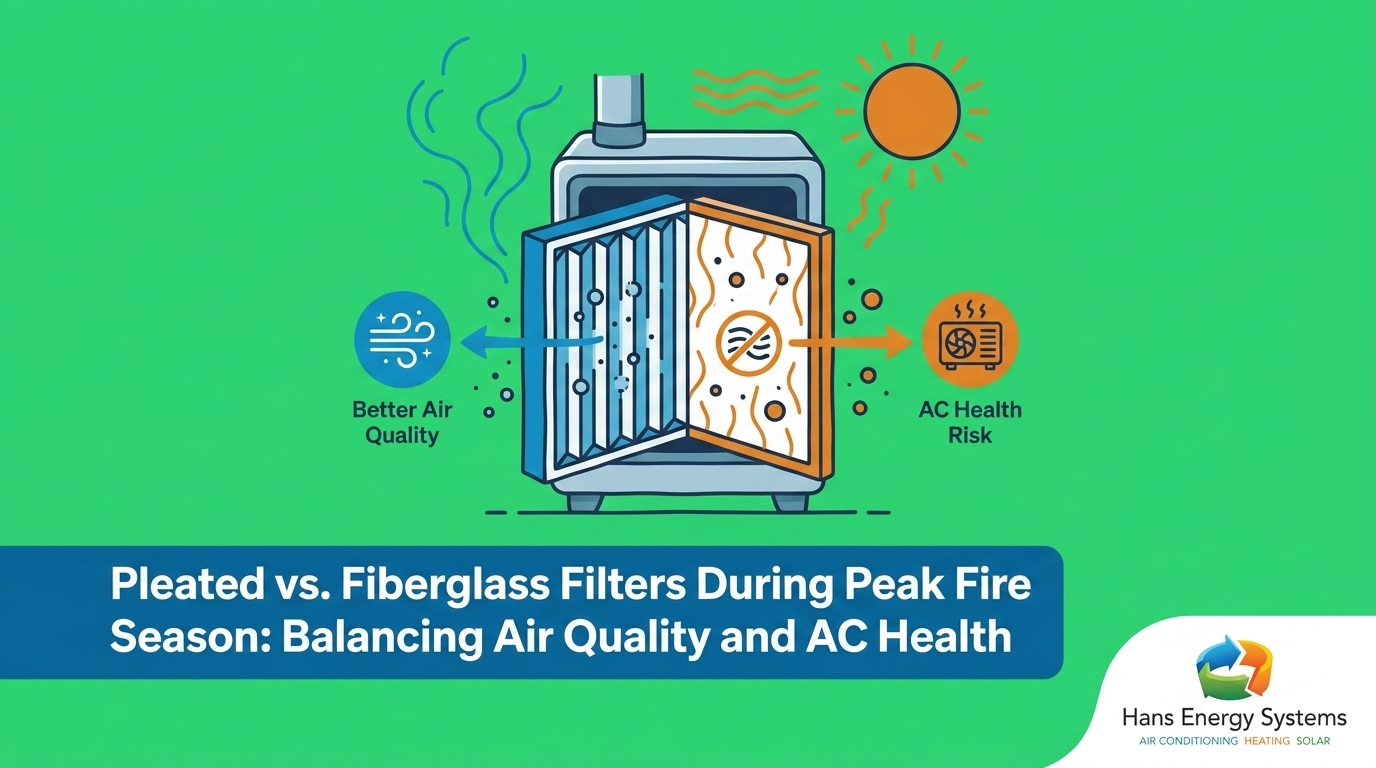
- Filter Health: Dirty Air Filters Can Harm AC Efficiency by forcing the blower motor to work twice as hard to move half as much air. This extends the time needed to cool the room.
- Condenser Coils: Your outdoor unit (the condenser) needs to release heat. If it’s covered in dust, grass clippings, or spider webs, that heat stays trapped in the refrigerant.
If you’ve checked the basics and the unit still won’t stop, it may be time for AC Repair Poway CA to look for deeper mechanical issues.
Mechanical Issues That Force Continuous Operation
While long runtimes can be normal, they can also be a symptom of a system that is struggling due to a mechanical failure.
Refrigerant Leaks are a major cause of the “never-ending cycle.” Refrigerant is not fuel; it doesn’t get used up. If your levels are low, you have a leak. Less refrigerant means the system can’t absorb as much heat, forcing it to run 24/7 just to achieve a minor temperature drop. In these cases, an AC Freon Recharge is a temporary fix—the leak must be found and sealed to protect the compressor.
Another common issue is frozen evaporator coils. It sounds counterintuitive—how can the AC freeze when it’s 100°F outside? If airflow is restricted or refrigerant is low, the coil temperature drops below freezing, causing moisture to turn into ice. This ice acts as an insulator, preventing the AC from cooling the air. You might even notice Why Your AC Unit Leaking Water in Poway as that ice begins to melt and overwhelms the drain pan.
Warning signs of system strain
Your AC will often try to tell you it’s under too much pressure. Listen for Why Your AC Unit Makes Buzzing Sounds, which can indicate a failing capacitor or a motor that is overheating.
You should also watch out for the opposite of constant running: short cycling. When AC Starts Short Cycling in Poway, the unit turns on and off rapidly. This is incredibly hard on the compressor—the most expensive part of your system—and usually indicates a sensor failure or an oversized unit.
Weak airflow is another red flag. If the air coming out of the vents feels “lazy” or only slightly cool, the internal components are likely wearing down, increasing your energy consumption without providing the comfort you’re paying for.
How to Reduce AC Strain During a San Diego Heatwave
We want your system to last for its full 12-to-15-year lifespan. To do that, you need to reduce the “marathon” load during heatwaves.
- Smart Thermostat Settings: The Department of Energy recommends setting your thermostat to 78°F when you are home. For every degree you set it lower, you can expect an 8% increase in energy usage.
- The “Wind-Chill” Assist: Use ceiling fans. They don’t lower the room temperature, but they create a wind-chill effect on your skin, making 78°F feel like 74°F.
- Manage Humidity: High humidity (above 70%) makes it harder for the AC to cool. Ensure your “Fan” setting is on “Auto,” not “On.” When the fan is “On,” it constantly circulates moisture back into the house that was just removed.
- Maintenance is Key: Joining an HVAC Maintenance Plan Poway CA ensures that your coils are cleaned and your electrical connections are tight before the first 90-degree day of May 2026 hits.
Improving home efficiency in May 2026
Sometimes the problem isn’t the AC—it’s the “envelope” of your home. If your house is “leaky,” you are essentially trying to cool the entire neighborhood.
- Seal Air Leaks: Use weatherstripping around doors and caulk around window frames.
- Attic Insulation: Proper insulation can prevent up to 40% of heat from entering through your ceiling. On a 100-degree day, your attic can reach 140°F+. Without a barrier, that heat radiates directly into your living space.
- Duct Sealing: Up to 30% of conditioned air can escape through leaks in your ductwork before it ever reaches your vents. If you suspect your ducts are failing, schedule a comprehensive HVAC Service in Poway CA.
When to Consider a New AC Installation
If your system is more than 10–12 years old and struggles every summer, repairs may eventually become a “sunk cost.”
Modern systems have much higher SEER (Seasonal Energy Efficiency Ratio) ratings. Upgrading from an old 10 SEER unit to a modern 16 or 18 SEER unit can cut your cooling costs by nearly half. If you find yourself calling for repairs every few months, these are clear Signs Home is Ready for New AC Installation.
At Hans Energy Systems, we specialize in AC Installation Poway CA, ensuring that your new unit is a perfect match for your home’s specific needs.
Sizing and capacity limits
One of the biggest reasons an AC runs all day is that it was never sized correctly to begin with. If a unit is too small (undersized), it will run forever and never reach the target temperature. If it’s too large, it will short cycle and fail to remove humidity, leaving your home feeling “clammy.”
We use a Manual J load calculation to determine the exact “tonnage” your home needs, taking into account square footage, window orientation, and insulation levels. If your current unit was installed without this calculation, it might be the reason for your frustration. Check for these Warning Signs AC Needs Replacement in Poway to see if a capacity mismatch is your primary issue. Knowing When to Replace Your AC System in Poway can save you thousands in utility bills over the next decade.
Frequently Asked Questions about Constant AC Runtime
Is it normal for my AC to run for 12+ hours during a heatwave?
Yes. In San Diego locations like Chula Vista or El Cajon, where temperatures can spike into the triple digits, it is perfectly normal for an AC to run for 12 to 16 hours a day. As long as the system eventually cycles off (usually in the late evening or early morning) and maintains a comfortable indoor temperature, it is simply doing the heavy lifting required by the weather.
What is the best thermostat setting for extreme outdoor temperatures?
The best balance of comfort and system longevity is 78°F. If you find this too warm, try lowering it by only 1 or 2 degrees at a time. Setting the thermostat to 65°F will not cool the house any faster; it will only ensure the compressor never gets a break, which can lead to overheating and electrical failure.
How does high humidity affect how long my air conditioner runs?
Your AC has two jobs: lowering the air temperature and removing moisture. When humidity is high (above 60-70%), the AC has to spend more energy condensing water vapor on the evaporator coils. This “latent heat” removal takes time, which extends the cooling cycle. If your home feels “sticky” even when the AC is running, your system may be struggling with dehumidification.
Conclusion
Understanding why does my ac run all day in extreme heat helps take the stress out of the summer months. In most cases, your air conditioner is simply working hard to combat the intense San Diego sun. However, when that constant running is paired with rising indoor temperatures, odd noises, or spiking bills, it’s a sign that your system needs a professional eye.
At Hans Energy Systems, we pride ourselves on being the reliable choice for home comfort from Oceanside down to Chula Vista. Whether you need a quick tune-up to improve efficiency or a full AC Repair, our team is dedicated to keeping your home a sanctuary against the heat. Don’t let your AC suffer through the summer alone—give us a call and let us ensure your system is ready for the long haul.