
The Hidden Threat to Peak Summer Solar Production
Here at Hans Energy Systems, we frequently receive calls in the middle of July from homeowners whose monitoring apps show a noticeable dip in energy output. This inevitably prompts them to ask us exactly what happens when dust accumulates under your solar panels during a dry spell. The sun is blazing, the sky is perfectly clear, and yet your rooftop array is struggling to hit the peak production numbers you saw earlier in the year. Many homeowners immediately assume the glass surfaces are simply too dirty to absorb sunlight. While surface dirt certainly plays a role in reducing solar efficiency, our team knows there is a much more insidious problem developing out of sight.
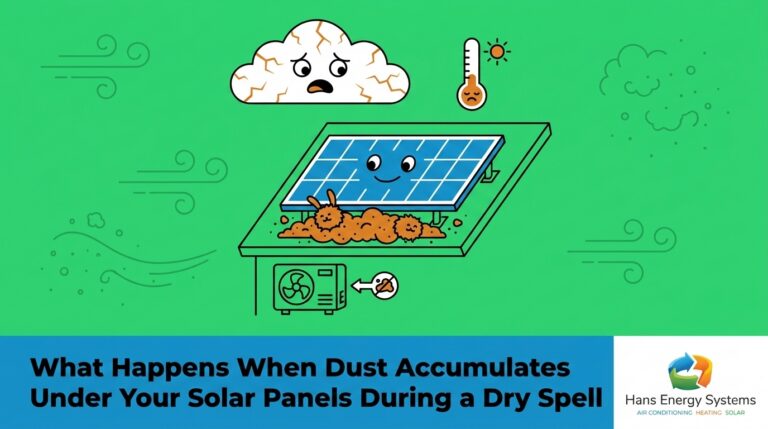
The core issue isn’t just the light being blocked from above; it is the heat being trapped underneath. When thick dust packs into the narrow gap between your roof and your solar panels, it severely restricts critical airflow. This hidden accumulation forces your system to operate at significantly higher temperatures, leading to a phenomenon known as thermal throttling. You are then left with a difficult decision: do you schedule a professional intervention immediately, or do you wait out the long summer months hoping for seasonal rains to wash the problem away?
Before you decide to let the system bake in the summer heat, it helps to understand how our professional solar and energy services evaluate thermal performance. In our experience servicing Poway rooftops, prolonged dry spells and Santa Ana wind events create the perfect storm for this specific type of under-panel buildup, turning a minor maintenance task into a major efficiency drain. Addressing this hidden threat requires looking beyond the glass and understanding the thermal dynamics at play on your roof.
The Physics of Convective Airflow Under Solar Arrays
To understand why under-panel dust is so detrimental, we first need to look at how a rooftop solar array is designed to cool itself. Solar panels convert sunlight into electricity, but they are not perfectly efficient. A significant portion of the solar energy that hits the panels is converted into thermal energy, or heat. If this heat is not dissipated quickly, the electrical components inside the panels begin to suffer from increased resistance, which directly lowers their voltage output.
This is where convective cooling comes into play. The deliberate space left between your roof shingles and the bottom of the solar panels acts as a critical heat sink. As the panels heat up, the air underneath them warms and naturally rises, pulling cooler ambient air up from the bottom edge of the array. This constant, natural airflow sweeps away excess thermal energy. When this convective airflow is working optimally, it can lower the operating temperatures of your solar panels by up to 15°C compared to a restricted setup.
However, through our direct field observations in local installations across Poway CA and inland Southern California, our technicians frequently see how easily this airflow is compromised in real-world scenarios. When the gap becomes clogged, the heat stagnates. Instead of a cooling breeze, the space becomes an oven, baking the underside of the panels and severely restricting their ability to generate power efficiently.
Why the Under-Panel Gap Matters
The mounting hardware and roof standoffs holding your panels are engineered with specific tolerances for a reason. That gap is not just for running wires; it is a fundamental part of the system’s thermal management.
- Engineered clearance: Most residential systems are installed with a 4-to-6-inch gap to allow sufficient air volume to pass through.
- Thermal dissipation: The continuous flow of ambient air prevents the roof itself from radiating excess heat back into the panels.
- Ambient baseline: The ambient July temperatures dictate the starting point for your system’s heat load. If the air is already hot, the panels rely entirely on that unrestricted airflow to keep from overheating.
When the gap is clear, the system thrives. When it is obstructed, the physics of energy conversion begin to work against you, turning your high-tech energy investment into a trapped heat source.
How Under-Panel Dust Throttles Energy Conversion
When our region experiences prolonged dry spells and Santa Ana wind events, the air carries millions of microscopic particulates. This ultra-fine dust doesn’t just settle on top of the panels; it swirls underneath and packs into the mounting hardware, the wiring channels, and the backing sheet of the modules. Over weeks and months without rain, this dust builds up into a thick, insulating blanket.
This insulating layer is disastrous for solar efficiency. According to data from the National Renewable Energy Laboratory (NREL), solar panels are evaluated at a standard testing temperature of 25°C (77°F). For every degree Celsius the panel operates above that baseline, it typically loses 0.3% to 0.5% of its efficiency. This metric is known as the temperature coefficient, and it is the key to understanding why your system underperforms in the heat.
The effect compounds rapidly. If the ambient air is hot, the panel is already operating above its ideal temperature. When you add a layer of insulating dust underneath, you eliminate the natural cooling breeze. The panel’s temperature spikes, pushing it further and further past its optimal thermal range. This thermal throttling is entirely separate from the light-blocking effect of surface dust, meaning your panels could look perfectly clean from the street while still suffering massive efficiency losses.
The Temperature Coefficient Explained
Understanding the temperature coefficient helps clarify exactly why trapped heat is so destructive to your energy production. It is a simple matter of electrical resistance.
- Increased resistance: As the silicon cells heat up, the flow of electrons becomes more chaotic, increasing internal resistance.
- Voltage drop: This increased resistance causes a direct drop in the voltage the panel can push to your inverter.
- Forced inefficiency: The system is forced to work harder, absorbing the same amount of intense sunlight but yielding significantly less usable alternating current (AC) for your home.
When you check your production app and see a noticeable dip during the sunniest part of the day, you are watching the temperature coefficient in action. The heat is literally choking the electrical output.

The Compounding Impact of Peak Summer Heat
Our crews know firsthand how brutal the local climate can be; Poway experiences average July high temperatures hovering around 88°F, establishing an exceptionally high baseline thermal load for any rooftop equipment. When the ambient air is already this warm, your solar panels are entirely dependent on optimal, unrestricted airflow to keep their internal temperatures manageable.
This creates a dual-threat scenario for homeowners in inland Southern California. First, you have the peak ambient heat beating down on the roof. Second, you have the total loss of convective cooling due to the insulating layer of under-panel dust. Prolonged arid conditions literally bake this fine dust into place, turning a loose layer of silt into a hardened, restrictive barrier that clings to the back of the modules and the mounting rails.
Under these extreme conditions, the combination of heavy surface soiling and under-panel thermal blanketing can reduce overall system output by a staggering 7% to 20%. This isn’t a minor fluctuation; it is a massive loss of peak generation potential exactly when you need the power the most to offset your summer air conditioning costs.
Wind-Driven Particulates and Array Packing
Not all dust is created equal, and the way it arrives on your roof dictates how hard it is to remove. Seasonal weather patterns play a major role in how this accumulation forms.
- Ultra-fine silt: Seasonal winds carry microscopic dust particles that easily bypass standard surface cleaning and slip into the tightest crevices under the array.
- Physical packing: During extended dry periods, the daily cycle of heating and cooling causes this fine dust to pack tightly together, solidifying around critical components.
- Stubborn accumulation: Because this packed dust is sheltered from light breezes and morning dew, it is significantly harder to clear naturally, requiring specialized intervention to dislodge.
Surface Soiling vs. Under-Array Thermal Blanketing
To truly protect your solar investment, it is vital to differentiate between the two distinct types of dust problems. Most generic solar advice focuses entirely on surface soiling—the visible dirt on the glass that blocks photons from reaching the solar cells. While keeping the glass clean is important, addressing only the surface fails to resolve the deeper thermal throttling issue.
Our technicians routinely inspect systems where homeowners attempted a simple DIY hose-down, assuming that splashing water over the glass will solve their production dip. However, a garden hose rarely has the pressure or the correct angle to reach the packed dust underneath the center of the array. Worse, spraying hard municipal water onto hot solar glass during the middle of the day can cause severe hard water scaling, leaving mineral deposits that permanently etch the glass and block even more light.
Under-array cleaning requires specialized approaches to safely remove the thermal blanket without damaging the sensitive backing sheets, the MC4 connectors, or the mounting hardware. Here is a breakdown of how these two issues differ and why they require different solutions:
| Characteristic | Surface Soiling (On Top) | Thermal Blanketing (Underneath) |
|---|---|---|
| Primary Impact | Blocks sunlight (photons) from reaching the silicon cells. | Traps heat, increasing electrical resistance and lowering voltage. |
| Visibility | Highly visible from the ground; panels look dull or brown. | Hidden from view; panels may look clean while still underperforming. |
| Natural Clearing | A heavy rainstorm can often wash away a significant portion. | Sheltered from rain; wind packs it tighter over time. |
| Required Solution | Deionized water brushing to prevent hard water stains. | Specialized under-array debris removal and airflow restoration. |
Why Standard Cleaning Isn’t Enough
Ignoring the under-panel space leaves your system vulnerable to more than just heat. When debris and dust are allowed to pack tightly under the array, they create an environment that attracts pests looking for shelter from the sun. Furthermore, if unseasonal humidity does roll in, that thick layer of dust can hold moisture against your roof and wiring, increasing the risk of long-term corrosion. Comprehensive system maintenance must account for the entire physical footprint of the array, not just the shiny glass on top.
Decision Framework: Should You Wait for the Rain?
When you notice a drop in production during a hot, dry summer, the immediate question is whether to take action or wait for the weather to change. In regions like Poway CA and inland Southern California, waiting for rain is rarely a viable strategy. The dry season stretches for months, meaning you are sacrificing peak solar generation potential precisely when your air conditioning usage is at its highest.
To help you weigh the immediate efficiency loss against the benefits of professional maintenance, our Hans Energy Systems experts recommend using this decision framework:
- Evaluate the timeline: Look at the calendar. If it is July, you likely have three to four months of peak heat and dry conditions remaining before any meaningful rainfall arrives. That is a quarter of the year operating at a deficit.
- Assess the production drop: Check your monitoring app for unexpected production drops during the sunniest, clearest days. If your output is down 10% or more compared to historical data for the same month, thermal throttling is likely the culprit.
- Inspect the environment: Have you experienced recent Santa Ana wind events? Is your home located near a busy road, a construction site, or dry hillsides? These factors drastically accelerate under-panel dust packing.
- Weigh the cumulative loss: A 7% to 20% reduction in output over four months of peak summer sun translates to a significant amount of purchased grid power. The cost of lost energy often outweighs the cost of a professional cleaning and inspection.
- Look for secondary signs: If you can safely see the edge of your array from a ladder or a second-story window, look for visible webbing, trapped leaves, or packed dirt bridging the gap between the roof and the panels. If the edge is clogged, the center is almost certainly choked off.
If you check multiple boxes on this list, waiting for rain will only cost you money and put unnecessary thermal stress on your expensive solar equipment.
Frequently Asked Questions About Summer Solar Maintenance
Do solar panels lose efficiency when they get hot?
Yes, solar panels absolutely lose efficiency as their temperature rises. Because of the temperature coefficient, excess heat increases the electrical resistance within the silicon cells, which directly lowers the voltage output. This means that even on the brightest summer days, a panel running too hot will produce less electricity than it would on a cooler, sunny spring afternoon.
How does dust under solar panels affect performance?
Dust underneath the panels acts as a thick insulator, completely stopping the natural convective cooling that the system relies on. Without ambient air flowing through the gap between the roof and the panels, the thermal energy cannot dissipate. This causes the panels to run significantly hotter than the ambient temperature, triggering severe thermal throttling.
Should I clean my solar panels in the summer?
Yes, our team highly recommends summer maintenance, especially if you are experiencing a prolonged dry season. Because you have months of peak heat ahead, restoring optimal airflow and removing surface soiling ensures you capture the maximum amount of energy when your home needs it most. Focus on comprehensive maintenance that addresses both the glass and the under-panel space.
What happens if you never clean your solar panels?
If left entirely unmaintained, you will experience compounding efficiency losses as layers of dust block light and trap heat. Over several years, the constant thermal stress caused by restricted airflow can accelerate the degradation of the panel components, the backing sheets, and the microinverters. Regular maintenance protects both your daily energy yield and the long-term lifespan of the hardware.
Can wind actually make solar panels dirtier?
Yes, dry wind events carry immense amounts of fine particulates that settle onto the glass and swirl underneath the arrays. Unlike heavy debris, this ultra-fine silt packs tightly into the mounting hardware and solidifies over time. Wind often does more to clog the critical under-panel airflow gaps than standard daily dust settling.
Protect Your System’s Output This Summer
Maintaining optimal airflow underneath your solar array is just as important as keeping the glass clean on top. The physics are clear: when you understand what happens when dust accumulates under your solar panels during a dry spell, you realize that trapped heat is the true enemy of peak summer production. By prioritizing convective cooling and keeping that critical gap clear of insulating dust, you ensure your system operates within its ideal thermal range.
Understanding these thermal dynamics is the first step to maximizing the return on your solar investment. If your production app is showing a mid-summer slump, or if your home has recently weathered severe, dry winds across Poway CA and inland Southern California, it is time to take action. Don’t let thermal throttling drain your energy savings. Reach out to contact our team for an expert evaluation, and let us help you restore your system’s peak output before the hottest days of the year arrive.