
Why Getting AC Installation & Sizing Right Is the Most Important Decision You’ll Make This Summer
AC installation & sizing is the process of selecting and installing a cooling system that matches your home’s exact heat load — measured in BTUs — so it runs efficiently, keeps you comfortable, and lasts for years.
Here’s a quick breakdown of what you need to know:
- 1 ton of cooling = 12,000 BTUs per hour
- Residential AC units range from 1.5 to 5 tons (18,000 to 60,000 BTU/hr)
- General starting point: 20 BTUs per square foot of living space
- Common sizing by home size:
| Home Size | Estimated Tonnage |
|---|---|
| 800 – 1,200 sq ft | 2 tons |
| 1,500 – 1,800 sq ft | 3 tons |
| 2,000 sq ft | 3.5 – 4 tons |
| 2,400 – 3,300 sq ft | 4 – 5 tons |
- Square footage alone is not enough — insulation, ceiling height, window orientation, and your local climate all change the final number
- A professional Manual J load calculation is the only reliable way to size an AC system correctly
That last point matters more than most homeowners realize. San Diego’s climate varies widely — coastal neighborhoods like Pacific Beach sit in a completely different heat zone than inland areas like El Cajon or Escondido. A system sized for one won’t perform the same in the other.
And when sizing goes wrong, the consequences go beyond just a high electricity bill. An oversized unit short-cycles, meaning it cools the air so fast it shuts off before removing humidity — leaving your home feeling cold and clammy. An undersized unit runs nonstop, wears out fast, and still can’t keep up on the hottest days. Either way, you lose comfort and money.
This guide from Hans Energy Systems breaks down exactly how AC sizing works, what goes into a proper load calculation, and why getting it right from the start is the smartest thing you can do for your home’s comfort and your wallet.

Why Square Footage is Only the Start of AC Installation & Sizing
When many homeowners begin looking into a new system, they often start with a simple question: “How many square feet is my house?” While that is a vital piece of the puzzle, relying on square footage alone to determine ac installation & sizing is a bit like buying a pair of shoes based only on your height. It might get you close, but it probably won’t be a comfortable fit.
In the HVAC world, we measure cooling capacity in BTUs (British Thermal Units) and tonnage. One “ton” of cooling is the ability to remove 12,000 BTUs of heat from your home per hour. For a Professional AC Installation for Your Home, we have to look at how that heat gets into your house in the first place.
San Diego County is a land of microclimates. The local design temperatures — the maximum outdoor temperature a system is designed to handle — vary significantly as you move inland. If you live in Oceanside or Carlsbad, your home deals with much lower solar heat gain than a similar home in Santee or Ramona. A 3-ton unit might be perfect for an 1,800-square-foot home near the coast, but that same unit would likely struggle to keep up in the heat of an El Cajon summer.
Moving Beyond the Rule of Thumb for AC Installation & Sizing
The “rule of thumb” often cited is that you need one ton of cooling for every 400 to 600 square feet. In a moderate climate, that might be 1 ton per 500 or 600 square feet. In the hotter inland valleys, you might need 1 ton for every 400 square feet. However, our AC Installation Services emphasize that these are just estimates.
Environmental factors play a massive role. For instance, the age of your home tells us a lot about its “thermal envelope.” An older home in North Park built in the 1940s likely has thinner walls and less insulation than a modern build in Carmel Valley. This means the older home will “leak” more coolness and “absorb” more heat, requiring a higher BTU capacity even if the square footage is identical. Airflow requirements also change based on the layout; an open floor plan in a Chula Vista ranch house moves air differently than a compartmentalized two-story in Scripps Ranch.
Key Variables in Professional AC Installation & Sizing
To get the sizing exactly right, we have to look at the unique DNA of your property. This is why a AC Installation Poway Guide often highlights more than just room dimensions. We consider:
- Insulation Quality: The R-value of your attic and wall insulation determines how well your home holds onto conditioned air.
- Window Orientation: South-facing windows in a La Jolla home act like giant magnifying glasses, significantly increasing the cooling load during the afternoon.
- Ceiling Height: A room with 12-foot vaulted ceilings has much more air volume to cool than a room with standard 8-foot ceilings, often requiring a 25% increase in BTU capacity.
- Occupancy Loads: Every person in a home generates roughly 380 BTUs of heat. If you frequently host large family gatherings in San Marcos, your AC needs to account for that extra heat.
The Science of the Manual J Load Calculation and Efficiency
The industry gold standard for determining the right size is the Manual J load calculation. This isn’t a “guesstimate”; it’s a scientific assessment of your home’s heat gain and loss. When we perform AC Replacement Services, we use this calculation to ensure the new equipment matches the home’s current needs — which may have changed if you’ve added new windows or a room addition since the last unit was installed.
| Variable | Impact on Cooling Load | Recommendation |
|---|---|---|
| Insulation | High (reduces heat gain) | Upgrade to R-38 or higher in attics |
| Window Type | High (Solar heat gain) | Use double-pane, Low-E glass |
| Ceiling Height | Moderate (increases volume) | Add 25% BTUs for vaulted ceilings |
| Home Color | Low to Moderate | Lighter roofs reflect more San Diego sun |
In 2026, efficiency standards are stricter than ever. The transition to SEER2 (Seasonal Energy Efficiency Ratio 2) and EER2 (Energy Efficiency Ratio 2) means that modern units are tested under more realistic “static pressure” conditions. SEER2 measures how efficiently a unit operates over an entire season, while EER2 measures efficiency during the peak of a 95°F heatwave.
Modern systems often feature ECM (Electronically Commutated Motors) blower motors. These are variable-speed motors that can adjust airflow precisely. However, even the most efficient SEER2 18 unit will fail to save you money if the ac installation & sizing is wrong. Static pressure testing is a vital part of our process; it ensures your ductwork can actually handle the volume of air the new unit produces.
Risks of Improper Sizing: Oversized vs. Undersized
One of the most common mistakes is thinking “bigger is better.” In reality, an oversized air conditioner is a recipe for discomfort. When a unit is too large for the space, it engages in “short cycling.” It turns on, blasts the house with cold air, reaches the target temperature in five minutes, and shuts off.
The problem? An air conditioner has two jobs: lowering the temperature and removing humidity. It takes about 10 to 15 minutes of running for the coils to get cold enough to effectively pull moisture from the air. If the unit only runs for five minutes, the air stays humid. You end up with a “cold and clammy” house, which can eventually lead to mold or mildew issues. Furthermore, short cycling puts immense strain on the compressor, potentially reducing the equipment’s lifespan by 30-50%.
On the flip side, an undersized unit is just as problematic. If you’ve missed the Warning Signs AC Needs Replacement in Poway, you might find your old unit running 24/7 without ever reaching the desired temperature. This constant operation leads to massive energy bills and premature component wear. You’ll likely notice uneven temperatures, where the rooms furthest from the unit stay warm while the unit itself works itself to death. Checking for Signs Your Home is Ready for New AC Installation can help you avoid the “steaming” frustration of a unit that simply can’t keep up.
Evaluating Your Home’s Infrastructure for a New System
Before we finalize any ac installation & sizing plan, we have to look at the “veins” of your home: the ductwork. You could have the most perfectly sized 3.5-ton unit, but if your ducts are leaky or too small, you’ll lose 20-30% of your conditioned air before it ever reaches your living room.
When reviewing your HVAC Replacement Poway Guide, consider the three main types of systems:
- Central Air Systems: The standard for most San Diego homes with existing ductwork.
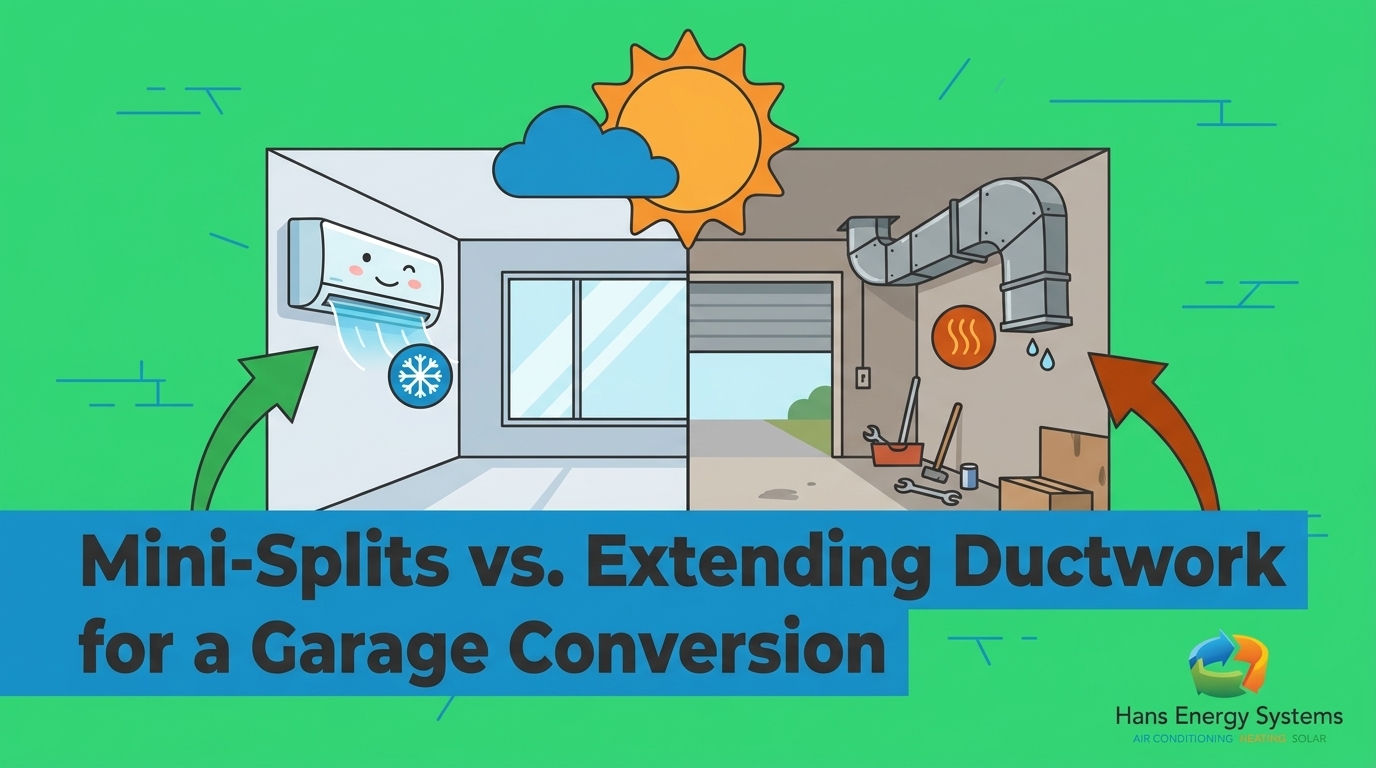
- Ductless Mini-Splits: Perfect for ADUs in North Park or room additions where extending ducts isn’t feasible.
- Packaged Units: Often used in homes with limited interior space, where the entire system sits on the roof or a concrete pad outside.
If you’re curious about your current system, you can often “decode” the model number. Look for a two-digit number divisible by 6 or 12. For example, a model number containing “36” usually indicates a 36,000 BTU unit, which is 3 tons (36,000 / 12,000 = 3).
Finally, don’t forget the electrical requirements. Modern high-efficiency units often require dedicated circuits. If you’re moving from an old, small unit to a larger 5-ton system, your electrical panel in your Pacific Beach cottage might need an upgrade to handle the increased amperage limits. Units drawing more than 7.5 amps typically cannot share a circuit with other appliances.
Frequently Asked Questions about AC Installation & Sizing
How many square feet does a 3-ton AC unit cover?
In a typical San Diego home, a 3-ton AC unit covers between 1,500 and 1,800 square feet. However, this is highly dependent on your specific neighborhood. A 3-ton unit is usually plenty for an 1,800-square-foot home in Del Mar where the ocean breeze helps, but if that same home is in the sun-drenched hills of Lakeside, you might need to step up to a 3.5-ton unit. We always recommend a professional evaluation for AC Installation in Poway, CA to be certain.
What is the difference between SEER2 and EER2 ratings?
Think of SEER2 (Seasonal Energy Efficiency Ratio 2) as the “miles per gallon” for your AC over an entire summer. It accounts for the changing temperatures throughout the season. EER2 (Energy Efficiency Ratio 2) measures how efficiently the unit runs during the absolute hottest part of the day (usually 95°F). For 2025 and 2026, look for systems with a SEER2 of 16 or higher to ensure you’re getting an Energy Star certified level of performance.
Can a smart thermostat fix an oversized air conditioner?
Unfortunately, no. While a smart thermostat is great for scheduling and remote control, it cannot change the physical capacity of the machine. If the unit is too big, it will still short-cycle and fail to dehumidify. The mechanical limitations of the compressor and the blower motor are set by the ac installation & sizing phase. A smart thermostat might help you track the problem, but only professional recalibration or a correctly sized unit can fix it.
Conclusion
Getting your ac installation & sizing right isn’t just a technical requirement — it’s the foundation of your home’s comfort. At Hans Energy Systems, we take pride in our engineered approach to cooling. Whether you are in Poway, Escondido, or Chula Vista, we focus on reliability and precision.
We understand that every home in San Diego is unique, from the coastal cottages of Solana Beach to the multi-story family homes in Rancho Bernardo. Our team is dedicated to providing quick installs and exceptional customer service, ensuring that your new system is perfectly matched to your lifestyle and your home’s specific needs. Don’t spend another summer steaming in a clammy house or overpaying for a unit that’s working too hard. Contact us today for expert AC Installation Services and let’s make sure your home stays perfectly cool all year long.