
Who in San Diego Can Help Me Pair Solar and EV Charging to Reduce My Carbon Footprint?
Understanding how pairing solar and EV charging reduces your carbon footprint starts with one simple idea: the electricity source matters just as much as the vehicle itself.
Quick Answer: How Solar + EV Charging Cuts Carbon Emissions
- Grid electricity in the U.S. still relies heavily on fossil fuels, meaning a grid-charged EV still carries a carbon cost
- Rooftop solar generates clean, zero-emission electricity that can power your EV directly during daylight hours
- Solar-charged EVs produce effectively zero tailpipe and zero upstream emissions during operation
- In Europe, EVs powered by solar emit more than three times less CO₂ than petrol cars
- A typical residential solar setup can offset 100% of a home EV’s annual charging needs
- Over a 25-year system life, a solar + EV household can offset 137–162 metric tons of CO₂
- Smart and managed charging systems maximize the share of solar energy going directly into your battery
Most EV owners in San Diego switch to electric to cut emissions — and that’s a great first step. But if your car charges overnight from the standard grid, you’re still drawing power from a mix that includes natural gas and other fossil sources. The real emissions breakthrough happens when you pair your EV with on-site solar generation. That combination transforms your vehicle from a low-emission option into a near-zero-emission one — and it also slashes your reliance on grid energy at the same time.
At Hans Energy Systems, we help San Diego homeowners make that full transition: from the solar panels on your roof to the charger in your garage, designed to work together from day one.
How Pairing Solar and EV Charging Reduces Your Carbon Footprint
When we talk about the environmental impact of solar energy systems, we often focus on keeping the lights on and running the air conditioning. But when you introduce an electric vehicle to your household, your home’s energy profile changes drastically.
An EV is incredibly efficient at converting stored energy into motion, but it is also a massive electrical load. Charging an EV on grid power alone means you are indirectly responsible for the emissions of the power plants supplying that grid. By generating your own power on-site, you bypass the grid’s carbon intensity entirely.
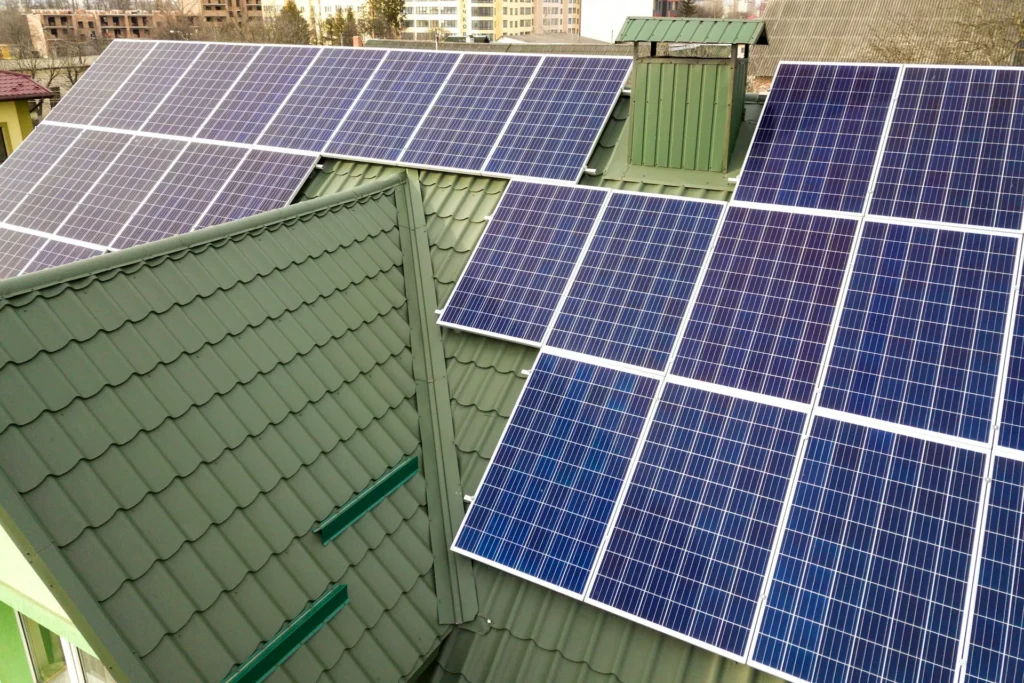
Eliminating Grid-Related Emissions with On-Site Generation
To understand the real-world carbon math, we have to look at grid emissions factors. In the United States, the national average grid emissions sit at approximately 0.86 lbs of CO₂ per kilowatt-hour (kWh). When you charge a standard EV like a Tesla Model 3 (which consumes about 26 kWh per 100 miles) on this average grid, your car is responsible for about 0.22 lbs of CO₂ per mile driven.
While that is already a massive improvement over a conventional gasoline vehicle (which averages about 0.71 lbs of CO₂ per mile when accounting for both tailpipe and upstream refinery emissions), it is not truly zero-emission.
When you transition to on-site solar generation, the equation changes completely:
- Zero Upstream Emissions: Solar panels produce 100% emission-free electricity. Once the initial manufacturing emissions of the solar panels are paid back (which typically takes just 1 to 3 years of operation), every mile you drive on sunshine is completely carbon-free.
- Massive Carbon Offsets: Pairing your home solar system with an EV charger reduces household carbon emissions by the equivalent of planting 100 trees every single year.
- Lifetime Carbon Offsets: Over a standard 25-year system lifespan, a household that pairs solar with an EV will offset between 137 and 162 metric tons of CO₂.
By integrating these two systems, you are choosing a comprehensive path toward Green Energy Solutions that fundamentally alters your household’s relationship with fossil fuels.
How Pairing Solar and EV Charging Reduces Your Carbon Footprint in Different Seasons
A common concern among homeowners in Southern California is how seasonal weather shifts affect their ability to charge their cars with solar energy. Fortunately, our local climate in places like Poway, Carlsbad, and Chula Vista is incredibly well-suited for year-round solar production.
Even during the shorter days of winter, solar panels continue to generate consistent, usable electricity. While peak solar production naturally occurs during the long, sunny days of summer, winter solar generation in California often clears 10 kW during peak midday hours. In fact, real-world data from solar-synchronized systems shows that even in historically low-solar, cold-weather climates like Minnesota, solar arrays consistently produce enough energy to sustain daily EV charging needs.
In San Diego County, where we enjoy some of the highest solar irradiance levels in the country, seasonal variability is rarely an obstacle to maintaining a zero-carbon commute. During the winter, you may occasionally draw a small percentage of power from the grid during consecutive overcast days, but your annual net carbon savings remain exceptionally high.
If you are looking to maximize your environmental return, learning the mechanics of Charging Tesla with Solar Panels during different seasons is the key to maintaining a self-sufficient energy ecosystem.
Maximizing Renewable Energy Use with Smart and Managed Charging
Simply having solar panels and an EV charger is only half the battle. To truly optimize how pairing solar and EV charging reduces your carbon footprint, you must ensure that the solar energy generated on your roof actually goes directly into your vehicle’s battery.
If your solar panels are producing peak power at 12:00 PM while you are at work, and you plug your car in to charge at 7:00 PM, you are exporting your clean solar energy to the grid during the day and drawing fossil-heavy grid power at night. This is where managed charging and solar synchronization become essential.
How Pairing Solar and EV Charging Reduces Your Carbon Footprint via Solar-Synchronized Systems
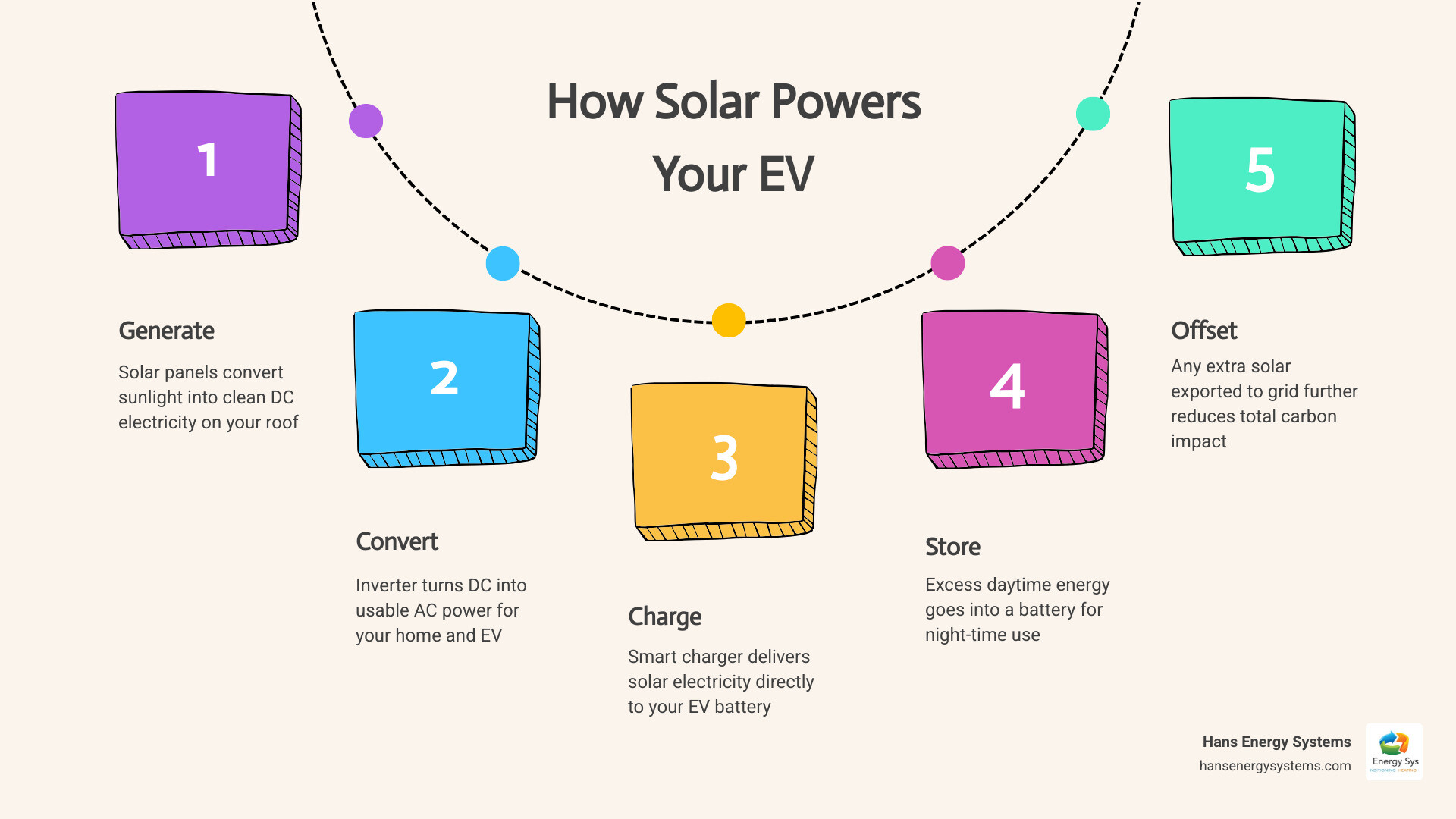
Managed charging is the capability to dynamically adjust the power level of your EV charger in real time based on specific rules or conditions. A solar-synchronized charging system uses a smart energy management monitor to track exactly how much surplus electricity your solar panels are producing at any given second.
Instead of charging at a fixed rate (which might force the system to pull additional power from the grid), a smart charger will ramp its output up or down to match your real-time solar generation.
- Dynamic Power Adjustments: If a cloud passes over your home and your solar production drops from 8 kW to 4 kW, a solar-synchronized charger will instantly throttle its charging speed to prevent grid draw.
- Minimum Service Levels: Most smart chargers maintain a minimum threshold (typically around 1.75 kW) to ensure your car continues to charge safely even when solar production is briefly interrupted.
- Zero Grid Waste: This synchronization ensures that you maximize your “self-consumption” — the percentage of your solar power used directly on-site rather than exported to the utility.
For a deeper dive into how to select a charger that supports these smart scheduling features, read our Tesla Wall Mount Charger Complete Guide and our companion Tesla Charger Install Complete Guide.
Overcoming Grid Mismatches with Battery Storage and Smart Panels
For many working families, cars are parked away from home during peak solar generation hours. This temporal mismatch can limit your direct solar-to-EV charging capability. However, integrating a home battery storage system solves this problem entirely.
Adding a battery storage system (such as a 6 kWh to 15 kWh home battery) allows you to capture your midday solar surplus and save it. When you return home in the evening, that clean, stored solar energy is discharged directly into your EV.
Integrating a battery can boost a home’s solar self-consumption rate from a modest 20–30% up to over 70%. When paired with a smart electrical panel, you can easily prioritize where your stored energy goes, ensuring your home comfort systems and your vehicle are always powered by clean energy.
Before committing to this setup, it is crucial to evaluate your home’s existing electrical infrastructure. We highly recommend reviewing The Panel Test: Can Your Home Handle Solar and EV Charging? to see if your current electrical panel has the physical capacity and busbar rating to handle the combined loads of a solar inverter, a home battery, and a high-power Level 2 EV charger.
Navigating Utility Policies, Incentives, and Grid-Level Impacts
Your energy independence and your carbon reduction are deeply intertwined with local utility policies. In Southern California, San Diego Gas & Electric (SDG&E) has transitioned to a billing structure that makes smart energy management more critical than ever.
Under California’s Net Billing Tariff (often referred to as NEM 3.0), the framework for exporting solar energy back to the grid has changed. This means exporting power to SDG&E is no longer the most efficient strategy.
Instead, the highest environmental return comes from self-consumption — keeping every kilowatt-hour you generate within your own home and vehicle.
Additionally, SDG&E has expanded its daytime “Super Off-Peak” hours to 10:00 AM to 2:00 PM on weekdays year-round. During these hours, abundant solar generation on the regional grid makes electricity highly accessible.
By utilizing smart chargers to charge your EV during these hours, or by storing that power in a home battery to offset the 4:00 PM to 9:00 PM peak period, you protect your home from peak utility demand while helping stabilize the regional grid.
To maximize these dynamics, explore our comprehensive guide on Solar Energy Revenue: Net Metering and More.
Leveraging Federal and State Programs for Solar-EV Integration
Installing an integrated solar and EV charging system represents a significant long-term upgrade for your home. Fortunately, there are several federal, state, and local programs designed to support your transition:
- Federal Residential Clean Energy Credit (Section 25D): This federal program supports the installation of a residential solar panel system and battery storage system.
- Federal Alternative Fuel Vehicle Refueling Property Credit (Section 30C): Homeowners in eligible areas can utilize this program for purchasing and installing a Level 2 EV charger.
- California State Programs: Programs like the Self-Generation Incentive Program (SGIP) offer support for home battery storage installations, particularly for homes in high-fire-threat districts or low-income areas.
- Utility-Specific EV Rate Plans: SDG&E offers dedicated EV time-of-use rate plans that optimize electricity usage during super off-peak hours.
To ensure you don’t miss out on any active regional programs, read our guide on how to Don’t Leave Money on the Table with California EV Rebates.
Grid-Level Benefits of Widespread Solar-EV Adoption
When thousands of homeowners across San Diego, Poway, Oceanside, and Chula Vista adopt solar-synchronized EV charging, the benefits extend far beyond individual households.
Widespread adoption of managed charging acts as a massive buffer for our regional electrical grid. By shifting heavy EV charging loads to the middle of the day (when solar generation is at its peak) or utilizing home batteries to discharge power during evening peaks, we collectively reduce the need for utilities to fire up expensive, highly polluting “peaker” natural gas plants.
This collective load shifting lowers regional emissions, reduces the risk of rolling blackouts, and avoids costly grid transmission upgrades — leading to a cleaner, more resilient energy grid for everyone.
Best Practices for Designing Your Solar-EV Charging System
To achieve the perfect balance of carbon offset, daily convenience, and energy independence, your system needs to be carefully engineered. Below is a quick comparison of how different charging setups interact with your solar energy system:
| Charging Type | Electrical Requirements | Solar Integration Potential | Carbon Offset Profile | Best Suited For |
|---|---|---|---|---|
| Level 1 Charging | Standard 120V outlet (15A) | Low (cannot easily adjust to variable solar production) | Moderate (slow charge speed limits daytime solar capture) | Drivers with very short daily commutes (<20 miles) |
| Standard Level 2 | Dedicated 240V outlet (40A–50A) | Medium (requires manual scheduling to match daylight hours) | High (fast charging allows capturing solar window) | Average daily commuters who charge overnight or on weekends |
| Solar-Synchronized | Dedicated 240V circuit + Smart Energy Monitor | High (automatically matches charging speed to real-time solar) | Outstanding (maximizes direct self-consumption of solar) | Homeowners looking for the absolute lowest carbon footprint |
Getting these parameters right requires professional planning. You can learn more about how we approach these calculations by visiting our resource on Solar Energy System Design and Engineering.
Sizing Your Solar Array for EV Driving Demands
When we design a solar array for a home with an EV, we don’t just look at past utility bills. We have to calculate your future driving demands to ensure your solar array is sized appropriately. Here is the basic math we use:
- Determine Annual Mileage: The average U.S. driver travels roughly 13,476 miles per year (about 37 miles per day).
- Calculate EV Efficiency: A standard electric sedan averages about 3 to 4 miles per kWh. A larger electric SUV or truck might average 2 to 2.5 miles per kWh.
- Calculate Annual kWh Demand: If you drive 12,000 miles per year in an EV that gets 3.5 miles per kWh, your car will require approximately 3,428 kWh of electricity annually.
- Determine Additional Solar Capacity: In San Diego, 1 kW of installed solar capacity typically produces about 1,500 to 1,600 kWh of electricity per year. To cover that 3,428 kWh EV load, you will need to add roughly 2.2 to 2.5 kW of solar capacity (about 5 to 6 additional 400W solar panels) to your system.
Properly sizing your system prevents you from under-producing and relying on grid imports, resulting in significantly Lower Utility Bills and a much faster path to energy self-sufficiency.
Selecting and Installing the Right EV Charger
For most homeowners, installing a high-quality Level 2 charger is the most practical choice. A Level 2 charger operating on a dedicated 240-volt circuit can fully charge most EVs in 4 to 8 hours, delivering 20 to 30 miles of range per hour of charging.
Whether you prefer a sleek Wall Mount Tesla Charger or a space-saving Tesla Charger Ceiling Mount to keep cables off your garage floor, proper installation is key.
Our team performs detailed load calculations to ensure your home’s electrical system is fully compliant with the National Electrical Code (NEC) before adding a dedicated 40-amp or 50-amp circuit. We also handle all local permitting in your specific municipality, ensuring a safe, reliable, and code-compliant installation.
Frequently Asked Questions about Solar and EV Charging
Can I charge my EV directly from my solar panels without a battery?
Yes! You can absolutely charge your EV directly from your solar panels without a home battery. When your car is plugged in during sunny daylight hours, a solar-compatible smart charger will direct the DC power generated by your panels (converted to AC by your inverter) straight into your car’s battery.
However, if you are not home during the day, any excess solar power you generate will be exported to the grid, and you will have to charge your car at night using grid power.
How many solar panels do I need to support my daily EV driving?
For an average daily commute of 30 to 40 miles, you will generally need between 5 and 6 dedicated solar panels (assuming standard 400W panels).
If you drive longer distances or operate a larger, less efficient electric vehicle (like an electric pickup truck), you may need 10 or more panels to fully offset your vehicle’s energy consumption.
Do solar panels generate enough energy in winter to charge an EV?
Yes. While winter days are shorter and the sun sits lower in the sky, modern high-efficiency photovoltaic panels are incredibly capable.
Even in colder, cloudier climates, solar arrays consistently clear 10 kW during peak midday hours, providing more than enough clean energy to maintain your daily EV charging needs. In sunny San Diego County, winter solar generation remains exceptionally strong.
Conclusion
Pairing rooftop solar with an EV charger is the single most effective action a homeowner can take to slash their carbon footprint and gain true energy independence. By generating your own clean power on-site, you eliminate upstream grid emissions, protect yourself from rising utility rates, and ensure that your daily commute is powered by 100% renewable energy.
At Hans Energy Systems, we are proud to serve communities across San Diego County — from our home base in Poway to Carlsbad, El Cajon, Chula Vista, and everywhere in between. We are committed to providing rapid installations and exceptional customer service.
If you are ready to drive on sunshine, let our team design a customized solar and EV charging solution tailored to your home. Explore How Hans Energy Systems Promotes a Greener Future and contact us today to schedule your consultation. For more information on vehicle-specific integration, check out our guide on Charging Tesla with Solar Panels.