
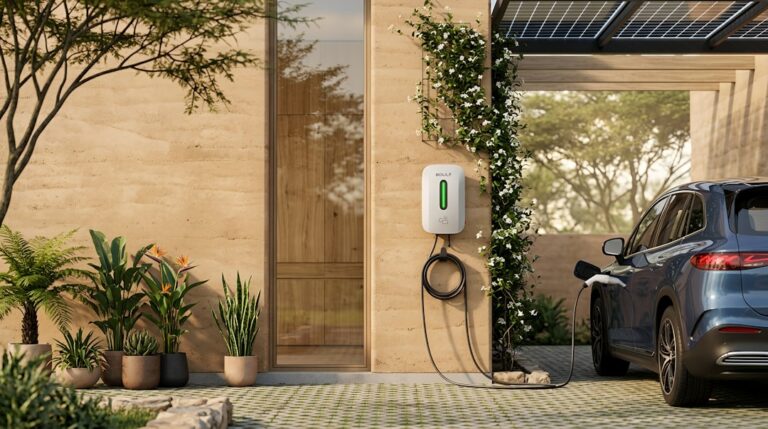
Why Your Electrical Panel Is the Starting Point for Solar and EV Charging
How a panel upgrade supports solar and EV charging comes down to one simple idea: your electrical panel is the hub that every watt of power in your home flows through. Before a solar inverter can send energy to your outlets, or a Level 2 EV charger can top up your car overnight, your panel has to have the capacity, the circuit space, and the safety hardware to handle those loads — reliably, every single day.
Here is a quick breakdown of what a panel upgrade actually does for solar and EV charging:
- Increases total capacity so your home can handle a solar inverter, an EV charger, and your existing appliances at the same time
- Opens dedicated circuit slots that solar inverters and Level 2 EV chargers are required to have by code
- Brings your system into NEC compliance, including the 120% rule that governs how much solar power can safely feed back through your panel
- Eliminates outdated or undersized hardware that would otherwise become a bottleneck or a safety risk
- Future-proofs your home for battery storage, heat pumps, and additional EVs down the road
Most homes in the San Diego suburbs were built with 100-amp service. That was plenty for the appliances of that era. Today, a single Level 2 EV charger can use up to 40% of a 100-amp panel’s total capacity on its own — and that is before your air conditioner, refrigerator, or solar system enters the picture. About 20% of homes need some kind of electrical upgrade before an EV charger can even be installed safely.
If you are planning to add solar panels, an EV charger, or both, understanding your panel’s current limits is the first step — and it is one of the most important decisions you will make for your home’s energy future.
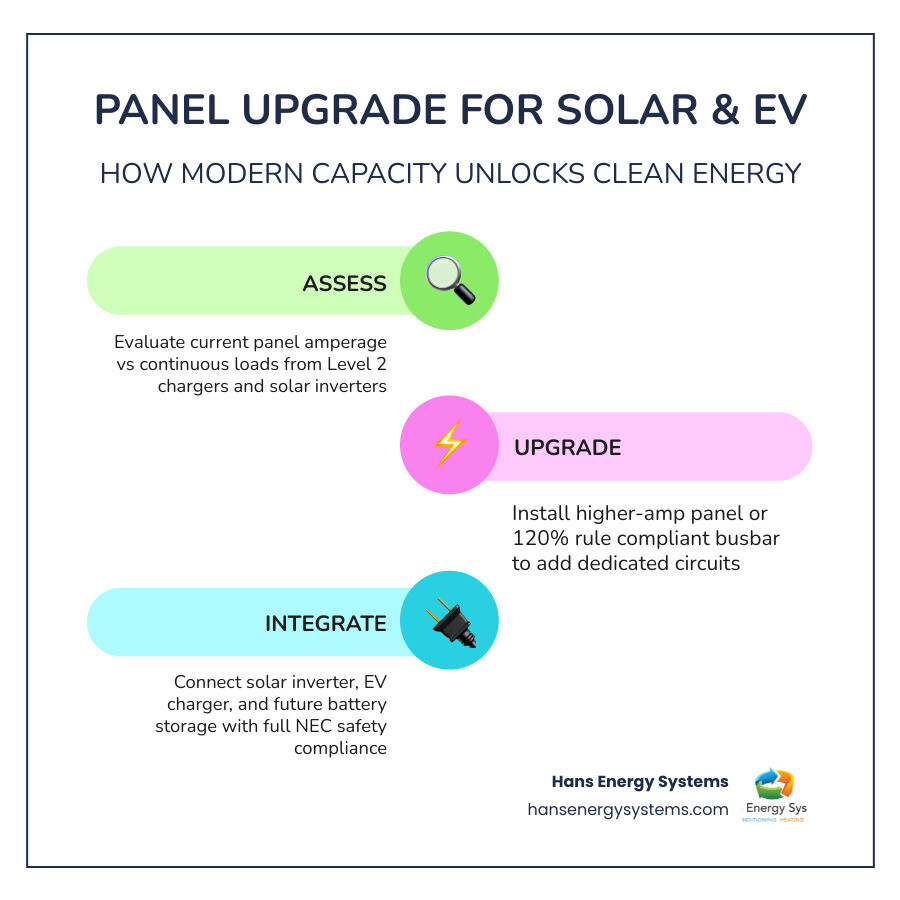
Why Your Home Needs an Electrical Panel Upgrade
Your home’s electrical panel is essentially the traffic cop of your entire household electrical system. Every light bulb, television, microwave, and air conditioner relies on the panel to distribute power safely from the utility grid. However, older panels were simply never designed to handle the massive, continuous power demands of modern clean energy technologies.
When you add solar panels and electric vehicle charging to your home, you are not just adding a couple of standard appliances. You are introducing heavy-duty electrical infrastructure. To understand why your panel might need a boost to keep up, it is helpful to look at how we address safety and capacity in modern residential electrical systems. For a detailed breakdown of how these components protect your household, read The Homeowner Guide to Modern Electrical Panels and Safety.
How a Panel Upgrade Supports Solar and EV Charging Capacity
To understand how a panel upgrade supports solar and EV charging capacity, we have to look at how electricity is consumed. Standard household appliances like a toaster or a vacuum run in short bursts. Your electrical system can easily manage these temporary spikes.
An EV charger, however, is classified as a continuous load. This means it draws a high amount of electricity at full capacity for hours on end. A standard Level 2 EV charger typically requires a dedicated 240-volt circuit drawing 40 to 48 amps continuously.
When you combine this massive draw with a solar energy system that is backfeeding power into your panel, an older 100-amp panel quickly runs out of headroom. If your panel does not have the capacity to manage both the incoming solar generation and the outgoing EV charging load, you risk overloading your system. To see if your current setup is ready for this transition, you can take The Panel Test: Can Your Home Handle Solar and EV Charging?.
Warning Signs Your Current Panel is Overloaded
How do you know if your electrical panel is struggling before you even try to plug in an EV or turn on a solar array? Your home will usually give you a few clear warning signs:
- Flickering or dimming lights when heavy appliances like your air conditioner or clothes dryer kick on
- Frequent tripped breakers that disrupt your daily routine and indicate circuits are operating near their limits
- A warm or hot panel door, which is a major red flag indicating excessive resistance and potential fire hazards
- Buzzing, crackling, or hissing sounds coming from inside the breaker box
- Outdated panel brands such as Federal Pacific Electric (FPE), Zinsco, or Pushmatic, which have well-documented safety flaws and failure rates
If you notice any of these warning signs, it is critical to have a licensed professional evaluate your system before proceeding with any new installations. For homeowners planning a charger setup, ensuring your panel is stable is the crucial first step in a successful Tesla Wall Charger Installation.
Navigating the NEC 120% Rule for Solar and EV Integration
One of the most common technical hurdles in solar and EV integration is a regulation known as the “120% Rule” in the National Electrical Code (NEC). This safety standard is designed to prevent the metal busbars inside your electrical panel from overheating when they are receiving power from two different sources at the same time: the utility grid and your solar panels.
When we design a solar energy system, we must ensure that the sum of the main utility breaker and the solar breaker does not exceed 120% of the panel’s total busbar rating. If your panel is already maxed out, you cannot legally connect your solar system without a panel upgrade or a specialized workaround. For a deeper dive into how this rule affects system planning, explore our guide on Solar Energy System Design and Engineering.
Understanding the Math Behind the 120% Rule
The math behind the 120% rule is straightforward but rigid. The code allows the total current supplied to a busbar to exceed the busbar’s physical rating by 20%, provided the solar breaker is installed at the opposite end of the busbar from the main utility breaker. This physical separation ensures that power flows from both ends toward the middle loads, preventing any single point on the busbar from carrying too much current.
The formula is: (Busbar Amperage Rating x 1.2) – Main Breaker Amperage = Maximum Allowed Solar Breaker Size
Here is how common electrical panel sizes compare under the NEC 120% rule:
| Busbar Rating (Amps) | Main Breaker Rating (Amps) | Max Allowed Solar Breaker (Amps) | Approximate Solar System Capacity Limit |
|---|---|---|---|
| 100 A | 100 A | 20 A | ~3.8 kW |
| 150 A | 150 A | 30 A | ~5.7 kW |
| 200 A | 200 A | 40 A | ~7.6 kW |
| 225 A | 200 A | 70 A | ~13.4 kW |
As you can see, a standard 100-amp panel severely limits the size of the solar array you can install. Upgrading to a 200-amp panel with a 225-amp busbar provides the ultimate flexibility, allowing you to install a robust solar system alongside your high-draw EV charger.
How a Panel Upgrade Supports Solar and EV Charging Safety Standards
Upgrading your electrical panel does more than just satisfy the mathematical requirements of the NEC; it fundamentally enhances the safety of your entire home. Modern panels are built with advanced overcurrent protection and robust grounding systems that minimize the risk of electrical fires.
This is especially important in coastal San Diego communities like Carlsbad, Del Mar, and Oceanside, where salt air can accelerate the corrosion of electrical components. A fresh panel upgrade ensures all connections are clean, tight, and highly resistant to environmental wear. To learn more about standard safety practices during solar setups, refer to our Professional Solar Panel Installation Guide.
How a Panel Upgrade Supports Solar and EV Charging Infrastructure
When you upgrade your electrical panel, you are laying the groundwork for a complete home energy ecosystem. This infrastructure allows your solar panels to generate clean electricity during the day, feed it through a highly capable panel, and deliver it directly to your vehicle’s battery.

By reinforcing your home’s electrical backbone, you ensure that high-voltage charging does not strain your household wiring. If you are looking to install a charger at home, you can find step-by-step guidance in our Tesla Charger Install Complete Guide.
Integrating Battery Storage and Smart Technology
A modern electrical panel upgrade also prepares your home for advanced energy storage and smart home automation. Adding a battery backup system allows you to store excess solar energy generated during the day and use it to charge your EV at night or power your home during utility outages.
Smart panels (such as SPAN) take this a step further by replacing traditional mechanical breakers with digital, app-controlled switches. This technology allows you to monitor your energy consumption in real-time, prioritize essential circuits during a power outage, and dynamically allocate power to your EV charger based on your solar production. If you live in Poway or the surrounding areas, discover how storage fits into this equation by reading about Solar Battery Storage Poway.
Alternatives to a Full Service Upgrade
If a full electrical panel upgrade is not feasible for your home, there are several smart alternatives that can help you integrate solar and EV charging safely:
- Main Breaker Derating: If your local load calculations allow it, we can swap your existing main breaker for a slightly smaller one (e.g., swapping a 200-amp main breaker for a 150-amp main breaker on a 200-amp busbar). This immediately frees up capacity for a larger solar breaker under the 120% rule.
- Smart Load-Shedding Devices: These intelligent switches automatically pause power to your EV charger if high-demand appliances like your electric range or clothes dryer turn on, keeping your total home draw within safe limits.
- Sub-Panel Installation: If your main panel has plenty of electrical capacity but is physically out of breaker slots, installing a sub-panel can open up the physical space needed for new dedicated circuits.
- Supply-Side Taps: In some solar installations, we can tap into the service wires before they reach your main breaker, bypassing the busbar capacity limits entirely.
Timeline, Permitting, and What to Expect on Installation Day
Upgrading an electrical panel is a highly coordinated process that requires a licensed C-10 electrical contractor, local building permits, and coordination with San Diego Gas & Electric (SDG&E).
On the day of the installation, the power to your home will be shut off for a period of 4 to 8 hours while our technicians remove the old panel, mount the new hardware, and reconnect your household circuits. The entire project — from pulling permits to scheduling the final city inspection — typically takes 2 to 4 weeks. If you are planning a complete solar project alongside your panel work, you can learn more about what to expect during the process in our guide to Solar Panel Installation.
Maximizing California Incentives and Rebates
In 2026, California homeowners have access to excellent incentives that can help offset the cost of upgrading their electrical infrastructure for clean energy. Under the federal Inflation Reduction Act (IRA), you may qualify for tax credits covering a significant portion of your panel upgrade when it is paired with qualifying solar or battery storage installations.
Additionally, state programs and local utility initiatives frequently offer rebates for making your home “EV-ready.” To maximize your savings, be sure to review our resources on California Solar Incentives and check out how to Don’t Leave Money on the Table with California EV Rebates.
Frequently Asked Questions about Panel Upgrades
Can I add an EV charger to a 100-amp panel without an upgrade?
Yes, in many cases it is possible, but it comes with limitations. If you have a 100-amp panel, you may be limited to a slower Level 1 charger or a throttled Level 2 charger (drawing 16 to 24 amps instead of the standard 40 to 48 amps).
Before attempting this, a licensed electrician must perform an official NEC 220.82 load calculation to ensure your existing appliances (like air conditioning, electric dryers, and water heaters) will not overload the system when the vehicle is charging.
How long does a typical electrical panel replacement take?
The physical installation of the new panel usually takes a single working day, with your home’s power turned off for about 4 to 8 hours. However, the total project timeline — including site assessments, obtaining municipal permits, coordinating the disconnect and reconnect schedules with SDG&E, and passing the final safety inspection — typically spans 2 to 4 weeks.
Does upgrading my electrical panel increase my home’s resale value?
Absolutely. An upgraded 200-amp electrical panel is a highly attractive feature for modern home buyers. As EV adoption and home electrification continue to rise rapidly throughout San Diego County, having an “EV-ready” and “solar-ready” home provides a distinct competitive advantage on the real estate market, signaling to buyers that the property is fully prepared for the future.
Conclusion
Upgrading your electrical panel is the single most effective way to ensure your home can safely and efficiently support the transition to solar energy and electric vehicle charging. By expanding your capacity, opening up physical circuit space, and meeting modern safety codes, you protect your household while maximizing the return on your clean energy investments.
At Hans Energy Systems, we are proud to provide reliable, high-quality solar, electrical, and home comfort services to families throughout Poway, CA, and the greater San Diego region. Whether you are ready to take the first step toward home electrification or simply have questions about your current panel’s capacity, our experienced team is here to help.
Ready to future-proof your home’s electrical system? Request a Custom Quote with us today, or explore our full range of clean energy solutions on our Pillar Page CTA.