
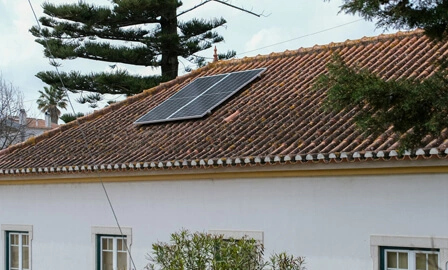
How San Diego Homeowners Can Save Big with SDG&E Rebates in 2026
SDGE Rebates for San Diego Homeowners: Essential Guide
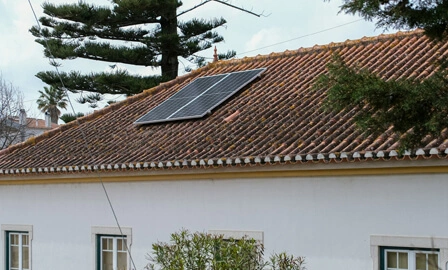
SDG&E rebates for San Diego homeowners cover a wide range of energy-efficient upgrades in 2026 — from smart thermostats and heat pump water heaters to solar panels, battery storage, and electric vehicles. If you want a quick snapshot of what’s available right now, here’s a summary:
Key SDG&E and Related Rebates Available to San Diego Homeowners (2026)
| Program | What It Covers | Who Qualifies |
|---|---|---|
| Golden State Rebates | Smart thermostats, water heaters, room ACs | Most SDG&E customers |
| Energy Savings Assistance (ESA) | No-cost home upgrades | Income-qualified (up to $82,500 for household of 4) |
| Residential Energy Solutions (RES) | AC tune-ups, low-flow fixtures | Renters and homeowners |
| San Diego Solar Equity Program | Rooftop solar installation | Income-qualified City of San Diego homeowners |
| Pre-Owned EV Rebate | Used electric vehicle purchase | SDG&E customers; amount varies by income |
| HEART Program | Full appliance replacement coverage | City of San Diego residents; income and location-based |
| Federal 25C Tax Credit | Heat pumps, water heaters, insulation | Any homeowner filing U.S. taxes |
| SGIP | Battery storage systems | SDG&E customers with solar; extra tiers for low-income |
San Diego has some of the highest electricity rates in the country. For homeowners already dealing with aging HVAC systems, sky-high summer bills, and unreliable cooling during heat waves, these programs can make a real difference. The challenge is that the landscape is complex — multiple agencies, income tiers, and application windows mean it’s easy to miss savings you’re entitled to.
This guide cuts through the confusion. Whether you’re replacing a furnace, adding solar, or simply upgrading your thermostat, you’ll find everything you need to claim the right rebates and stack them effectively.
Know your sdge rebates for san diego homeowners terms:
- how to apply for energy rebates in california
- inflation reduction act benefits for california homeowners
Understanding SDGE Rebates for San Diego Homeowners in 2026
Navigating utility rebates doesn’t have to feel like decoding a foreign language. For San Diego Gas & Electric (SDG&E) customers, the utility offers several direct and partner-funded programs designed to lower your energy consumption. To get the most out of these opportunities, it is essential to understand how the programs operate, what products qualify, and how to successfully navigate the application process.
Before committing to any upgrade, we highly recommend reading our comprehensive breakdown on How to Apply for Energy Rebates in California to ensure you do not miss any critical pre-purchase steps.
To qualify for most SDG&E-backed incentives, you must have an active residential service account. Depending on the program, you can access instant discounts at the point of sale, apply for post-purchase mail-in rebates, or work with approved trade professionals who apply the discounts directly to your invoice.
Smart Thermostats and Appliances Qualifying for SDGE Rebates for San Diego Homeowners
One of the easiest ways to start saving is through the Golden State Rebates program. Funded by California utility customers under the oversight of the California Public Utilities Commission (CPUC) and implemented by CLEAResult, this program provides instant coupons for high-efficiency products.
The primary products qualifying for these instant rebates include:
- Smart Thermostats: Qualifying ENERGY STAR certified smart thermostats can receive rebates of up to $75. Select brands, such as Amazon smart thermostats, qualify for a $40 rebate.
- Heat Pump Water Heaters: Replacing an old electric resistance water heater with an energy-efficient heat pump model can qualify for a rebate of up to $500.
- Gas Tank Water Heaters: Standard energy-efficient gas tank water heaters qualify for a $75 rebate.
- Room Air Conditioners: High-efficiency room air conditioners (ENERGY STAR Advanced) qualify for a $15 rebate.
To take advantage of these rebates, you must obtain your coupon code before making your purchase. The program does not honor post-purchase rebates. You simply visit the Golden State Rebates portal, verify your eligibility as an SDG&E customer, select your retailer, and apply the coupon code at checkout. This works both online and at participating in-store locations such as Home Depot, Best Buy, or Lowe’s. These small upgrades are excellent steps toward achieving Lower Utility Bills in your household.
Income-Qualified Programs and Energy Savings Assistance
For families looking to reduce their monthly utility expenses without upfront financial strain, SDG&E offers robust income-qualified programs. The two primary pillars of this assistance are the Energy Savings Assistance (ESA) Program and the California Alternative Rates for Energy (CARE) Program.
The ESA Program provides no-cost energy-efficient home improvements to income-qualified renters and homeowners. To qualify, your household income must fall at or below 250% of the Federal Poverty Guidelines. For example, the maximum combined annual income for a household of four is $82,500. These income limits are updated annually and remain effective through May 31 of each program year.
The ESA program operates on a tiered product system:
- ESA Basic Products: These require minimal documentation and include smart thermostats, low-flow faucet aerators, high-efficiency showerheads, shower valves, LED light bulbs, and smart power strips.
- ESA Basic Plus Products: These upgrades require more detailed income verification and include larger appliances and structural improvements such as energy-efficient refrigerators, variable-speed pool pumps, air purifiers, portable or room air conditioners, whole-house fans, energy-efficient clothes dryers, gas furnaces, duct sealing, attic insulation, and high-efficiency water heaters.
Additionally, the CARE program provides a permanent monthly discount on your SDG&E bill. Qualifying for CARE is often the gateway to other income-qualified solar and appliance programs throughout San Diego County, making it a vital resource for eligible households.
Stacking Federal, State, and Utility Incentives
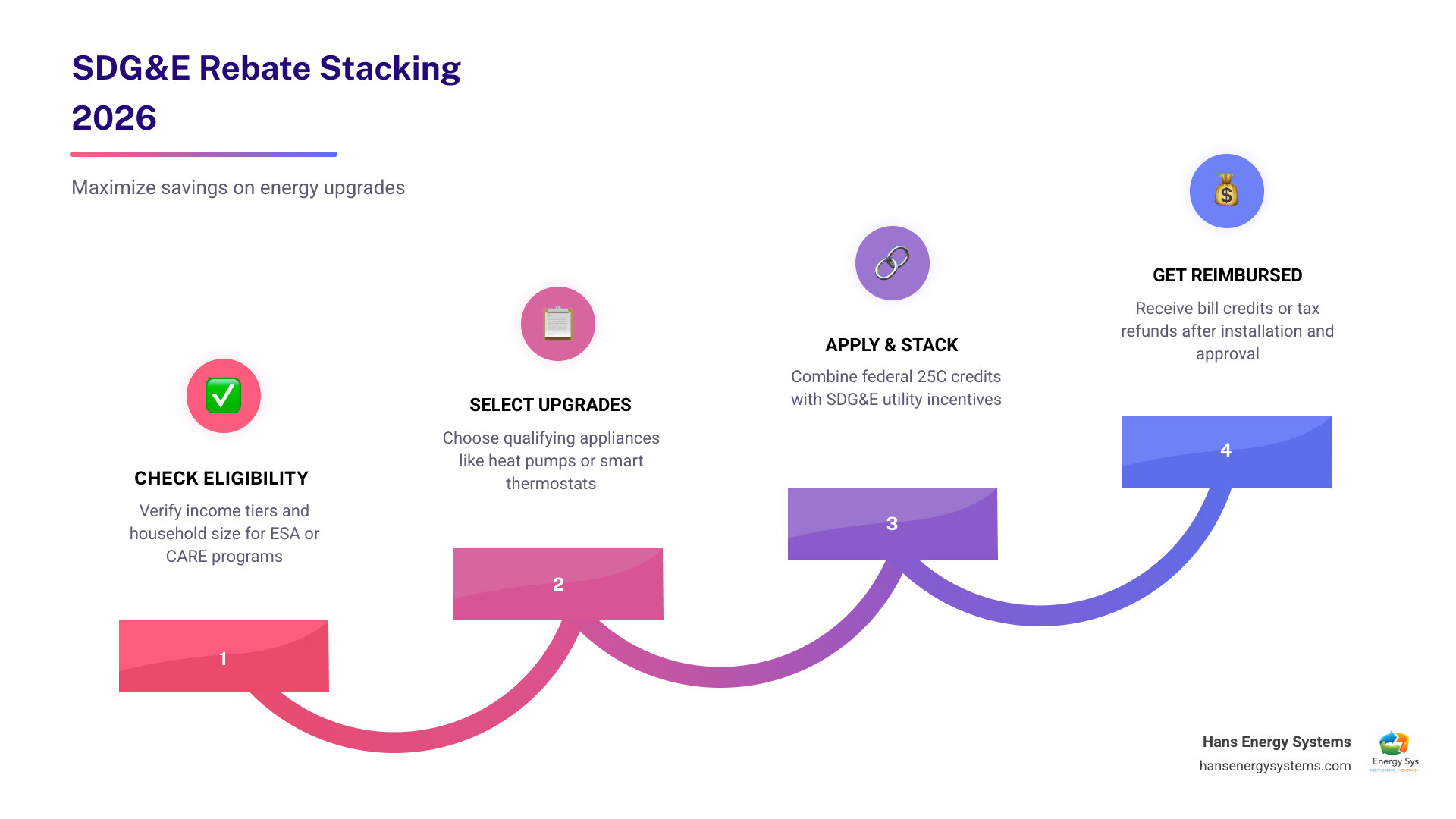
One of the most powerful strategies for minimizing your out-of-pocket expenses is “rebate stacking.” This is the process of combining local utility rebates, state programs, and federal tax incentives for a single home upgrade. When executed correctly, stacking can cover a substantial portion of your project costs.
To understand how federal legislation plays a role in your local upgrades, read about How the Inflation Reduction Act Makes Your California Home Cooler and Cheaper.
The table below outlines how different incentive layers can be combined for qualifying home improvements:
| Upgrade Type | SDG&E / Local Rebate | State / IRA Rebate (HEEHRA/HOMES) | Federal Tax Credit (25C / 25D) |
|---|---|---|---|
| Heat Pump HVAC | Up to $2,500 (SDG&E Home Energy Savings) | Up to $8,000 (HEEHRA for income-qualified) | 30% of cost (up to $2,000) |
| Heat Pump Water Heater | Up to $500 (Golden State Rebates) | Up to $4,000 (HEEHRA) | 30% of cost (up to $1,250) |
| Rooftop Solar | Solar Equity Program (income-qualified) | N/A | 30% of cost (no cap) |
| Battery Storage | Up to $500/kWh (SDCP Program) | SGIP Resiliency / Equity Resiliency | 30% of cost (no cap) |
Maximizing HVAC and Heat Pump SDGE Rebates for San Diego Homeowners
Heating and cooling make up the largest portion of a home’s energy consumption. Upgrading to a highly efficient heat pump or ductless mini-split system is the most effective way to lower your energy bills, and the available rebate stack for these systems is incredibly lucrative.
To successfully claim this stack, your new system must meet strict efficiency standards, including specific SEER2 and HSPF2 ratings, and be ENERGY STAR certified.
The stacking process works in three distinct steps:
- Utility Rebate: Your approved contractor installs the qualifying system and submits the paperwork to SDG&E. The rebate is typically applied as a credit on your SDG&E bill within 6 to 10 weeks.
- State/Federal IRA Rebates (HEEHRA): If your household income is below 150% of the Area Median Income (AMI), you can access point-of-sale discounts funded by the Inflation Reduction Act’s HEEHRA program. This program is fully active and administered through state-approved channels.
- Federal 25C Tax Credit: When you file your federal income taxes for the year of installation, you can claim the 25C tax credit using IRS Form 5695. This credit covers 30% of the remaining system cost, up to a maximum of $2,000.
By combining these three resources, San Diego families can significantly reduce the net cost of a premier climate control upgrade.
Solar and Battery Storage Incentives in Southern California
San Diego is one of the premier locations in the nation for solar energy, but maximizing your investment under current net metering rules requires pairing solar panels with a battery storage system. Fortunately, several local and state programs make battery storage highly accessible.
First, the Self-Generation Incentive Program (SGIP) is a statewide initiative that provides substantial rebates for installing energy storage systems. SGIP features three primary pathways: General Market, Resiliency, and Equity Resiliency. Homeowners living in Tier 2 or Tier 3 High Fire Threat Districts, or those enrolled in the Medical Baseline Program, often qualify for the highest resiliency rebate tiers, which can cover a large portion of the battery equipment costs.
Second, the San Diego Community Power (SDCP) Solar Battery Savings Program offers upfront rebates ranging from $250 to $500 per kilowatt-hour (kWh) of battery capacity, along with ongoing performance payments for exporting stored energy back to the grid during peak demand hours (4:00 PM to 9:00 PM). This program works in tandem with SDG&E’s delivery infrastructure.
To explore the full range of solar benefits in our region, check out our dedicated guide on California Solar Incentives.
Eligibility Criteria and Program Requirements
While the savings opportunities in San Diego are extensive, every program has strict eligibility rules. Failing to meet a single requirement can result in a denied application. Understanding these boundaries beforehand ensures a smooth, successful upgrade process.
If you are considering upgrading your ride along with your home, make sure to read our guide: Don’t Leave Money on the Table with California EV Rebates to learn how to claim up to $4,000 back on pre-owned electric vehicles.
Geographic and Income-Based Qualifications
Many of the most generous rebate programs are reserved for specific income tiers or geographic zones. In the City of San Diego, the Home Electrification Affordability Rebates and Technical Assistance (HEART) Program is a prime example. The HEART program provides up to 100% coverage for permits, appliance disposal, new electric appliances, and labor costs. However, it is rolled out in distinct phases:
- Phase 1: Prioritizes households under 80% Area Median Income (AMI) located in designated Communities of Concern and flood-impacted areas (such as those affected by the historic winter storms of late 2023 and early 2024).
- Phase 2: Expands eligibility to households under 120% AMI within Communities of Concern.
- Phase 3: Opens citywide to any household under 120% AMI, subject to remaining fund availability.
Similarly, programs like the San Diego Solar Equity Program allocate $1 million annually specifically for income-qualified homeowners within city limits to install rooftop solar. If you live in unincorporated areas of San Diego County, a separate county pilot program supports limited solar installations for income-qualified homeowners in disadvantaged unincorporated communities.
Contractor and Installation Guidelines
For almost all major utility and state rebates, DIY installations are strictly disqualified. Programs require that all work be performed by licensed, bonded, and insured professionals.
To protect your rebate eligibility, keep these rules in mind:
- Approved Contractor Networks: Programs like SDG&E’s Residential Energy Solutions (RES) require you to work with their authorized partners (such as Synergy Companies) to receive your no-cost energy assessments and upgrades.
- Permit Closure: For HVAC and heat pump installations, you must obtain and close out all local municipal permits. Proof of permit closure is a mandatory document for releasing utility incentives.
- Energy Assessments: Some advanced whole-home programs require a professional “test-in” and “test-out” energy assessment using diagnostic tools like blower doors to verify performance improvements before incentives are disbursed.
If you are planning an upgrade in the inland North County area, exploring Financing Poway CA can help you secure low-interest financing options that pair beautifully with these contractor-led rebate programs.
Frequently Asked Questions About San Diego Energy Rebates
Can I stack multiple energy rebates for the same upgrade?
Yes. You can stack SDG&E utility rebates, state-administered IRA rebates (like HEEHRA), and federal tax credits (like the 25C credit) for the same project. The federal tax code explicitly permits stacking utility and state rebates, provided the tax credit is calculated based on your net out-of-pocket cost after those upfront discounts are applied.
Do renters qualify for SDG&E energy-saving programs?
Yes. Renters are fully eligible for programs like the Energy Savings Assistance (ESA) Program and the Residential Energy Solutions (RES) Program. These programs offer no-cost upgrades like smart thermostats, low-flow fixtures, and AC tune-ups. However, written landlord or property owner permission is required before any permanent appliances or structural improvements can be installed.
How long does it take to receive an SDG&E rebate?
For instant rebate programs like Golden State Rebates, the savings are applied immediately at the time of purchase. For post-installation utility rebates that require contractor submission and documentation, it typically takes 6 to 10 weeks from the date of submission for the credit to appear on your SDG&E bill or for a check to be issued.
Conclusion
Upgrading your home’s energy systems is one of the smartest investments you can make as a San Diego homeowner. By taking advantage of sdge rebates for san diego homeowners, stacking federal tax credits, and utilizing local equity programs, you can dramatically lower your energy bills while enjoying a more comfortable, modern home.
At Hans Energy Systems, we are proud to serve communities across San Diego County—from Poway and Escondido to El Cajon, Chula Vista, and Carlsbad. Our team specializes in high-efficiency cooling, heating, plumbing, and solar solutions designed to maximize your comfort and your rebate potential.
If you are ready to transition to clean, affordable energy, check out our guide on California Solar Incentives and contact us today to plan your home’s next energy-saving upgrade!